বাংলা
 English
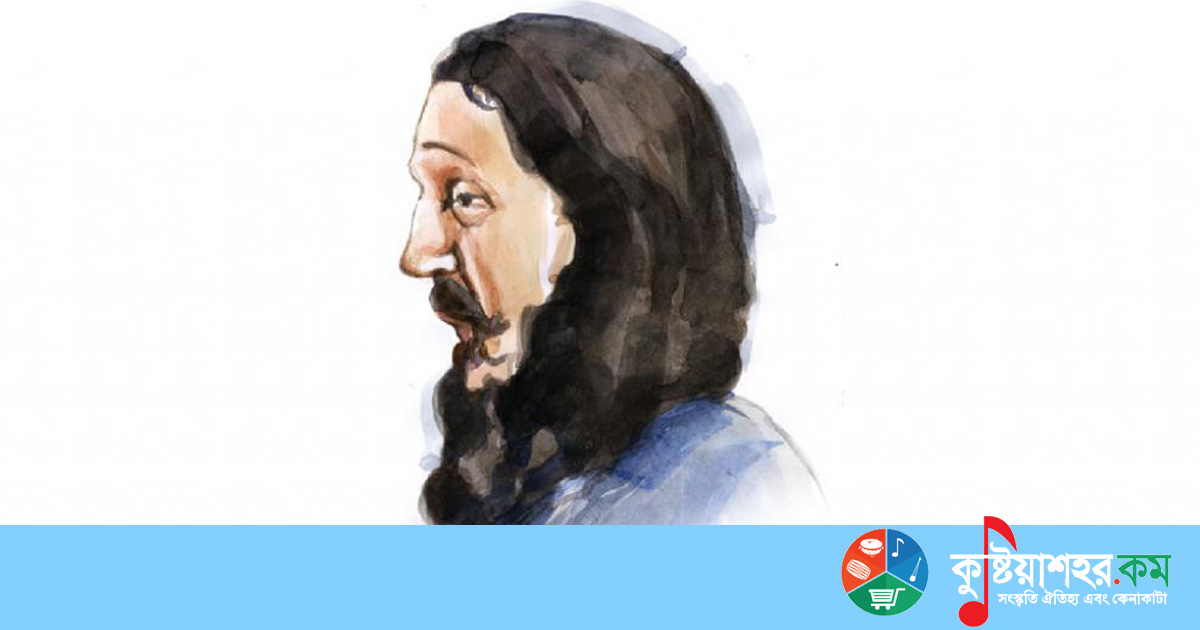
Among the Baul poets of Bengal, Lalon Shah is the most famous. A Baul poet his equal — Hindu or Muslim — is found in no community. Because he devoted himself to the path of Allah, he is called a fakir. Among his community of devotees, and in Bengali literature, he is best known by the name Lalon Fakir.
As great a poet as Lalon Fakir is among the folk poets of Bengal, exactly to that extent has controversy arisen over his name, caste and religion, birthplace, and the dates of his birth and death. To this day no researcher has been able to arrive at any irrefutable, settled conclusion on these matters. One by one we are discussing the various views current about his caste-religion and birthplace.
Some say Lalon was a Hindu, some say a Muslim. According to Upendranath Bhattacharya, author of 'Bauls and Baul Songs of Bengal' (1364), 'Lalon was born in Bharara village on the bank of the Gorai river, five miles to the south-east from under Kumarkhali thana, within the Kushtia subdivision of the former Nadia district (now Kushtia district of Bangladesh).'
Professor Mansuruddin, Upendranath Bhattacharya, Kshiti Mohan Sen and other earlier biographers have described Lalon as born of a Hindu family. His birth-name was Lalan Chandra. Some say his hereditary title was Roy, some Kar, some Das. He was probably a Kayastha by caste.
There is no less controversy over the dates of Lalon's birth and death. According to Professor Upendranath Bhattacharya, he was born in 1181, that is 1774 AD; according to Professor Mansur Uddin, in 1182, corresponding to 1775 AD.
According to Upendranath Bhattacharya, Lalon died in 1297, 1 Kartik — 1890 AD, 17 October. At the time of his death he was 116 years old. According to Mansur Uddin, it was 1299, that is, 1891 AD.
The divergence between Upendranath Bhattacharya and Mansur Uddin over the dates of Lalon's birth and death is not so very great. In 'Haramoni', volume 5 (1961), published by the Bangla Department of Dhaka University under the joint editorship of Mansuruddin and myself, I too have taken the dates of Lalon's birth and death to be 1774 and 1890 AD respectively. On this point everyone agrees that Lalon was long-lived.
Arguing over whether he was a Hindu or a Muslim is futile, for Lalon outwardly did not wish to live — nor did he live — as a Hindu or a Muslim. He was a sage and a mystic poet. In plain terms, his fame rests on his being a Baul poet.
The tradition and interpretation of terms such as Sahajiya, the Nath cult, mysticism and Baul are extremely intricate. In the medieval age, when Buddhism degenerated and its branches such as Hinayana and Mahayana broke apart, men of various secret spiritual paths arose among the lower-class inhabitants of this land. These people had no capacity for elevated ideals or for conceiving great thoughts. These vagrant groups lived wretchedly at the lowest stratum of rural Bengali society. Streams of various spiritual disciplines — Vedic, Buddhist and so on — merged and mingled to form these perverted tastes and paths. Yet it is not that nothing good came of it in the field of cultural practice. The Baul creed too is the fruit of just such a discipline.
The Baul religious practice is founded upon a secret rite and bears a special resemblance to the secret practices of the Buddhist Siddhacharyas. Up to the seventeenth and eighteenth centuries in the medieval age, the word 'Baul' was used in such senses as 'devoid of outward knowledge', 'mad', 'bereft of natural consciousness'. Many have taken the word 'Baul' to be the Prakrit form of the word 'batul' (insane). Some would have 'Baul' as synonymous with 'aul', derived from 'akul' (restless); in their view the Muslim sages of the Baul community are to be counted as 'aul' or aulia.
Among the Baul sages are found people of both the Hindu and Muslim communities. The Muslim Bauls are be-shara fakirs. 'Be-shara' means outside the Sharia or the formal religion of Islam. These people do not observe the rules relating to namaz, fasting, Hajj and zakat. Hindu or Muslim alike, the Bauls are mystics; they are spiritualists. Under Sufi influence, the Muslim Bauls are more particularly seekers of truth. They strive consciously to know themselves, and through knowing themselves they seek to know Allah.
Lalon was just such an accomplished Baul poet. No one claims he was a lettered, educated man; he was ummi, unlettered. His general knowledge was keen. He possessed knowledge of the Hindu and Muslim traditions born of true vision. Through inner insight he became a knower of truth. Like the educated Muslim poet Alaol of the seventeenth century and the modern poet Nazrul Islam, he had mastered the essence of the Hindu and Muslim cultures. In his maxims, songs and sayings the traditional imprint of Hindu and Muslim society and ways of life is clearly evident. In pre-independence Bangladesh — particularly in the eighteenth and nineteenth centuries — the Hindu and Muslim sages of the lower stratum of society were creating a field of practice for a union of Hindu-Muslim culture; the songs of Baul sages such as Lalon bear its marvellous acknowledgment.
Besides this, the modern poet Nazrul Islam, adopting Hindu culture separately, composed Shyama songs and devotional kirtans about the goddess Kali, and again took minor episodes of Muslim history steeped in Islamic idealism into numerous songs and ghazals. The Baul poet Lalon Fakir likewise composed songs independently on themes of the Hindu and Muslim traditions.
Having attained perfection in sadhana and become a knower of truth, Lalon Fakir could express the deep meditation-born realisations about life and the familiar world of experience in the simplest, most flowing manner. To him 'man' was the greatest of all. The feeling in Chandidas's line 'Above all is man, truth there is none above him' is caught in simple terms in this song of Lalon;
Whatever you do, O mind, do it quickly in this world.||
The Lord created infinite forms;
I hear that nothing of man is higher.
The gods and goddesses
offer worship
to be born as man.||
I know not the fruit of what fortune
this mind has gained this human vessel;
Cross over quickly, in the stream of nectar,
lest the raft sink.||
In this man shall be the worship of sweetness;
that is why the formless One formed the human form.
If now you are cheated again,
you will see no shore —
so the restless Lalon muses.||
The Bauls do not worship man, but to know man is their chief discipline. Setting God aside, the Baul is engaged in unravelling the mystery of God's finest creation, man. He unravels that mystery through the discipline of this body. In their view, what is in the universe is in the body-vessel. So by surveying the body they search within it for the man of the mind, the dweller of their body. Their man of the mind is a man of light. 'Allah', the Lord of the universe, dwells within this human body itself. Only the ability to catch Him, searching back and forth, is wanted. On this the supreme Baul Lalon spoke a wondrous word;
Could I catch it, O mind, I would put a fence round its feet.||
Eight chambers, nine doors locked fast,
here and there glinting coins,
above them the grand chamber —
that is the hall of mirrors.||
O mind, you remained at the cage's side;
the cage, you see, is made of raw bamboo.
Some day the cage will fall apart;
Lalon says, open the cage —
where will that bird fly away?||
We hear the echo of this feeling in Tagore too:
in me your revelation — that is why it is so sweet.
As a Baul poet, Lalon Fakir on the one hand practised the discipline of the body; under Sufi influence, on the other, he likewise prayed to the murshid in hope of attaining Allah.
This murshid was, in his view, the 'Insane Kamil' (the Perfect Man), Hazrat Muhammad (peace be upon him). In Sufi practice the pir or guru is needed to attain nearness to Allah. When one can truly practise for the attainment of God, one finds that Allah is nearer than the veins and arteries of each man's own neck. But to gain the strength to realise this, one must obtain a guru-pir, that is, a murshid. In his practice Lalon accepted Hazrat Muhammad (peace be upon him) as his murshid. For him, if one could seize 'Ahad' (the One Allah) and 'Ahmad' (the Praised One), that is, the Prophet, attaining God was not difficult;
When the reckoning of Ahad and Ahmad is done, it is known.||
Ah, in the name Ahmad I see
the Prophet written in the letter Mim;
once Mim is taken away, Ahad remains —
does the name Ahmad remain or not?||
Sought in the servant's body,
God lies hidden there;
when Mim is placed in Ahad,
does the name Ahmad come to be?||
That is, here one is asked to ponder whether God is formed or formless; and one must also know the doctrine of which letter does what. Hazrat Muhammad (peace be upon him), the Prophet of God, is also named Ahmad. Writing the word Ahmad requires four letters — alef, he, mim and dal — and removing the letter mim from within it yields Ahad, that is, God; while adding the letter mim to the word Ahad yields Hazrat Muhammad (peace be upon him).
Though influenced by the Sufi creed, Lalon was not a follower of Sufism proper. He was essentially a Baul theorist, that is, a mystic poet; in other words, he was a connoisseur of truth, a Mystic. It is as if he never quite attained God by merely seeking; the lifelong search for Him seems to have become his chief aim — his identity is stated in many verses such as the following —
In the company of the awakened guru, brother, seek word of Him.
In the dark chamber of the eye, by the deceit of illusion,
behind the tresses hides a mountain.
What a play, Lord — show it ever,
sitting at the seat of the scripture.
Even now I have not seen Him;
how shall I recognise Him?
If only at the close of my fortune
I might see Him.
Understand and practise sadhana in this world;
the treasure near at hand may be gained.
Lalon says, carry your own burden —
He is not far away.
Or,
Not for a single day have I seen Him;
my home is in Arshinagar,
and a neighbour lives there.
Leaving the village, deep water lies ahead,
without bank and without boat
to cross.
I build a raft
to go and see Him —
how shall I ever reach that village?
What shall I say of that neighbour,
He has no hands, feet, shoulders, no head.
At one moment He stays upon the void,
at another moment floats on water.
If the neighbour touched me,
my deathly torment would go far away.
Again, He and Lalon are in one place,
and still a hundred thousand leagues apart.
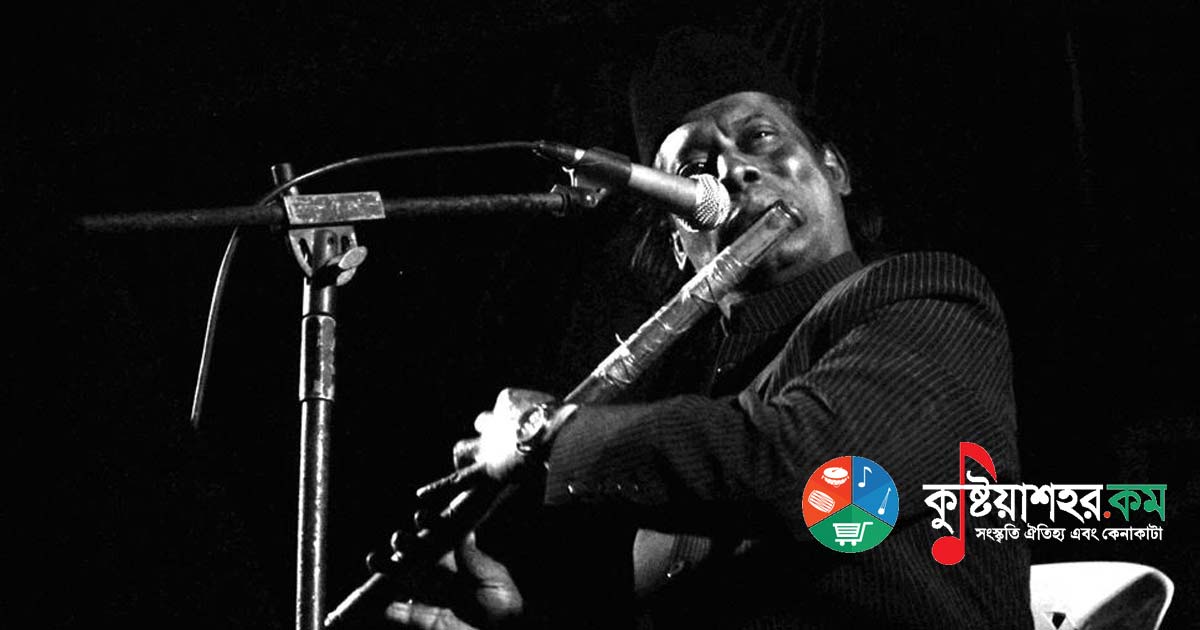
Lalon Fakir composed thousands upon thousands of songs of this kind. It is not that he wrote them all sitting down. Most of his songs were filled with feeling. He would sing, and his devotees and disciples would memorise those songs and keep them. Mouth to mouth among village singers, Lalon's songs spread across the whole of East Bengal and even into West Bengal. His songs predominate precisely in the districts of central and lower Bengal such as Nadia, Jashore, Khulna, Pabna and Faridpur. Sung by his disciples, followers and devotee communities, his songs were distorted in many ways. Nor was this distortion only a matter of pronunciation; often, unable to memorise correctly, the singers perhaps even added words of their own. And in passing from one mouth to another, many songs changed. There is no lack of instances, either, of some obscure singer composing a song for self-satisfaction and appending Lalon's bhanita (signature line) to it.
Be that as it may, sung from people's mouths, Lalon's songs have now become, like folk songs, a national treasure. Bangladesh has no lack of folk poets of the Aul, Baul and other branches. We know the songs of innumerable folk poets such as Pagla Kanai, Madan Baul, Gagan Harkara, Bisha Bhuimali, Sitalang Shah. As the urge for investigation has grown in the present day, more folk poets are being discovered and, piece by piece, their songs too are being recovered. However much Lalon's songs may be distorted, to the discerning reader which is genuine and which a fake is easily apparent. The reason is that no other Baul, that is, folk poet, had a divine vision like Lalon's. How through some discipline of long years his inner being grew so rich, outsiders cannot know; but if one is closely familiar with his composed songs, it is readily understood how fluently the profound meditation and knowledge born of his extraordinary, richly conscious heart — matters of this world and the next, caste, religion, community, man, the seer, and various intricate doctrines besides — were caught in such fluent compositions. Hence he must be called a truth-knowing great poet. The word-choice and effortless weaving of his songs bear witness to how much mystery can lie hidden within simple, plain Bangla words. The artistry of such brisk, weightless use of classical words is seen in no other folk poet's songs. It is here that Lalon claims distinction from his contemporaries and from the other folk poets before and after his time. Hence Lalon is the greatest Baul and folk poet.
Seeing his use of Arabic and Persian words, his knowledge of the Quran, and his effortless command of the Hindu Puranas, one cannot but wonder, and one cannot believe that he was unlettered.
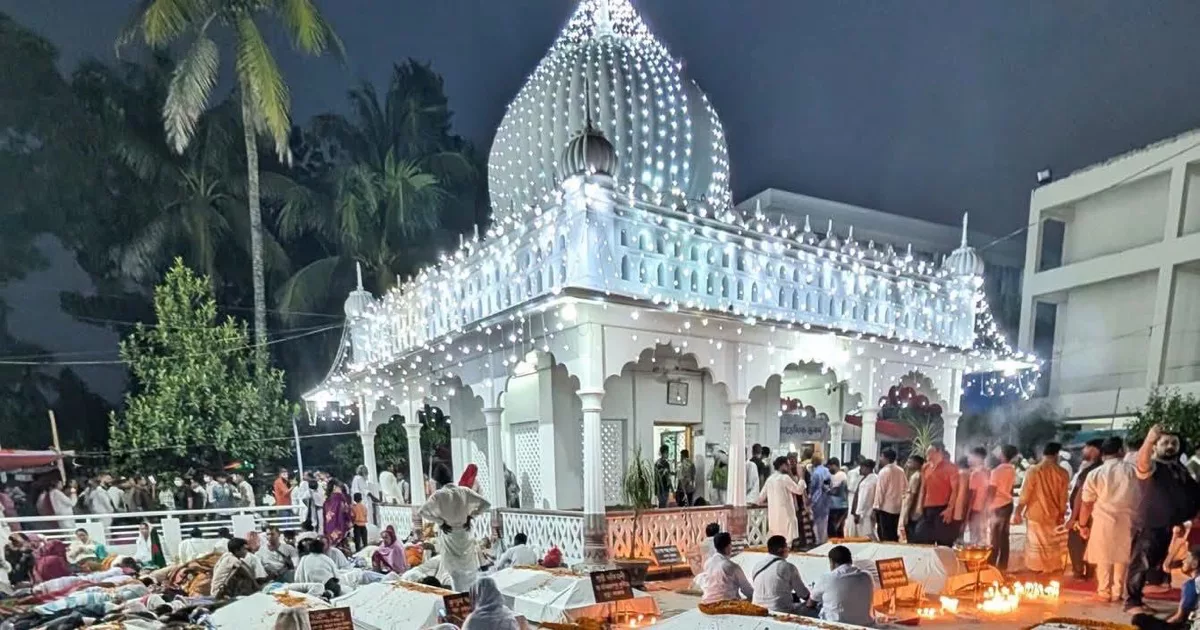
The government of (then) East Pakistan showed wisdom and foresight by building a research library at Lalon's ashram at Cheuria. It may be hoped that in the not distant future Lalon's songs will be collected there and research on him carried out. If information is gathered in bulk, a comprehensive picture will be obtained of the full form of his contribution to his poetic genius, to the literature of Bangladesh, indeed to the whole of Bengali literature, and of his thought, religious views and ideal of life, rich in information.
Until that happens, he will not for that reason remain some trivial folk poet. From the efforts of various researchers to date, and from his songs, we know that he has established himself before the Bengali-speaking public as a powerful and the greatest Baul poet. The poems and songs of his published so far are the greatest means of knowing him. Listening to them, it does not occur to the mind whether he was Hindu or Muslim, whether his birthplace was Bharara village of Kushtia district or Harishpur at Kulbere of Jashore. Seeing the form of his divine knowledge, mystery, humour and spiritual feeling we are astonished, and at the marvellous simplicity of his compositional style we are utterly charmed. Then we know him as a great poet, a seer of truth endowed with inner vision.
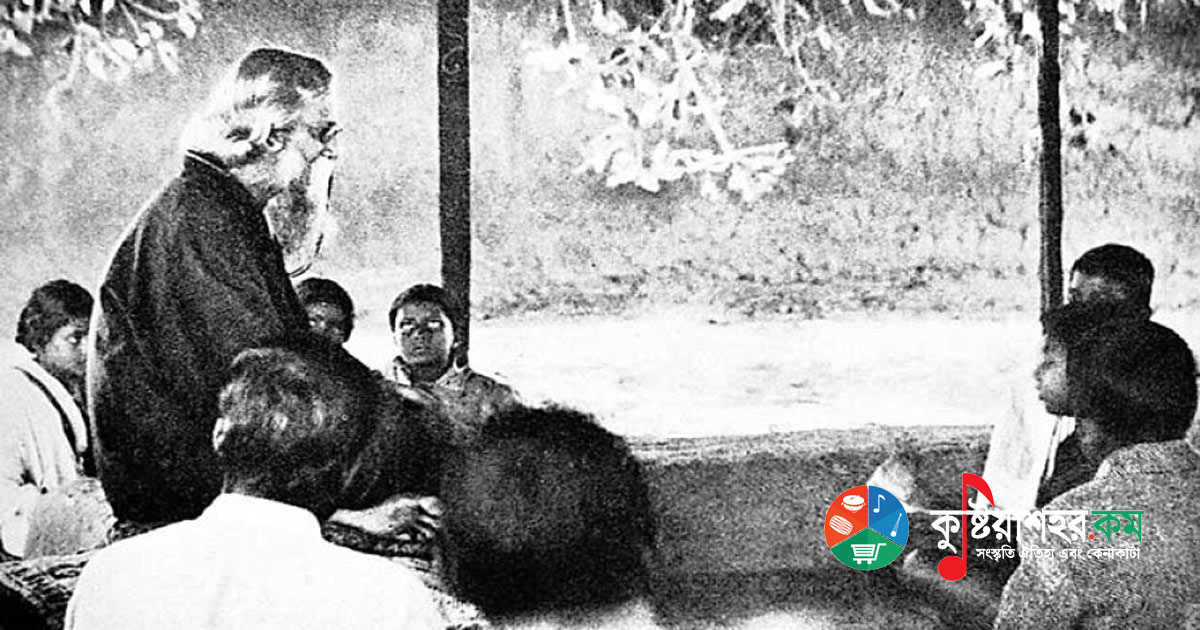
That Lalon was a great and the greatest Baul poet even Tagore acknowledged. The young Tagore met the aged Lalon, and was considerably influenced by Lalon's spiritual discipline. In Tagore's utterance the characteristic of the Baul's religious discipline also finds support — 'Man's god is man's "man of the mind". In knowledge, in action, in feeling, to the extent that I am true, to just that extent do I attain that man of the mind. When the inner being is deranged, I cannot see that, my own man of the mind, within the mind. Man has a certain lowliness: losing that own man of the mind, he goes searching for him in outward means — that is, he loses himself. Then I see you in money, I see you in fame, I see you in the arrangements of enjoyment. Over this, indeed, are all of man's quarrels, all his tears. One day I heard, from the lips of a wayfaring beggar, the lament-song of that scattered, self-bereft man:
my man of the mind?
Having lost that man of the mind and his purpose,
I wander home and abroad.
From the lips of that unlettered villager I heard too:
That same madman sang:
The prayer of that very search still resounds: 'Abhirabhur adhi' — may the manifestation of the Supreme Man in his vast form, whose self-manifestation is within me, be fruitful in its revelation through me.
Tagore's gaze fell upon Lalon Shah Fakir, the central figure among Baul poets. He was charmed hearing his songs, and it is not that he was unaffected by his cast of thought. In Tagore's song-poems such as Gitanjali, Gitali and Gitimalya, one may notice a kinship of his spirituality with Lalon's. This kinship, however, owes less to influence than to a unity of thought and spiritual striving.
It is true, however, that Tagore grew curious about Lalon and accorded him recognition as the greatest Baul poet, and it was for this reason that the poetry-loving and educated Bengali public came to regard him with special attention. As a result, discussed over a long time, he came to be established in his own grandeur; otherwise, for how long he might have remained hidden from public view, none can say.
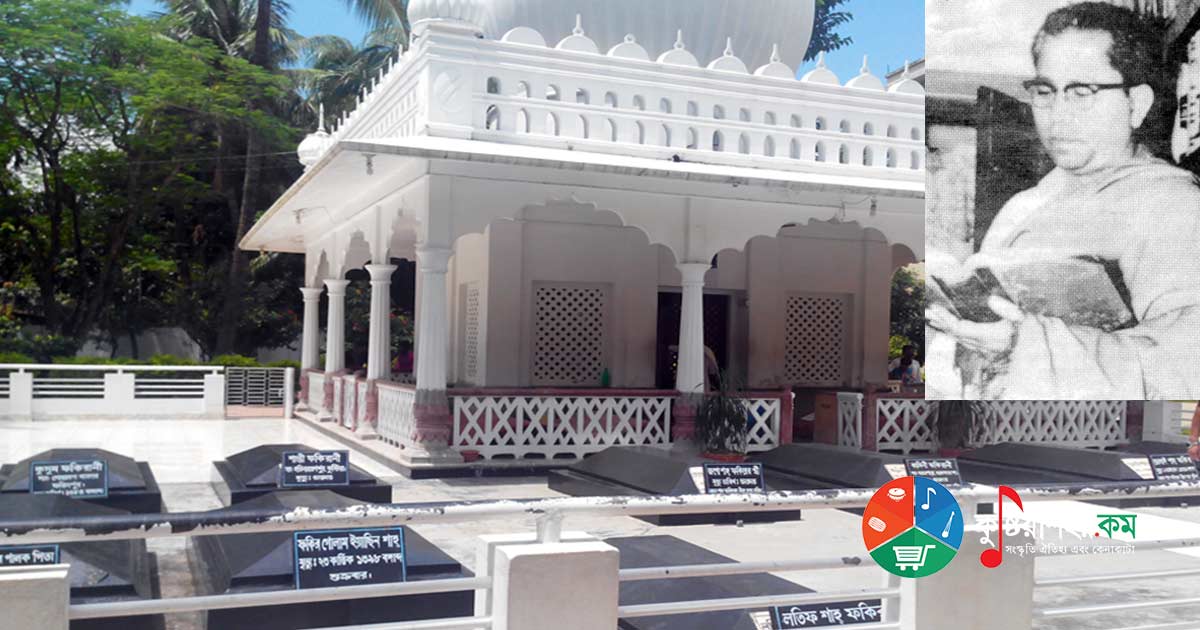
The Cheuria area of Kushtia lay within Tagore's zamindari. It is heard that he it was who took the initiative to have Lalon's grave walled up at Cheuria.