বাংলা
 English
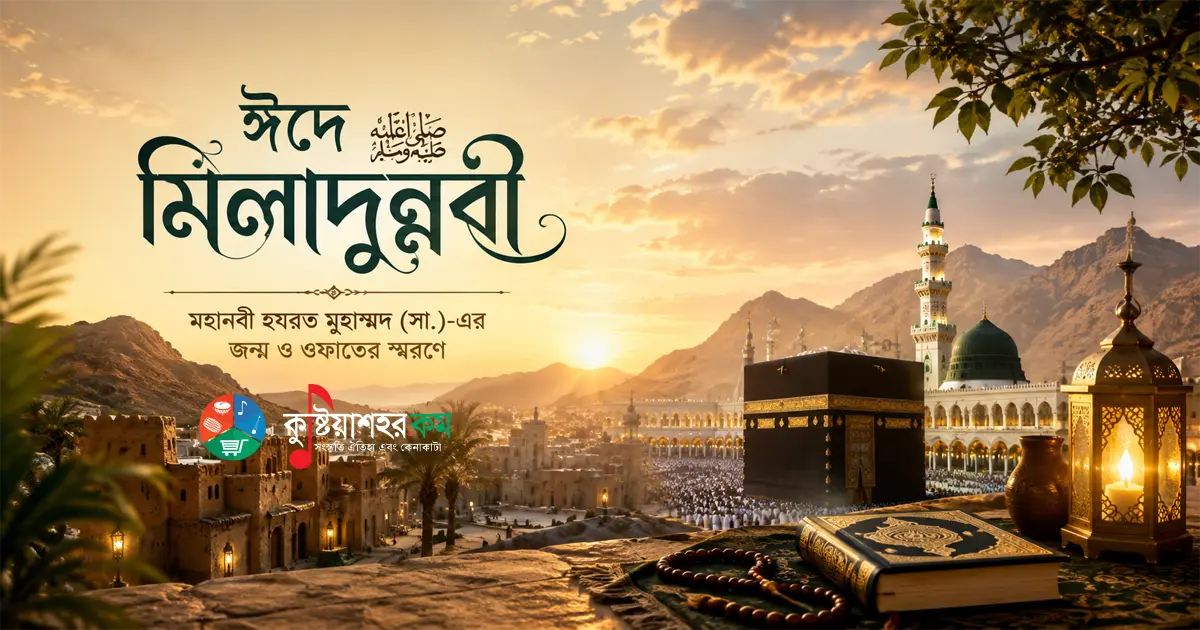
The history of human civilisation holds certain moments that change not merely the history of one nation or one land; rather their influence spreads from generation to generation, from society to society, and eventually into the history of the whole world. The arrival of the Prophet Hazrat Muhammad (SAW) upon the earth is such a historic event. Although he was born in the Arabian Peninsula of the seventh century, his life, teachings and ideals went on to deeply influence the thought, faith, morality, social order and culture of the people of vast regions of the world in later times.
The day connected with remembering the birth of the Prophet (SAW) and his arrival in the world is known in Muslim society as Eid-e-Miladunnabi (SAW). The word 'Milad' means birth or the time of birth. In other words, Eid-e-Miladunnabi is essentially an occasion for remembering the birth and arrival of the Prophet Hazrat Muhammad (SAW).
Yet to understand this matter, knowing only the story of his birth is not enough. To understand him, one must look back to that Arabian society of nearly fifteen hundred years ago — the society into which he was born. Only by knowing the religious beliefs, social structure, tribal system, system of justice and governance, economy, the position of women and of the weak, and the background of moral crisis of that time can one understand why his arrival became so important in the history of Islam.
Arabia of the Seventh Century: The Context of the Prophet's (SAW) Arrival
The Prophet Hazrat Muhammad (SAW) was born around 570 CE in the city of Makkah. According to the prevalent Islamic tradition, his birth was on 12 Rabiul Awwal, in the time known as the Year of the Elephant. However, historians and Hadith researchers differ over the specific date of his birth. Therefore, in stating 12 Rabiul Awwal as his date of birth, saying "according to the prevalent opinion" is the more historically cautious position.
At the time of his birth, Arabia was not a single state. The entire Arabian Peninsula was a vast region made up of countless tribes, sub-tribes and local leaderships. In the modern sense there was no central government, no single constitution, and no effective central judicial system over all of Arabia.
The tribe was one of the principal foundations of a person's identity and security. If a person fell into danger, his tribe would protect him. And if a member of one tribe was killed at the hands of someone from another tribe, a cycle of retaliation could begin. In this way blood feuds, tribal clashes and long-standing conflicts often continued from generation to generation.
What Were Justice and Governance Like Then?
Before the birth of the Prophet (SAW) and at the beginning of his prophethood, Arabia had no universal system of justice and administration like that of a modern state. In particular, in Makkah the Quraysh were the dominant tribe, and political and economic power was concentrated in the hands of their various branches.
The settlement of disputes often depended on tribal influence, social standing, power and mutual compromise. There was no fixed central court or common legal system for all of Arabia. Tribal chiefs, influential figures or locally respected individuals played a role in resolving disputes.
In this situation people's rights were not always equally protected. A member of a powerful tribe enjoyed comparatively greater social security, while a person without tribal protection, or a weak one, could easily fall victim to oppression.
Yet it is not correct to portray the Arabia of that time as entirely lawless or devoid of civilisation either. Among them, hospitality, courage, keeping one's word, valour, poetry and eloquence, the prestige of lineage and certain social customs were extremely strong. That is, just as that society had grave moral and social problems, it also possessed some valuable human virtues. Later, the Prophet (SAW) joined these positive qualities to Islamic morality and reformed the unjust and harmful customs.
The Religious Situation
Makkah, centred on the Kaaba, was an important religious and commercial centre. Though the Kaaba had been regarded by the Arabs as a sacred place of importance since ancient times, by the time of the Prophet's (SAW) arrival many idols had been installed there.
Different religious beliefs and rituals prevailed in different parts of Arabia. Alongside idol worship there were also Jewish and Christian communities, while some people sought a monotheistic faith. Thus Arabian society was not religiously uniform; rather it was made up of a combination of many beliefs and practices.
The advent of Islam arose in this environment with the call to Tawhid, the worship of one Allah. The Prophet (SAW) called people to obedience not to any tribe, idol, lineage or social class — but to one Allah.
Social Inequality and the Position of the Weak
In the Arabia of that time, social standing depended to a large extent on tribe, lineage, wealth and power. Rich and influential people enjoyed special status in society. In contrast, orphans, the poor, slaves and those weak in tribal terms could face all manner of deprivation and persecution.
The position of women was not equal in every respect either. Although women's social rights and status varied across tribes and regions, some prevalent customs were extremely harsh and discriminatory. The cruel practice of killing infant daughters is also mentioned in Islamic sources.
Through the Prophet (SAW), Islam later gave special importance to the rights of women, orphans, the poor, slaves and the weak of society. Instead of wealth and lineage, Taqwa (God-consciousness) and morality were given importance as the basis of human dignity.
Economy and Trade
One of the principal foundations of Makkah's economy was trade. The trading caravans of the Quraysh maintained contact with different regions of Arabia. The Quran also mentions the winter and summer trading journeys of the Quraysh.
Centred on the Kaaba, Makkah acquired commercial importance alongside its religious importance. People of various tribes came there, and so Makkah was one of Arabia's important commercial and religious centres.
Yet justice was not always established in economic life. Debt, usury, the concentration of wealth and economic pressure on the weak created inequality in society. After the advent of Islam, importance was given to honesty in economic transactions, trustworthiness, accuracy in measurement, the rights of the poor and the policy of opposing usury.
What Does 'Jahiliyyah' Mean?
In Islamic history, the Arabian society preceding the Prophet's (SAW) prophethood is often called 'Ayyam-e-Jahiliyyah', the age of Jahiliyyah. Here the word 'Jahiliyyah' should not be understood simply in the sense of illiteracy or lack of knowledge. It is essentially a concept connected with deviation from the guidance of Allah, moral and social decay, and unjust customs.
For that society also had many advanced features such as knowledge, poetry, language, commercial skill and social organisation. The problem was that these capabilities were not being conducted under a coherent, justice-based ethical framework.
It was amid this reality that the Prophet (SAW) arrived.
From Birth to Prophethood: A Historical Journey
The Prophet (SAW) was born into the honoured Banu Hashim family of the Quraysh tribe. His father Abdullah passed away before his birth. His mother Amina bint Wahab also died in his childhood. Later his grandfather Abdul Muttalib, and afterwards his uncle Abu Talib, took responsibility for his upbringing.
Growing up through the hard experiences of childhood and adolescence, this man came to be known among the people of Makkah as Al-Amin, the Trustworthy. His reputation for honesty and trustworthiness was so well established that even before the proclamation of prophethood, the people of Makkah knew him as a reliable person.
Around 610 CE, when he was 40 years old, the first revelation descended upon him in the cave of Hira near Makkah. With this began his responsibility of prophethood, and a new chapter opened in the open proclamation of the message of Islam to humanity.
Why Was His Arrival So Important?
The importance of the Prophet (SAW) is not merely that he proclaimed a new religious message. His life became a practical example of the moral, social, political and human reconstruction of a society.
He proclaimed the call to Tawhid in a society where people's identity and allegiance were to a large extent tribal. He said that all human beings are the creation of Allah and that justice must be established. He gave importance to the rights of orphans and the poor, the dignity of women, the human rights of slaves, the rights of neighbours and the keeping of trusts.
After the migration (Hijrah) to Madinah he served not only as a religious leader but also as the leader of a new society. The Hijrah of 622 CE was an epoch-making event in the history of Islam. In Madinah he built a new framework of social and political relations among the different communities and tribes. In this context the Charter of Madinah is regarded as an important document of early Islamic political history.
Birth and Demise: The Prevalent Idea of the Same Date
The date of the Prophet's (SAW) demise, together with that of his birth, is also a matter of deep emotion for Muslims. According to the prevalent Sunni opinion, his birth was on 12 Rabiul Awwal, and his demise also occurred on 12 Rabiul Awwal of the year 11 Hijri. That is, the same date is linked with both the memory of his arrival in the world and his departure from it.
However, historical caution is needed here. There are differences among the various sources of Islamic history regarding the specific date of the Prophet's (SAW) birth and the specific date of his demise. Therefore, when 12 Rabiul Awwal is cited as the date of his birth and demise, presenting it as the "prevalent opinion" is the more acceptable course.
For this reason, 12 Rabiul Awwal carries for Muslims at once the memory of joy, love, reverence and deep sorrow.
Where Lies the True Significance of Eid-e-Miladunnabi?
The most important way to make the commemoration of the Prophet's (SAW) birth meaningful is to know his life and character. He is not only for the people of Makkah; according to Islamic belief he is the Messenger of Allah for all humanity.
From his life people can learn — how justice can be joined with power, how forgiving conduct toward an enemy is possible, how the rights of the poor are to be established, what responsibility within the family should look like, and what it means to stand beside the weak in society.
Therefore the importance of Eid-e-Miladunnabi is not confined to observances centred on a single day. Its deeper significance lies in the effort to purify our own lives from the life, character and teachings of the Prophet (SAW).
The greatest meaning of remembering his birth can be — striving to realise in personal and social life the ideals of truthfulness, trustworthiness, mercy, forgiveness, justice, humanity and peace that he taught.
For the birth of a great man in history becomes truly meaningful only when his life and ideals continue to enlighten the character and society of the generations that follow.