বাংলা
 English
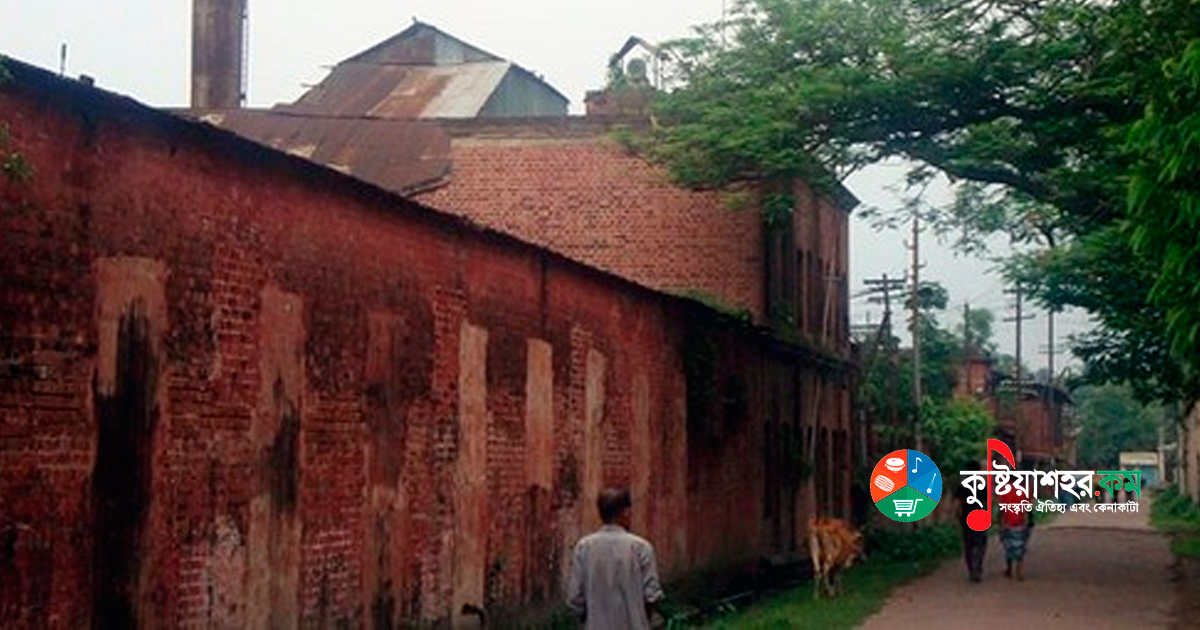
Mohini Mohan Chakrabarty was a celebrated yarn trader of India. Because of safe river-borne travel and improved railway connections, he took the initiative to set up a yarn mill on land adjoining Kushtia's big station. In 1908 he built Mohini Mill on 100 acres of land in the Millpara area. At that time he imported brass handloom machines and about 200 looms made of brass from faraway England and installed them in his mill. Among the handful of modern yarn mills then working in different parts of India, Mohini Mill was one. Nearly 300 workers laboured there. The yarn produced at this mill went to all the provinces of India, as well as to Burma, Pakistan and Sri Lanka. In those days Kushtia's heritage textile mill, Mohini Mill, was an economic driving force.
Day and night, a few reserved carriages would come to Kushtia's big station from Sealdah in India to collect Mohini Mill's yarn. And from the Gorai river ghat at Barabazar, big boats carried the yarn to different parts of the country. Weavers would come here from almost every part of the country, Pabna, Shahzadpur, Gazipur, Natore and elsewhere, to buy yarn. This golden age of Mohini Mill ran on until 1965. After the Partition of 1947, West Pakistanis began casting covetous glances at Hindu property in this land. In the later part of 1965, communal claws descended on the mill's owner Mohini Mohan Chakrabarty. Entering the mill under cover of night, they looted it and threatened the owners with death. One day, in fear of his life, Mohini Babu had to leave this country in the darkness of night, taking only his wife and children, abandoning everything in exchange for a verbal transfer of the mill's ownership. Then, at the Pakistanis' behest, the mill's MD Kanu Babu became the all-in-all of Mohini Mill. In the meantime came the Liberation War. In the Liberation War, Kanu Babu and his people left the country. The ownerless mill lay idle for several years.
After the country became independent, in 1972 the mill was nationalised under Presidential Order No. 27 and placed under the management of the Bangladesh Textile Industries Corporation. The establishment ran for some time and then closed again. Deemed unfit to run on a commercial basis because of excessive losses, the mill was decided to be wound up at a meeting of the Council of Ministers held on 12 June 1981. On 5 February 1982 the mill was shut down. At the same time a liquidator was appointed to sell the mill's movable and immovable property and settle its liabilities. Through a tender process, the mill's movable and immovable property was handed over on 2 September 1984, under a sale agreement, to the highest bidder Nazrul Islam for Tk 11 crore 26 lakh. On 20 January 1986, under a tripartite agreement, the buyer of the wound-up Mohini Mill's transferred assets was taken in the name of Messrs Shah Mokhdum Textile Mills Limited in place of Nazrul Islam, and that company replaced Nazrul Islam. Pledging its own assets as collateral and creating a second charge over the wound-up Mohini Mill's property, the buying company took a loan of about Tk 7 crore from Agrani Bank's Kushtia Barabazar branch. But because the condition of reopening the mill's old part was attached, the desired and quality production did not come, and the owners had to suffer losses of crores of taka. Because of these losses the mill closed completely on 25 May 1988. On 20 January 1991 tenders were called again to sell the mill. Agrani Bank and Nazrul Islam then filed a case against the ministry; the court issued an injunction, and the sale process was suspended.
In 2009, Shah Mokhdum's third owner, another party, The Peoples Development Services Corporation (PDSC) Limited, signed an agreement with the ministry to restart the mill. The agreement said that, according to the Textile and Jute Ministry's reckoning, the government would receive Tk 48 crore 39 lakh 73 thousand from the buyer (Nazrul) on account of Mohini Mill - the sale price plus the principal and interest of loans taken and grants while the mill was in government hands (1984 to 2009). Of this, Tk 30 crore 47 lakh was to be paid within three months of signing the agreement, and the remaining Tk 17 crore 92 lakh within the following year. The agreement, made on 10 December 2009, said that the earlier case would have to be withdrawn and that, failing payment of the dues within the stipulated time, the organisation could not take legal recourse against the government. But the establishment could not pay the dues on time. The ministry therefore made a fresh agreement to sell the mill at the same price to a businessman named Abdul Matin. But even then PDSC was with it. Under the agreement, paying Tk 1 crore 10 lakh to the government and Tk 11 crore to Agrani Bank, they ran the mill until 8 September 2011. The mill then closed, and it is now held by the present Inargotec Limited. Of the mill's 99 bighas of property, the factory stands on about 28 bighas of land. The machinery inside the factory lies abandoned. The BMRE unit is now closed. On that land there are four mosques, four temples, a school, a college, a playing field and a charitable hospital.
Local sources say that, since the entire site lies within Kushtia pourashava, the price of land here is currently above Tk 10 lakh per katha. On that reckoning, the market price of 99 bighas of land is Tk 198 crore. Contacted, the present buyer Arifur Rahman said: 'I bought the mill after examining all the liabilities and legal matters.' Asked what he would do with the mill's land, he said: 'I will run the BMRE unit, then set up some other factory.' Asked whether, after forfeiture and another breach of agreement, the mill still had the legal right to be handed over, the present chairman of Shah Mokhdum Mills Limited, Joyenal Abedin, said over mobile phone: 'The mill was handed over precisely to free ourselves of the burden of the loan. The whole matter was done with the ministry's approval.'
Meanwhile, Kushtia's heritage Mohini Mill is changing hands again. A tripartite agreement has been made to hand the mill, along with its 99 bighas of land, over to Inargotec Limited. This will be the fifth handover of the mill by the Textile and Jute Ministry. In the latest handover the mill, with its land, has been valued at Tk 48 crore 39 lakh 73 thousand. But the ministry fixed this price according to a review of December 2009, and several years have since passed. In that time three more rounds of agreements were made with three parties for the handover; but as they failed to pay on time, the final agreement was made with Inargotec Limited's owner Arifur Rahman. Yet there is a question over the legal right of the Shah Mokhdum authorities to hand over the mill. The organisation bought the mill at auction in 1984 for Tk 11 crore; but because it did not pay the full amount, the money it had paid was once confiscated. Inargotec will pay the government Tk 48 crore within three months. And, keeping this land mortgaged, the present owner must also pay Tk 10 to 12 crore to the bank on account of the loan taken by Shah Mokhdum's owner Nazrul Islam, principal and interest included. The new buyer must also pay Tk 6 crore each to the Shah Mokhdum and Dinar authorities within 20 days. Besides, Inargotec must also repay the money that Abdul Matin, PDSC and M. Aslam had paid the government.
Inargotec has already paid the government Tk 10 crore. It has been asked to pay the remaining Tk 38 crore 39 lakh in four equal instalments every three months. If it fails to pay two consecutive instalments, the agreement made with Inargotec will be treated as cancelled. And to sell the mill, Inargotec will need the ministry's approval. After paying the Tk 10 crore, on 26 August 2012 the ministry wrote to Kushtia's Deputy Commissioner, asking that the mill be handed over to the Inargotec authorities. The ministry also permitted Inargotec to sell the mill's old machinery.