বাংলা
 English
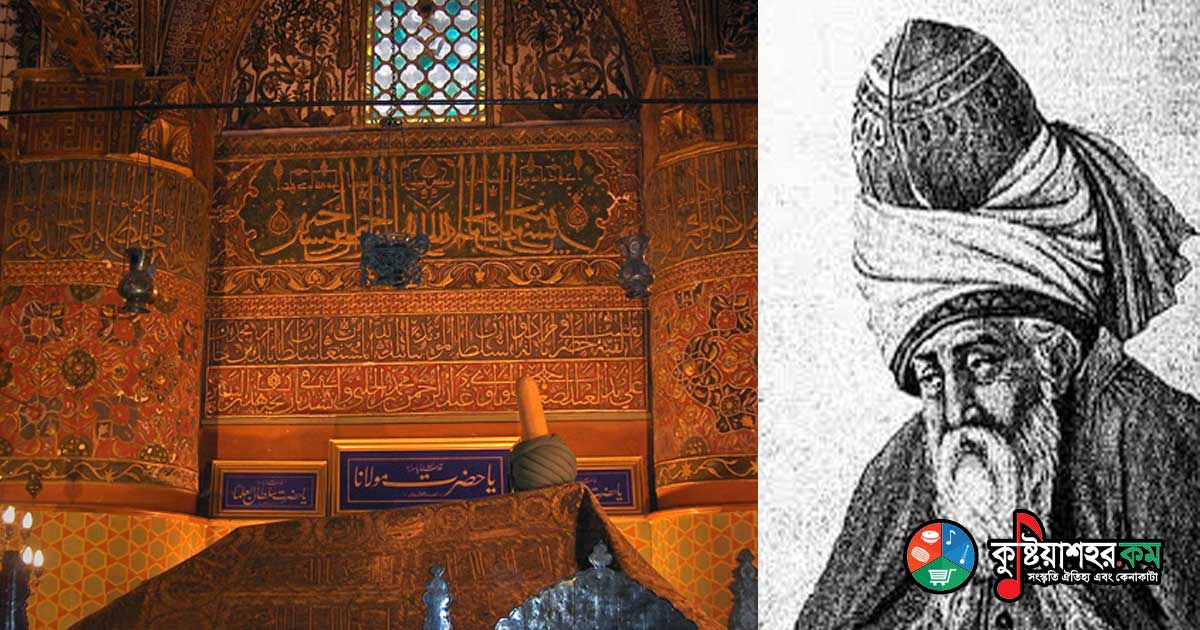
Jalal Uddin Muhammad Rumi (Persian: جلالالدین محمد رومی) (1207 - 17 December 1273), or known as Jalal Uddin Muhammad Balkhi, Maulana Rumi, Moulvi Rumi — though he is most popular simply by the name Rumi. He was a 13th-century Persian Sunni Muslim poet, jurist, Islamic personality, theologian, mystic and Sufi. Rumi's influence has transcended national borders and ethnic divisions and spread across the courts of the world; the Muslims of Persia, Tajikistan, Turkey, Greece, Pashtun areas, Central Asia and South Asia have been duly honouring his spiritual legacy quite well for the past seven decades.
His poetry has been widely translated into various languages all over the world and converted into various formats. Rumi is called the United States' 'most popular poet' and 'best-selling poet'.
Although most of Rumi's literary works were composed in Persian, he also composed many stanzas in Turkish, Arabic and Greek. His Masnavi is compared as the greatest poetic work written in the Persian language. The people of the Iranian empire and the Persian-speaking people of the world still read his writings extensively in the original language. The translations are also very popular, especially in Turkey, Azerbaijan, the United States and South Asia. His poetry has influenced Persian literature, and not only that, it has also greatly influenced Turkish literature, Ottoman Turkish literature, Azerbaijani literature, the poetry of Punjab, Hindi literature and Urdu literature. It has also influenced the literature of other languages, such as Turkic, Iranian, Indo-Aryan, Chagatai, Pashto and Bengali literature and Bengal.
In English he is most often called 'Rumi'. His full name is 'Jalal Uddin Muhammad Balkhi' or 'Jalal Uddin Muhammad Rumi'. Balkhi and Rum are both his ethnonyms, that is, from 'Balkh' and from 'Rum' (the Persian and Turkish name of Anatolia) respectively. According to Franklin Lewis of the University of Chicago, a reliable biographer of Rumi, the Anatolian peninsula belonged to the Byzantine or Rum empire, which later came under the possession of the Muslim Turks, known until now as Arab, Persian and Turk, which was the geographical region of Rum, where many historical personalities were born, and Rumi was one of them. The word 'Rumi' is originally Arabic, meaning Roman. However, he is widely known by his epithet 'Maulana'. Maulana is an Arabic word meaning teacher.
Rumi was born to native Persian-speaking parents, who were mainly inhabitants of Balkh, which is now in Afghanistan. He was either born in Wakhsh, a village near the Wakhsh river of the greater Balkh empire, now in Tajikistan, or he was born in the city of Balkh, in present-day Afghanistan. Greater Balkh was then the focal point of Persian culture and Sufi practice, which had been established over several centuries. Besides Rumi's father, the Persian poets of the time Attar and Sanai exerted the greatest influence upon Rumi. Rumi acknowledged them: 'Attar is the soul, Sanai is his two eyes, and after that time, we were in their train', and in another poem he reminisced, 'Attar traversed the seven cities of love, while I am still at the turn of one street'. On his paternal side he was a descendant of Najm Uddin Kubra. He spent most of his life in and around the Sultanate of Rum, where he composed his works and passed away in 1273 AD. He was buried in Konya, and it has now become a place of pilgrimage. After Rumi's death, his son Sultan Walad and his followers founded the 'Moulvi order', also called the whirling dervishes, which is famous for the Sufi dance 'sama'. He was laid to rest beside his father, and over his remains a magnificent darbar (shrine) was built. Shams Uddin Ahmad Aflaki's 'Manaqib al-Arifin' (written between 1318 and 1353) contains its details. This historical biography is said to be of great value because it contains both legend and truth about Rumi. For example, Professor Franklin Lewis of the University of Chicago devotes a separate chapter to it in his book on the life of Rumi.
Rumi's father Baha Uddin Walad was a theologian, jurist and mystic of Balkh, known to Rumi's followers as 'Sultan al-Ulama'. According to the most popular biographers he was a descendant of Khalifah Abu Bakr, although modern researchers-scholars have rejected it. Khwarizmian descent was claimed on the mother's side in order to be associated with the royal dynasty, but this claim was rejected on chronological and historical grounds. The most complete genealogy has been made of his forebears, extending over six to seven generations, which is joined to the Hanafi jurists. We do not know the source of the names from Baha Uddin's mother's side, but he only referred to her as 'Mami' (the colloquial form of mother in Persian), and she was a very ordinary woman who lived in the 13th century. Rumi's mother was Muimina Khatun. His family's work was, for several generations, the propagation of the Hanafi madhhab of the religion of Islam, and Rumi and Sultan Walad continued this family tradition. When Central Asia was struck by the Mongols between 1215 and 1220, Baha Uddin Walad set out westward with his whole family and a group of disciples. According to historians, which is not agreed upon by Rumi's disciples, Rumi then met Attar, the most popular mystic poet of Nishapur, in the Iranian city of 'Nishapur'. Attar at once recognised Rumi's spiritual quality. He saw Rumi walking behind his father and said, 'Behind a lake there goes an ocean'. He gave the boy a book named 'Asrar-nama', concerning the entanglement of the soul with the world. This meeting had a deep effect upon the eighteen-year-old Rumi and later served as the inspiration for his works. From Nishapur, Walad and his people set out for Baghdad and met many scholars and Sufis. They set out from Baghdad for Hajj and performed Hajj in Makkah. Then the party of the travelling caravan passed through Damascus, Malatya, Erzincan, Sivas, Kayseri and Nigde. Then they stayed in Karaman for seven years. Both Rumi's mother and brother died there. In 1225, in Karaman, Rumi married Gawhar Khatun. They had two sons: Sultan Walad and Ala Uddin Chalabi. When his wife died, Rumi married again and had a son, Amir Alim Chalabi, and a daughter, Malika Khatun. On 1 May 1228, the ruler of Anatolia, Ala Uddin Kayqubad, invited them; Baha Uddin came to Anatolia and began to reside permanently in Konya of Anatolia, the western part of the Sultanate of Rum. Baha Uddin became the chief teacher of a madrasa, and when he died, Rumi being twenty-five years old, by inheritance he received his father's post as an Islamic moulvi. One of Baha Uddin's students, Sayyid Burhan Uddin Muhaqqiq Tirmidhi, continued to teach Rumi about the shari'ah and tariqa, especially his father's aspects. For nine years he received the teaching of Sufism as Burhan Uddin's disciple, until he passed away in 1240 or 1241. Then Rumi's public life began: he became an Islamic jurist or faqih, issued fatwas, and continued delivering sermons on morality in the mosques of Konya. He worked as a moulvi in the madrasa and taught his followers. During this period Rumi travelled to Damascus, and it is said he spent four years there. The meeting with the dervish Shams Tabrizi on 15 November 1244 completely changed his life. From an established teacher and jurist, Rumi was transformed into an ascetic. Shams, travelling all over the Middle East, was seeking and saying, 'Who will endure my company?' A voice said to him, 'What will you give in return?' Shams answered, 'My head!!' The voice said again, 'The one you seek is Jalal Uddin of Konya'. On the night of 5 December 1248, as Rumi and Shams were talking, someone called Shams to the back door. He went out and was never seen anywhere again. Rumour spread that Shams was murdered with the tacit consent of Rumi's son Ala Uddin; if so, then Shams gave his head for this mysterious friendship.
Rumi expressed his love for Shams and the expression of grief at his death in the poetical work 'Diwan-e Shams-e Tabrizi'. He himself set out in search of Shams and travelled to Damascus. There he realised:
Why should I seek him?
He and I are one and the same
His existence dwells within me
I am seeking myself!
Rumi effortlessly began composing ghazals, and they were collected in the 'Diwan-e Kabir' or Diwan Shams Tabrizi. Rumi found another companion in Sala Uddin-i Zarkub, a goldsmith. After Sala Uddin's death, Rumi's scribe and favourite student Husam-e Chalabi played the role of Rumi's companion. One day, as they were roaming in a vineyard outside Konya, Husam suggested an idea to Rumi: 'If you were to write a book like Sanai's "Elahi-nama" or Attar's "Mantiq ut-tayr", it would accompany many people. They would fill their hearts from your work and compose music to accompany it'. Rumi smiled and took out a piece of paper and wrote the first eighteen lines of his 'Masnavi':
When the reed-flute plays, listen to it with your heart, what it says,
Repentant in the pain of its parting, it weeps…
Husam entreated Rumi to write more. Rumi devoted the next several years of his life in Anatolia to the six volumes of his finest work, the 'Masnavi'. In December 1273 Rumi began to feel ill. He prophesied his own death and composed a ghazal that became very popular, beginning:
How should I know what manner of king is within me as my companion?
Cast not your glance upon my bright face, for my closed eyes.
On 17 December 1273 Rumi died in Konya. He was buried beside his father, and a wondrous chamber, the 'Yasil Turbah' (the Green Tomb, قبه الخضراء; now the Maulana Museum), stands above his grave. Upon his tombstone is written:
When I am dead, seek not my tomb upon the earth; seek me in the hearts of men.
Gursu Khatun, the queen of Georgia, was Rumi's encourager and close friend. She provided funds for the building of Rumi's shrine in Konya. To see the Maulana Museum of the 13th century, along with his mosque, dwelling place, school and the tombs of the other persons of the Moulvi tariqa, Muslims and non-Muslims from different parts of the world still hurry there today. Jalal Uddin, known as Rumi, was a philosopher and mystic of Islam. In support of his preaching stand boundless tolerance through love, positive reasoning, piety, charitableness and awareness. To him and his disciples all religions are more or less true. He viewed Muslim, Christian and Jew with the same eye; his peaceful and tolerant teaching or preaching has touched the hearts of the people of all religions.
The general theme of Rumi's teaching, like the mystic and Sufi poets of other Persian literature, was the teaching of tawhid. His desire and longing to attain spiritual realisation appear in the following verse of his book Masnavi:
I died as a stone and was born as a plant
I died as a plant and rose as an animal,
I died as an animal and was born as man
Then what have I to fear? When have I ever grown less by dying?
At the next step I shall die from the nature of man,
That I may lift my head and wings with the angels,
And indeed I must leap from the river of the angels,
All things perish save only His Face (the Creator),
Once again I shall soar from among the angels,
What I shall become is beyond my imagination,
Then I shall become non-existent; the non-existent me proclaims (through the melody), like the flute,
Verily, to Him we must return, who created us.
از جمادی مُردم و نامی شدم —
وز نما مُردم به حیوان سرزدم
مُردم از حیوانی و آدم شدم —
پس چه ترسم؟ کی ز مردن کم شدم؟
حملهٔ دیگر بمیرم از بشر —
تا برآرم از ملائک بال و پر
وز ملک هم بایدم جستن ز جو —
کل شیء هالک الا وجهه
بار دیگر از ملک پران شوم —
آنچه اندر وهم ناید آن شوم
پس عدم گردم عدم چو ارغنون — گویدم کانا الیه راجعون
The Masnavi is composed of everyday scenes, verses and explanations of the Quran, and complex and vast mysticism. In the East it is said of him that he is 'not a prophet, but it is certain that he has brought a scripture'. Rumi believed intensely that the path to reaching the Creator is music, poetry and dance. For Rumi, music helps to sanctify the whole being by concentrating it, and so intensely that the soul is at once destroyed and resurrected. From this idea the Sufi dance arose. His teaching became the foundation of the Moulvi tariqa, which his son Sultan Walad brought to completion. Rumi was a patron of 'sama', sanctified dancing while listening to music. Within the Moulvi tradition 'sama' represents a mystical journey of spiritual ascent towards the One through mind and love. In this journey the seeker symbolically turns towards truth, grows in love, abandons the ego, finds the truth, and arrives at the Perfect One. Then the seeker returns from the spiritual journey, attaining maturity to love and serve creation.
In another stanza of the Masnavi Rumi describes the message of universal love:
The purpose of love is different from all other purposes
Love is the astrolabe of the mysteries of God.
Rumi's favourite musical instrument was the 'ney' (a kind of flute).
Rumi's poetry is sometimes divided into two classes: quatrains and ghazals. The prose works are divided into discourses, letters and 'seven sermons'.
Poetry
- Rumi's principal work is the 'Mathnawi-ye Manawi' (the spiritual couplets; مثنوی معنوی), a six-volume poem which some Sufis consider the Quran of the Persian language. Many compare it as one of the greatest works of mystic poetry. It contains about 27,000 lines of Persian verse.
- Rumi's other principal work is the 'Diwan-e Kabir' ('the great work') or 'Diwan-e Shams Tabrizi' (the work of Shams Tabrizi; دیوان شمس تبریزی), which is named after Rumi's teacher Shams Tabrizi. Besides, it has 35,000 Persian couplets and 2,000 Persian quatrains; it has 90 ghazals and 19 quatrains in the Arabic language, besides about twenty-four couplets in the Turkish language and 14 couplets in Greek.
Prose
- Fihi Ma Fihi ('what is in it, is in it'; Persian: فیه ما فیه): this is a collection of seventy-one discourses and lectures which Rumi gave to his students. It was compiled from the notes of Rumi's students, so Rumi is not the direct author of this book. A translation from Persian to English was first published by A.J. Arberry under the name 'Discourses of Rumi' in 1972, and the second translation was brought out by Wheeler Thackston as 'Signs of the Unseen' in 1994. The composition style of Fihi Ma Fihi was in colloquial language, and it was for middle-class men and women, and it lacked realistic diction.
- Majalis-e Saba (seven sessions, Persian: مجالس سبعه): within it are seven Persian sermons or lectures which were given at seven different assemblies. These sermons expound the deeper meaning of the Quran and Hadith. It also contains quotations from the poems of various other poets, including Sanai, Attar and many other poets, and Rumi himself. Aflaki narrates that, after Shams-e Tabrizi, Rumi gave these sermons at the request of the notables, especially Salah Uddin Zarkub. The style of the Persian is utterly plain, but the Arabic quotations and the knowledge of history and the hadiths display Rumi's knowledge of the Islamic sciences.
- Makatib (the letters, Persian: مکاتیب): this contains Rumi's letters in Persian which he gave to his students, family members, state personalities and other influential persons. The letters bear witness that Rumi was quite busy helping his family members and supervising the disciples growing up around him. Unlike his previous two works, the letters are consciously realistic and epistolary, which are generally written to dignitaries, diplomats and kings.
The Moulvi Sufi order was founded by Rumi's disciples in 1273 after his death. The first successor of this order was 'Husam Chalabi' himself; after the death of Rumi's younger and only son Sultan Walad (who died in 1312), who was known for the book 'Masnavi Rabnama', he was made the head of this order. Since then the leadership of this order has been kept, unbroken, within Rumi's family in Konya. The Moulvi Sufis are known as whirling dervishes, who perform dhikr through sama. In Rumi's time (as attested by the 'Manaqib al-Arifin') his disciples gathered for musical practice. According to tradition, Rumi himself was an important composer who played the rabab, although his favourite instrument was the flute. The music that accompanies sama consists of poems from the 'Masnavi' and 'Diwan-e Kabir' or Sultan Walad's poems. During the Ottoman empire the Moulvi order became well established, and many members of the order served in various official posts during the khilafat. The centre of the Moulvi order is at Konya. There is also a Moulvi lodge (درگاه, dargah) in Istanbul beside the Galata Tower, where sama is performed and which is open to the public. The Moulvi order invites people of all classes and professions:
During the Ottoman empire notable poets and artists emerged from the Moulvi order, among them Sheikh Ghalib, Ismail Rusuhi Dede of Ankara, Israr Dede, Halet Efendi and Gavsi Dede, who are all buried at the Galata Moulvi Khana in Istanbul. Music, especially the flute, plays an important role in the Moulvi order. With the modern foundation, in the secular Turkish republic Mustafa Kamal Ataturk removed religion from the policy of the people and confined it to personal will, conduct and belief. On 13 December 1925 a law was enacted under which all khanaqahs (the dwelling places of the dervishes) and zawiyas (the chief dervish's dwelling place) were closed, and a centre was built in reverence where 'ziyarat' is performed. Istanbul alone had more than 250 'tekkes' as well as small centres for the gatherings of various associations. This law broke up the Sufi orders, mystical or esoteric names, titles and the dress associated with titles were banned, the property of the orders was confiscated, and their festivals and gatherings were prohibited. The law also made provision for punishment if anyone tried to re-establish the order. Two years later, in 1927, a museum named the Maulana Museum was permitted to open in Konya.
Come, come, whoever you are
Wanderer, worshipper, hermit
It matters not.
Ours is not a caravan of despair,
Come, even though you have broken your vows a thousand times
Come, yet again, come, come.
In the 1950s, the government of Turkey permitted the whirling dervish ceremony to be held once a year in Konya. The Maulana festival is held every year for two weeks in December, culminating on 17 December, the Urs of the Maulana (Rumi's death anniversary), which is called 'Shab-e Urs' (شب عروس) (Persian meaning 'the night of union'), the night on which Rumi reached the Creator. In 1974, the whirling dervishes were permitted for the first time to travel to the West. In 2005 UNESCO declared Turkey's 'Moulvi Sama festival' a 'masterpiece of the oral and intangible heritage of humanity'.
According to Edward G. Browne, the three most profound Persian poets are Rumi, Sanai and Attar, who were Sunni Muslims, and their poems contain abundant praise of the first two khalifahs, Abu Bakr and Umar ibn al-Khattab. According to Annemarie Schimmel, foremost among the tendencies of the Shia poets are the mystic poets Rumi and Attar in their own verses, who became strengthened only after, in 1501, during the Safavid empire, Twelver Shi'ism gained recognition as the religion of the province.
“The Maulana Rumi Review” (ISSN 2042-3357) is published annually by the Centre for Persian and Iranian Studies of the University of Exeter in collaboration with the Rumi Institute of Nicosia, Cyprus, and Archetype Books of Cambridge. The first volume was published in 2010 and it has been published every year since. According to Leonard Lewisohn, the chief editor of the journal: “In importance and influence Dante, Shakespeare and Milton, though rivalled by a few Muslim poets, enjoy literary fame in the West because the Arabic and Persian philosophers, writers and poets are deemed negligible, trivial and tasteless beside the great narrative of the Western canon. The aim of the Maulana Rumi Review is to put an end to this disdain in world literature, which runs deeper than the Western literary misapprehension.”