বাংলা
 English
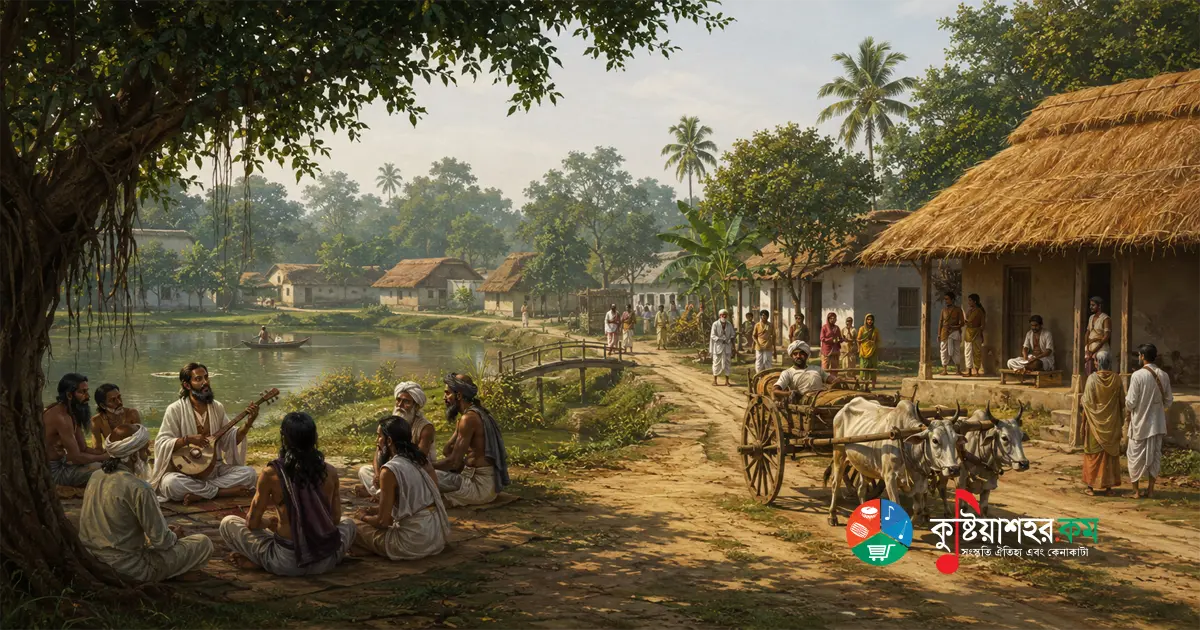
The songs of Lalon Fakir, according to researchers, are songs of finding the man of the heart on deep solitary paths. The songs of Lalon Fakir are songs of the path of devotion. This is largely true. But the songs of Lalon Fakir are, in the truest sense, songs of liberation. This liberation is both spiritual and social. Just as these songs carry the urge to find the man of the heart, so equally do they carry the seed-mantra of social revolution. Because the songs of Lalon Fakir are the harvest of his life-experience.
Lalon was a forward person of his society. On hearing 'Baul' many may think that he was a society-detached elitist person. But it is not so. He was a thorough social man. Spiritualism is his nature-philosophy, and social revolution is the harvest of his social experience.
Lalon's difference from the other song-poets of society is that he never bound any song for entertainment. He bound his songs from his social experience and innate urge. That is why his songs became the songs of man's liberation and showed the path in all ages, for all people. He searched for the man of the heart, pointed to truth and the right path - kindled in society the torch of liberation.
One may think that, sitting in the closed society of that nineteenth century, he tried to repel all the demons through melody. Caste and creed, religious bigotry, social discrimination, the mental destitution of people - everything appeared as the expression of his mystic mind.
The devotion or songs of Lalon Fakir are not sudden creations. Behind his creation there was a definite aim and objective. Although he bound songs in the trance of emotion, that emotion was the bridge of propagating the philosophy of human liberation born of deep thought. Lalon Fakir is at once a spiritual devotee and a social revolutionary. Therefore the discussion of spirituality alone is not the complete reading of Lalon Fakir. To know him fully, alongside his spirituality, his social revolution too must be presented equally.
We want to know the complete Lalon Fakir, not knowing him in fragments. Therefore we want to present his social philosophy, along with his spiritual philosophy, in its wholeness. And to present his social philosophy we have to know about his time, his society, the social structure and the social reactions.
When, how and where was Lalon born? This question has not been resolved. Nor is it possible to resolve. According to the prevailing opinion, Lalon floated and came to Kushtia. Although the incident of floating is true, it can be said that he did not float from some land outside Bengal. Lalon lived in Bangladesh, spoke in the Bengali language, bound songs in Bengali - leaving for us the heritage of traditional folk philosophy - therefore we shall accept that Lalon's birth was in Bengal.
In the minds of many of us the question perhaps arises: where did the illiterate Lalon get this emotion-philosophy, this theory-philosophy, and the education and courage to fight against society? Lalon was a village man. He lived with the then lowest class - among whom there was neither any modern educational material nor the courage to stand up against society. Then where did Lalon get so much knowledge, so much courage?
To search for the answer to this question we have to go around Lalon's society. If we take the time as the first half of the nineteenth century, then what does the social history of Bengal tell us? Or how was the society of Bengal of 1774, which is imagined as Lalon's birth time, or immediately before and after?
According to historical sources, if we accept 1774 as Lalon's birth year, then it will be seen that Lalon's birth came just 17 years after the Battle of Plassey. The Battle of Plassey is a notable event in the social change of the Indian subcontinent, because after the Battle of Plassey Indian society began to change at a rapid pace.
However that may be, looking at the history of India it will be seen that already a great change of scene had taken place in the political history of India. With the defeat of Nawab Siraj-ud-Daula in the Battle of Plassey of 1757, the ruling power of this country went into the hands of the English. And although the treachery of Mir Jafar is greatly shown as the cause of the Nawab's defeat in this war, needless to say that the catalyst behind it was the influential Hindus of the then Nawab state. The principal resentment of these Hindu rich against Nawab Siraj-ud-Daula is also historical.
The Mughals snatched state power one after another from the Hindu kings of this country, and with it the anti-Muslim feeling of the Hindus kept growing. But owing to the sturdy rule of the Mughals they could never anywhere find an opportunity. Yet the unextinguished flame of the resentment smoldering in their minds kept burning fiercely.
At the end of Mughal rule, their internal dissension, weak administration, their being overly absorbed in their own luxury, the change of the East India Company's policy from 'Trade Not Territory' to 'Territory Not Trade' and the diplomatic activities for that purpose - all combined with the political ambition of the influential Hindu persons, into whose trap Mir Jafar and some of the Nawab family stepped, falling a victim to the diplomacy of the East India Company - for these reasons mainly the governance of the Indian subcontinent went into the hands of the English.
And when the influential Hindus of this country welcomed the English government and expressed their gratitude to them, the Muslims here, in their mental world, with the pain of losing the state, gradually grew hostile to the English, clearly rejected them and created distance with them. In such a situation the Hindus went ahead of the Muslims in every sphere of society.
There arose in society the class of powerful zamindars. Exploitation and oppression grew in society; as a result the famine of '76 occurred. Great changes came in the social structure. A kind of unrest was created in society. Amid this unrest were Lalon's birth and growing up. In the meantime many important events took place.
The death of Majnu Shah, leader of the Fakir movement, in 1787, the French Revolution of 1789, the death of Majnu Shah, leader of the Fakir movement, in 1792, the Permanent Settlement of 1793 etc. - along with these historic events, Lalon passed from childhood to adolescence, from adolescence to youth. Thus Lalon's mental landscape, taking the signature of time, moved forward through the breaking and building of society.
We have no information or authentic document in hand about where and how Lalon's childhood, adolescence and youth passed. Again and again, therefore, we have to depend on the prevailing legends - although I am not inclined either to accept or to reject these legends.
When the death-path traveler Lalon was rescued from the ghat of the Kaliganga river of Kushtia, his age was 16 years - such is the belief of the devotees and admirers. Reckoning Lalon's approximate birth year, it comes to 1800. Then, on the strength of the belief of the devotees and admirers, it may be assumed that Lalon's residence in Cheuriya was from 1800 or immediately after. Of course the researchers say that, after touring various pilgrimages, Lalon came to Cheuriya in 1823, established an akhra and began to reside permanently. Then it is understood that Lalon began residing in Cheuriya from the very beginning of the nineteenth century.
Now let us learn a little of the social history of Bengal of that time. The place where Fakir Lalon Saiji came and established an akhra was the place of the local malm craftsman, and it belongs to Kumarkhali thana. From history, as much information about Kumarkhali as is available shows that it was reckoned a renowned commercial place, and that it belonged to the Thakur zamindari. However the distance of Kumarkhali from Cheuriya is several miles.
From the Census Report of 1872 it is known that the Nadia district had six subdivisions. They are -
- Krishnanagar
- Mirpur
- Kushtia
- Chuadanga
- Bongaon
- Ranaghat
At this time the total population of this region was 1,812,795.
The six thanas under the Kushtia subdivision were -
- Daulatpur
- Noapara
- Kushtia
- Kumarkhali
- Bhaluka
- Bhaduria
Among these, the area of Kumarkhali thana at that time (in 1872) was 110 square miles. The number of villages and towns under Kumarkhali was 242. The total number of houses was 14,581 and the total population was 86,254.
At this time Kumarkhali was the largest center of the weaving trade. Here there was also an indigo kuthi. Besides, the head office of 52 indigo kuthis was at Kumarkhali. Rabindranath's grandfather Prince Dwarkanath Tagore had established an indigo kuthi at Shilaidaha. Besides, evidence is found that there was also a silk kuthi at Kumarkhali. Moreover, at this time we find Kumarkhali as a business center too. Kumarkhali was the largest hat of cloth made by the weavers; the weavers of Santipur, Kumarkhali and the adjoining areas came here to sell cloth.
From the testimony of Rai Charan Das, the lawyer of Kumarkhali, it is known:
'Among the native moneylenders there was the business of paddy and ghee of the saheb-babus and the Ghosh babus of Kumarkhali and Amala. Paddy was imported in big saiya or boats (length 100 cubits, breadth 30 cubits) and went to Calcutta... Among the big businesses was the saheb company's silk kuthi. Kumarkhali's silk was very famous. Because the company's silk kuthi was there, for its operation an English Commercial Resident used to live.'
In the second half of the nineteenth century, because rail communication was established between Kumarkhali and Calcutta, its importance as a commercial center increased further. Kangal Harinath's biographer wrote, 'To say that at this time Kumarkhali was the "Manchester" of the Nadia district would be no exaggeration; countless weavers prepared various kinds of cloth, and its name was known as far as England; here was the silk kuthi of the honorable East India Company, and "Kumarkhali brand" silk cloth was sold in the Bilat market at a high price; the firm blue color of Kumarkhali's indigo cloth stirred the greed of the saheb merchants.'
In the era of the great improvement of the communication system, Kumarkhali too gained the status of an important place. Sitting in this very Kumarkhali, Kangal Harinath Majumdar, the father of rural journalism, published his Grambarta Prakashika in 1863.
From this it is easily inferred that Kumarkhali then was undoubtedly very excellent land - whether in crop production, as a commercial center or as a cultural center. The distinguished researcher Abul Ahsan Choudhury has said,
'The history of Kumarkhali in the field of education-literature-culture is not modern. From the Nawabi period itself there were tol-chatuspathi-maktab-pathshala here. In the English period the tols of scholars such as Chandrakumar Tarkabagish and Sitinath Smritibhushan had special fame. In the English period strong interest toward English education is observed even in this remote mofussil. For English education a high school was established at Kumarkhali as early as the forties of the nineteenth century. The name of the high school is the M.N. Vidyalaya, which received government approval in 1856. The founder of this school was the locally renowned wealthy businessman Mathuranath Kundu. It is said that he stopped the steamer of the Governor General (1844-48) Lord Hardinge in the Gorai river and had him inspect the school, and as a result of that Governor General's recommendation, when the system of government financial grant to mofussil schools was introduced during the time of Lord Dalhousie (1848-56), this school of Kumarkhali was the first to receive assistance.'
Alongside the taking of various kinds of efforts for spreading women's education in the various contemporary information and data, the condition of women in contemporary society has been described. In his essay 'Stri-Shikkha' (women's education) published in 1869 in his Grambarta Prakashika, Kangal Harinath Majumdar said of the prevailing women's education, 'The education now being given to girls shows no special result. The girls cannot receive education in the pathshala for many days. And in the antahpur too the custom of giving any kind of higher education has not been introduced.
'...Now we request the teacher mahashays of the girls' pathshala that, apart from regular lessons, giving various kinds of good advice in the form of stories, they will always take care to purify the character of the girls. They will give such advice that, even if the girls do not receive higher education, they are able to perform all kinds of domestic duties on the strength of the teacher's advice and the scriptures. No ill-charactered person can destroy their religion.'
That is, it is understood that, though within a very limited scope, the run of female education had already begun at Kumarkhali. In this period Kumarkhali was rich in business and trade and in education, and equally quite rich in the cultural direction. Jatra, pala-gan and kabi-gan filled Lalon's time and society. Abul Ahsan Choudhury has said,
'In the English period the practice of the culture of the Kumarkhali countryside was mainly confined within pathshala-kirtan-kabigan-gitabhinaya.' Through Jagadbandhu Sen, Mr. Choudhury further said, 'Before the beginning of the nineteenth century the kabi-gan had an extreme spread and prevalence in the Kumarkhali region, and there were quite a few kabi-gan parties at Kumarkhali.'
Quoting a poem of Bholanath Majumdar, he said, 'In a poem of Bholanath Majumdar some identification of Kumarkhali's cultural environment is found:
Under the tender shade, in a leaf hut, Mother Bharati's seat was spread,
At the feet of how many holy words the offering was given, the head washed...
Thirteen festivals in twelve months, jatra, panchali, Chandi songs,
Healthy, vigorous, strong bodies, the hearts of all filled with festival.'