বাংলা
 English
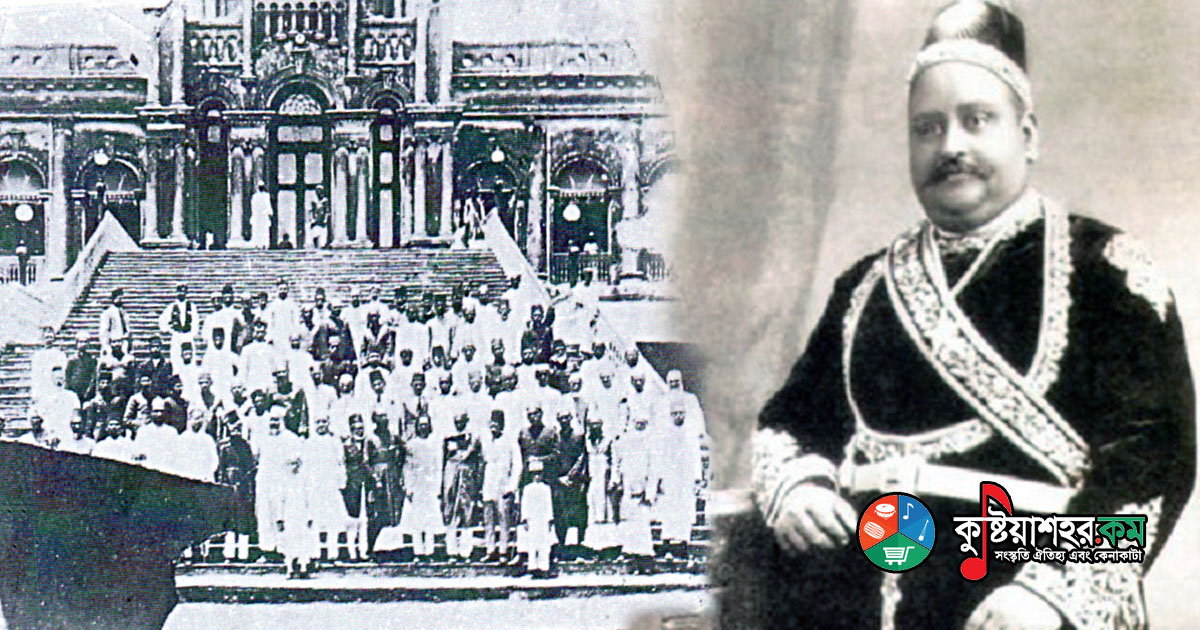
Nawab Salimullah (born 7 June 1871 - died 16 January 1915) was the Nawab of Dhaka. His father was Nawab Khwaja Ahsanullah and his grandfather Nawab Khwaja Abdul Ghani. He was one of the founders of the All India Muslim League. He played a special role in the founding of the University of Dhaka; indeed, he donated his own land in the Ramna area of Dhaka for the establishment of the university.
In 1903, when the Viceroy Lord Curzon visited Dhaka, Nawab Salimullah raised the problems of East Bengal. The Town Hall was built after Lord Curzon's name. Lord Curzon laid its foundation stone in 1904. It is now known as Curzon Hall inside the University of Dhaka. Meanwhile, with a view to reducing transport costs in exporting the tea and other products of Assam abroad, the British thought of using the Chittagong port instead of Calcutta, and at the same time the idea of decentralising the administration of the Bengal Presidency was also in the air. British commercial interests combined with the Nawab's appeal, and within a very short time the final decision on the partition of Bengal was taken. Against this backdrop, despite the fierce protest of the Calcutta-centred intellectuals and businessmen, in 1905 a separate province was formed comprising East Bengal and Assam. The partition of Bengal produced an adverse reaction among the Bengali Hindus.
In 1877, when the 'Central Mohammedan Association' was formed at the initiative of Syed Ameer Ali, Sir Syed Ahmad Khan expressed disagreement with it. He had advised the Muslims to refrain from politics. But after the Congress came into being and a conflict arose between Hindi and Urdu, Syed Ahmad became conscious of the interests of the Muslims and, taking an interest in political organisation, formed the 'United National Defence Association' (1889). In 1893 the Mohammedan 'Anglo Oriental Defence Organisation of Upper India' was formed in northern India. In 1903 a Muslim political organisation was formed at Saharanpur. In February 1906 a political organisation named the 'Muslim League' was formed in the Punjab. Meanwhile, in reaction to the partition of Bengal, a storm of protest by the Hindu community and of anti-Muslim sentiment swept across the whole of India, which stirred Sir Salimullah deeply. He began to think of Muslim unity at the all-India level.
In November 1906, Salimullah expressed his intention in correspondence with the eminent leaders of the whole of India and put forward the proposal of an all-India Muslim association. The All India Educational Conference was convened on 28-30 December 1906. Nearly 8,000 delegates from all over India joined this conference, held at Shahbagh. Nawab Salimullah proposed the formation of an 'All India Muslim Confederacy', that is, an all-India Muslim association; Hakim Ajmal Khan, Zafar Ali and some other delegates supported the proposal. In view of objections from some delegates, the word 'Confederacy' was abandoned and the word 'League' was adopted. Finally, under Salimullah's leadership the All India Muslim League was formed. At this historic conference in Dhaka the partition of Bengal was supported and the anti-partition movement was condemned. The Hindu community had taken an adverse stand towards this organisation from the very beginning. The Bengalee newspaper, edited by Surendranath Banerjee, dubbed the newly formed Muslim League the 'Salimullah League'.