বাংলা
 English
Through the worship and practice of humanity, and through his unbroken love for human beings, the Baul emperor Fakir Lalon Shah wished to build a non-communal society of equality. Taking up the vow of non-violent humanity, he created countless songs on the doctrine of the body, the doctrine of feeling and the doctrine of the guru. This immortal music of his is confined to no religion. Rising above all faiths, the mystic sage and Baul emperor Fakir Lalon Shah gave the world the Fakiri doctrine for the liberation of mankind. Saiji's Fakiri doctrine — a philosophy and music of casteless humanity — has crossed the borders of the country and spread across the globe. He called upon people, beyond the limits of every religion, to walk ever the path of truth and to follow the way of humanism.
Sujan Karmakar writes this series of reports based on interviews with eminent persons:-
The essayist and author M. Maniruzzaman tells us that around 1741, in the time of Nawab Alivardi (1676–1756), the Bargi raids plundered the age-old settlements along the Bhagirathi river of West Bengal. At that time many people from those areas came and settled in the Kumarkhali region. Along with his kith and kin, Lalon's grandfather took shelter in the twin villages of Chapra-Bhandara in Kumarkhali, having come from Panihati of the 24 Parganas. According to that book, Lalon Saiji was born in the village of Chapra-Bhandara, in present-day Kumarkhali upazila of Kushtia. His family name was Lalitanarayan and his pet name Lalu. On the advice of Molom Karikor of Cheuria village, he took initiation into the Baul-Fakir creed from the sage Siraj Sai of Harishpur in Jhenaidah and adopted the name "Lalon". After his guru's death, from around 1845 to the early 1860s, he came back once more to Cheuria village in Kushtia. When Molom granted him a plot of land, Lalon Shah set up his akhrabari there and began to live.
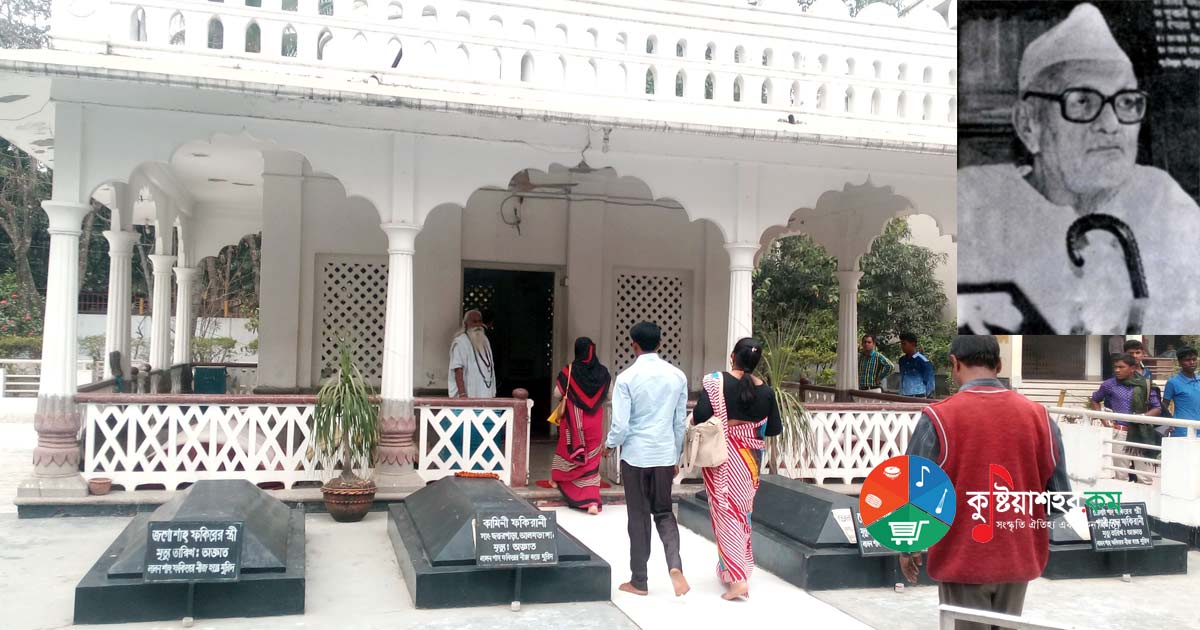
Talking with the followers who come to Saiji's akhrabari, we learn that at the very time when the British rulers' tyranny was poisoning the life of ordinary villagers, walking the path of truth and giving diksha to people in the guru of humanity, the Baul emperor Lalon Shah appeared as a guide on the path of humanity. He was self-educated. During a pilgrimage he was stricken with smallpox and his companions abandoned him; he regained his life under the shelter of Siraj Shah. In 1823 Lalon's akhra was built on the land donated by Molom Shah. From the founding of the akhra he lived there with his disciples and devotees, composing countless songs. On 17 October 1890 — the first of Kartik in 1297 of the Bengali calendar — Saiji passed away, and he was buried inside a room.
The eminent researcher and president of Bodhodoy, Adv. Lalim Haque, tells us that Lalon Sai was born in 1772 or thereabouts. Around 1815, as the story goes, he built the akhrabari at Cheuria in Kushtia and devoted himself permanently to sadhana and the writing of songs. He died in 1890. One may say that almost the whole of the nineteenth century (1800–1890) was the span of Lalon's genius, and that it was against this very century's social, economic and political background that his talent flowered. Evidence is found that in matters of religious thought Lalon was acquainted with the Brahmanism, the doctrine of incarnation or the doctrine of birth of the various faiths. He was indifferent to questions of God. Reading his songs of many themes deeply, one feels that first he accepted the creation-doctrines of all religions and then, stepping away from them, he came to believe in universal humanism. Needless to say, Lalon's songs themselves are the foundation of the spiritual consciousness of his religious thought and the reflection of his philosophy, and this song-analysis remains within that. The complete orientation of the Baul creed and path lies bound organically with Lalon Sai and the inner melody of the Baul outlook. In the analysis of Baul song we generally observe that there are two streams of Baul performance: one is the akhra-based song, where the style and melody are calm and soft in tempo.
The other stream is formal performance on the public stage, where these songs are sung to a high-pitched melody, and in this mode the Baul artist's dance is a companion element. Two kinds of melody are generally observed in Baul song: the first kali, that is the sthayi, is set to one melody, while the other kalis carry a somewhat different one; and at the very end the portion of the second kali is sung again at a quick tempo. In Baul songs generally — and especially in Lalon's — although one sometimes notices a continuous melody in the weaker verses, Lalon's songs are often in fast tempo. Some Baul songs are kirtan-based, the result of Vaishnav influence; yet the Sufi influence on Baul song is the strongest. There are differences between the Baul melodies of West Bengal and Bangladesh: in West Bengal the Sahajiya Vaishnav melody predominates, while in Bangladesh it is the Sufi ghazal — of which bhab-gan (songs of feeling) and shabd-gan (songs of word) are an indigenous form. Yet in the Baul's song, as Adv. Lalim Haque tells us, the ache of a not-finding seems to ring through the layers of the melody.
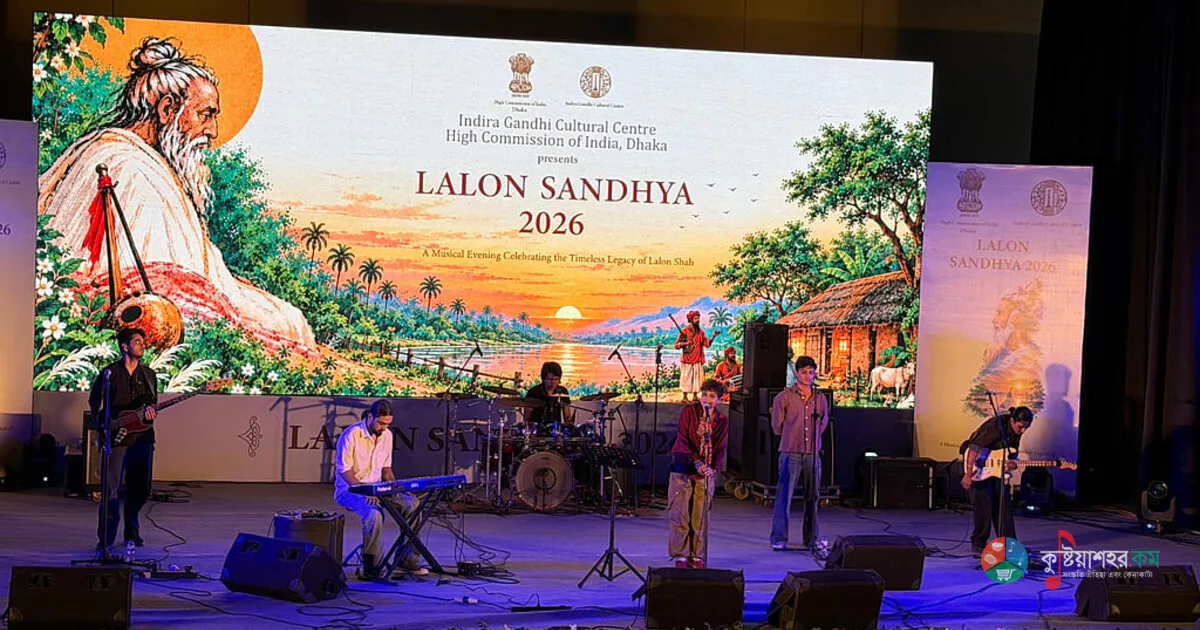
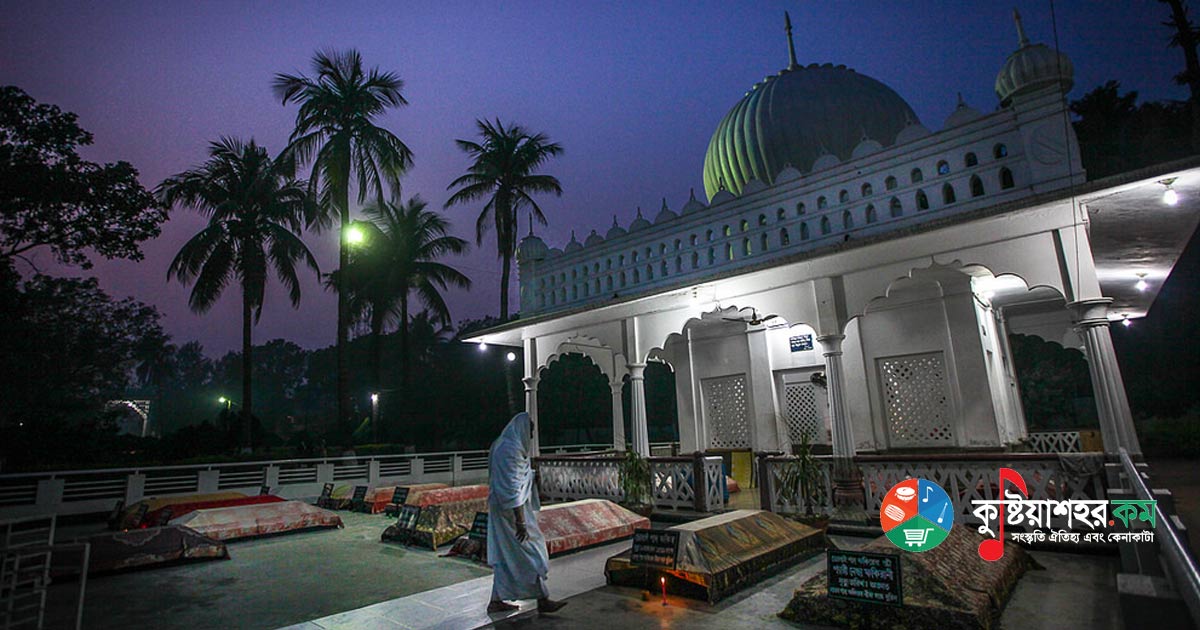
We learn that at Saiji's akhrabari, ceremonies are held twice a year, including a five-day observance on the occasion of Dol Purnima. Dol Purnima is the utsab of his appearance, and the first of Kartik is observed as his Tirodhan. People come to the observances from home and abroad — tourists and devotees and admirers of Lalon. The grounds of the Lalon Academy cannot hold another grain of people. During his lifetime the Baul emperor Fakir Lalon Shah held his commemoration utsab on the occasion of Dol Purnima; in that same tradition his annual remembrance utsab is held every year on Dol Purnima. On the occasion of Dol Purnima, discussions on Lalon and performances of Lalon's songs take place every day on the open stage on the bank of the Kali river, and the Lalon mela spreads across the vast grounds of the akhrabari.
The chief khadem, Fakir Mohammad Ali Shah, tells us that there are thirty-two tombs in all, Saiji's included. Of these, fourteen were murids made by Saiji's own hand, one was a disciple of a disciple, and the rest his followers. He adds that inside every human being dwells another unacquainted man — the achin manush. To gain the nearness of this achin manush, one must practise the worship of humanity. That is why Saiji said, "He whose devotion is fixed on the Man-Guru in this world finds fulfilment in every endeavour." And so, in this age of civilisation, forgetting envy and enmity among ourselves and ever walking the truthful and right path of Saiji's religious philosophy — 'satya bolo, supothey cholo' ("speak the truth and walk the good path") — we must keep ourselves engaged in the welfare of the country and the nation, so that Bangladesh may hold its head high in the court of the world.