বাংলা
 English
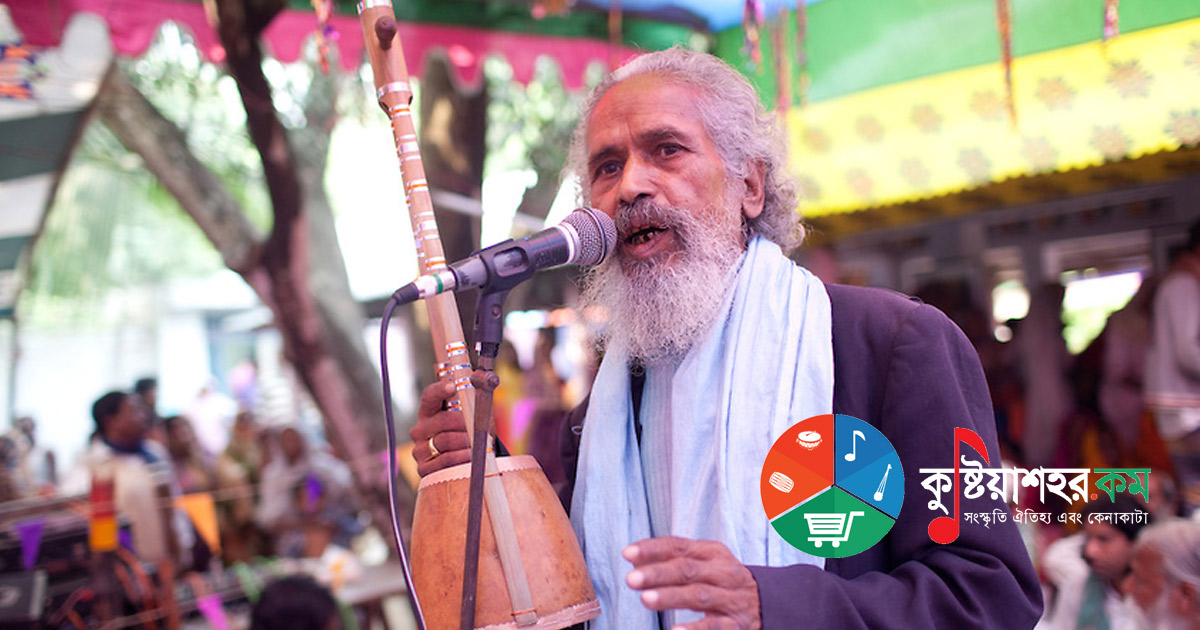
Lalon's songs are a novel creation in the world of music. There is a variety in the melodies of his songs. Although his songs are essentially mood-driven, in the union of melody and rhythm they are truly matchless. His songs carry the intoxication of devotional flavour. There is bewilderment in them. This bewilderment sends a thrill not only through the singer's heart but through the listener's mind as well. When the singer sings in total absorption, the listener hears in a daze. His songs carry the scent of Bengal's sweet clay. The melody of the human heart finds expression in them. That is why his songs overwhelm people and melt human hearts.
Lalon and Baul songs are deeply intertwined. The mood-realm of Baul songs is the search for the Ultimate Beloved within the body. In Lalon Shah's songs one finds the identity of the Ultimate Beloved who exists within the body itself. Lalon's songs are rich in theory. The core themes of his songs are dehotatta (the theory of the body) and attotatta (the theory of the self). His songs are songs of spiritual practice; hence their meaning is elusive. A play of light and shade runs through them. Lalon's songs carry both Sufi and indigenous moods. The Sufis too love music. Through music they express the moods of their hearts; they believe in the boundless power of music. Music is like fire hidden in stone — rub stone against stone and fire leaps out. Music is likewise a kind of stone; when it is struck against the soul, fire blazes forth. Gold is purified by burning in fire; in the same way, in the fire of music the heart becomes a mirror, and in that mirror the beauty of the world is reflected. That is why music was so precious to the Sufis. Lalon Shah pursued the sadhana of that very music.
That is why Lalon did not compose his songs out of pure artistic inspiration; his songs were born attached to a particular purpose. Yet in almost every case the purpose and the need are transcended, and Lalon's song effortlessly enters the well-tended garden of art in its own glory. His songs are thus at once songs of sadhana, philosophical discourse, and poetry adorned by art. Just as the Charyapada or the Vaishnava Padavali of the tattva-literature tradition, though songs of sadhana, stand as monuments of high art and literature, the same can be said of Lalon's songs, the finest exemplar of Baul song.
Long-lived Lalon composed songs for nearly a hundred years. Although the exact number of his songs is unknown, one may surmise that it easily crosses a thousand. Lalon was illiterate; he never had any opportunity of formal education. Yet observing the polish of his musical diction, the sweep of his melody, the depth of his mood and the craft of his art, one hesitates to call him an illiterate sage. In truth, Lalon was self-taught. He freed Baul song from the limitations of mood, the repetition of subject matter, the monotony of simile-metaphor-imagery and the sameness of melody. Because of these qualities, even in his own lifetime his padavali crossed the bounds of folk devotees and touched the educated gentry deeply. In later times Lalon's songs made room for themselves beyond the geography of the country, in distant lands. Entering the art-world of this illiterate village sage-poet, one is astonished at how skilfully he embellished his songs with the devices of art. Judged by mood-language, metre and ornament, these songs are monuments of high art, and beyond dispute they qualify as lyric poetry.
It is the peg of words accompanied by melody that infuses the flow of life into the body of a poem or a musical verse. In a skilled hand, ordinary words arrive with new connotation and significance. Lalon's songs are a shining example of how even homely words, through the dexterity of usage, are lit up with new meaning. In his songs Lalon created a special resonance through different uses of synonymous words — 'arshee', 'ayna', 'darpon' (all meaning mirror): for example, a. 'Arshinagar near the house', b. 'In the hall of mirrors', c. 'Do you know, O mind, you are a shoreless mirror'. The abundant and apt use of Sanskrit-derived words by the 'illiterate' Lalon creates wonder. Weaving a deep kinship between Bengali and Arabic-Persian words, he made his songs more attractive and ornate. The use of a few English words is also not rare in his songs. From this one can easily surmise how refined was the word-consciousness of the village sage Lalon and how rich his vocabulary. Lalon's extraordinary knowledge of metre awakens wonder even in the mind of a learned prosodist.