বাংলা
 English
Islam Khan is the commander of the Mughal Empire
Islam Khan Shaikh Alauddin Chishti (1570 - 1613) was the first governor and subadar of Dhaka, the capital of Bangladesh, and a commander of the Mughal Empire. Mughal Emperor Jahangir conferred on him the title of Islam Khan.
In his childhood Islam Khan was Emperor Jahangir's playmate. His father's name was Shaikh Badruddin Chishti, and he was the grandson of Shaikh Salim Chishti, the dervish residing at Fatehpur Sikri. Although he had the opportunity to receive formal education in the Mughal tradition, he did not receive much military training. Nevertheless he joined the Mughal army. Emperor Jahangir promoted him to the mansab of a two-thousandari and conferred on him the title of Islam Khan. Before taking over the responsibility of subadar of Bengal, he was the subadar of Bihar province.
Although Emperor Akbar conducted campaigns many times to establish his own rule in the Bengal region, they did not succeed because of feudal rebellions. After ascending the throne, Emperor Jahangir too sent troops on campaigns to the Bengal province several times. But all the campaigns failed. In 1608 Emperor Jahangir sent Islam Khan with the aim of conquering Bengal. Islam Khan was then only 38 years old. He observed the politics of Bengal deeply and took the decisions regarding the conduct of his campaign. Identifying them as the chief obstacles to the establishment of Mughal rule in Bengal, he planned to remove the Bhati territories of the Baro Bhuiyans and the Afghan patrons under Khaza Usman.
Islam Khan reorganised his army and navy and first planned a military campaign against the Baro Bhuiyans. He realised that to win the war in the Bhati region he would have to strengthen his navy. With this realisation he recruited experienced and efficient officers and soldiers for conducting military campaigns in the Bhati region. Islam Khan conducted the campaign in the Bhati region with great caution; he first subdued the allies of the Baro Bhuiyans, such as the powerful king Pratapaditya of Jessore and Satranjit, the king of Bhushana. He also sent troops against the defiant zamindars of north-western Bengal. In June 1609 Islam Khan's troops arrived at Ghoraghat from Rajmahal. Before arriving in Dhaka in June-July 1610, he was engaged in war against the Baro Bhuiyans during the first months of 1610. The Baro Bhuiyans, refusing to be still, consolidated their positions again on both banks of the Lakhya river. Giving them little opportunity, Islam Khan, having reorganised Dhaka, attacked all the strongholds of the Baro Bhuiyans, and towards the end of 1611 Musa Khan, the chief of the Baro Bhuiyans, and all the Baro Bhuiyans surrendered to Islam Khan. After this victory Islam Khan sent his troops against Khaza Usman Khan and the Afghan chieftains. The Afghans fled to Uhar (Moulvibazar) and kept trying to save themselves. At Islam Khan's request, the emperor sent Sujaat Khan to lead the troops against Usman. Although both sides suffered losses in the bloody war, Khaza Usman's sudden death gave the Mughal troops the advantage. The Mughal forces advanced further and defeated their opponents and the Afghan troops under Bayazid Karrani of Sylhet. Islam Khan later conquered the kingdom of Kamrup as well.
Islam Khan established Mughal rule in almost all of Bengal. He attacked his enemies one by one, and by subduing the rivals of the Mughal empire with well-organised Mughal troops, he established Mughal rule everywhere. Although the territories of the defeated zamindars, bhuiyans and chieftains were returned to them, they were forced to join the Mughal military contingent and their war boats were confiscated. As a result of joining the Mughal contingent, they were compelled to fight against their own allied zamindars and bhuiyans.
After subduing the bhuiyans, Islam Khan took the decision to shift the provincial capital. He brought the capital of Bengal from Rajmahal of East Bengal to Dhaka, the central region of Bengal. This transfer gave the Mughal troops the opportunity of being used permanently in the mainland of Bengal and of involving themselves in the political activities of the area. Islam Khan renamed Dhaka Jahangirnagar and laid the foundation of a modern city.
Dhaka's Islampur is named after him. A part of Ramna was once known as the Mohalla Chishtian after the name of his lineage. The mosque in Syed Aulad Hossain Lane is believed to have been built by Islam Khan. Dhaka's present central jail, which was a fort, was rebuilt by Islam Khan.
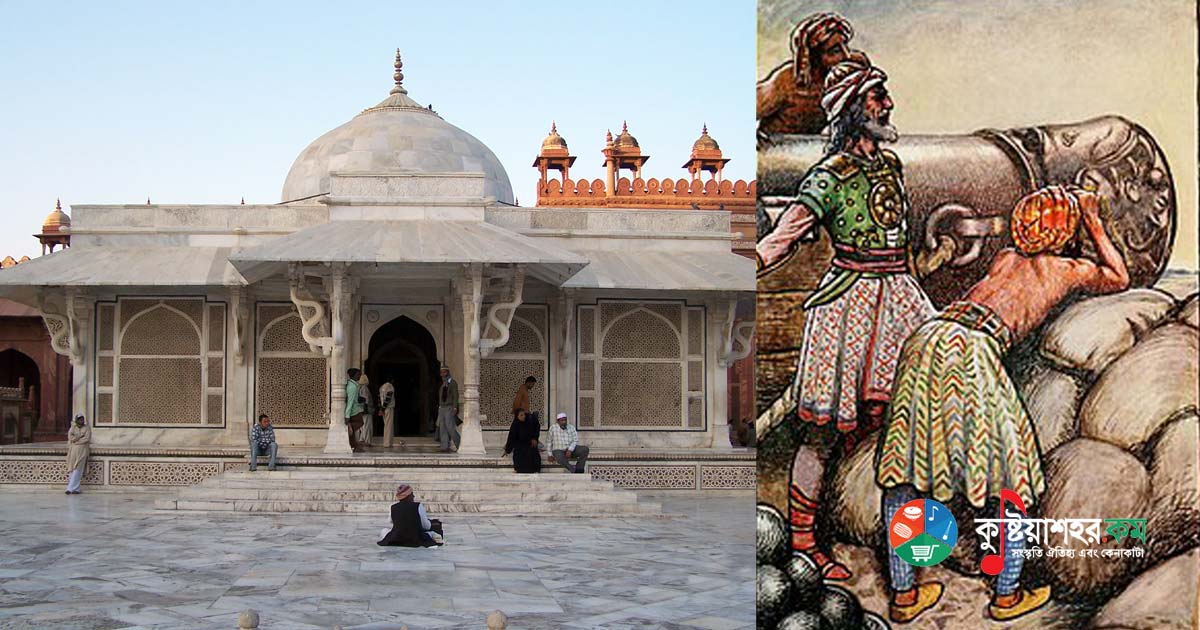
Islam Khan was the governor of Dhaka and Bengal from 1608 to 1613. In 1613 he died mysteriously and undesirably at Bhawal, 25 miles north of Dhaka. He was first buried at Badshahi Bagh (the old High Court area), Dhaka. Later his remains were taken to Fatehpur Sikri and buried beside his grandfather Shaikh Salim Chishti. There is a large mosque in Dhaka named after him.