বাংলা
 English

Humanism is a very modern philosophy and the fruit of the modern Renaissance. Humanism is the synonym of the Latin word Humanism. It means an interest in humane matters, a philosophical doctrine of principles for the welfare of mankind. Setting aside theology, the pursuit of human welfare purely in a worldly context is its chiefest purpose. Though the Greek philosopher Protagoras was the first to speak of humanism in the fifth century BC, still, until before the Renaissance this humanism was not practised so strongly in Europe. The keynote of the Renaissance is human dignity, the re-establishment of reason and free inquiry, and freeing the intellect within rationalism. Renaissance means rising anew. The logical liberation of the human intellect. The history of the Renaissance is therefore a history of beginning anew - a history of the liberation of reason and imagination.
Although the practice of humanism in Europe was the fruit of the Renaissance, in the Indian subcontinent the practice of humanism has a long history. The Bengali dictionaries and encyclopaedias indicate that at the root of the origin of the word 'manab' lies 'manushya', that is, the offspring of Manu, 'dear to Manu' or 'like a son', and that manushya is called manab. So from the pages of history we can say that at some time level with the spread of Aryan influence, the idea of 'man as the child of Manu' spread in the Indian subcontinent. And from this undivided human entity the word 'humanism' could come.
In Bangladesh we find the trace of a long history of humanism. Here humanism has come before everyone's notice through the practice of literature. The history of humanism in Bangladesh is nearly a thousand years old. That is, the history of its practice from the Charya age stands before us. From that Charyapada age, through Nath literature, Mangal-kavya, Vaishnava lore, Sufi lore, Shakta pada and baul songs, a continuous history of the practice of humanism unfolds before us. The composers of the Charyapadas were followers of the Sahajiya Buddhist creed. They were liberal humanists. Though all of them were highly educated sages learned in the scriptures, the practice among them was of the idea that all human beings are the creation of one God and in essence all are one. The eminent Charyapada composer Kanhapa speaks of kissing a Domni and of love with her. Bhusukupa married a Domni and became a Bengali. We know that in the caste-ridden, ritual-bound Indian society the Domni was a casteless woman of the lowest class. But the composers of the Charyapadas did not accept class distinction among themselves. Rather, it may be said that by rejecting this class division of society they were strong in the mantra of love for man. To them, not the caste-custom prescribed by society, not the class, but the undivided human entity was the greater. So Sarahapa, speaking of the Brahmin, could say with the greatest ease,
'The Brahmin was born from the mouth of Brahma; when he was born, he was born; but now, as others become Brahmins in that way, what remains of Brahminhood?' If you say, 'By the sacrament one becomes a Brahmin - give the sacrament to the Chandala and he becomes a Brahmin'; if you say one becomes a Brahmin by reading the Vedas, that too is false, for they read as well - are not the words of the Veda inside the grammar?'
In his doha song, opposing the Vedic rites in plain words, he says,
What good will your lamp do, what good your offering?
What good your mantra, what good your service?
What will you gain by going to the shrine and the hermitage?
Does one win liberation by bathing in the water?
Meaning - what will your lamp do, what will your offering do? What will your mantra and your service do? What will you gain by going on pilgrimage to the hermitage? Does one attain moksha by bathing in the water?
Poet Chandidas was the successor-sage of these very men. He himself was a Brahmin of the high class. Loving Rami, the washer-woman, he was disgraced and cast out of society. But this great poet of humanism did not forget his love for the washer-woman and did not lose his own faith. Though he was not a Vaishnava, he was a servant of Bashuli, a worshipper of Shakti. But the Vaishnava padas he composed are full of love for man and are a way-shower of humanism. He was the one who could say in a sublime voice,
Hear, O man, my brother,
above all is man, the truth; above him there is none.
He did not accept distinctions between man and man. To him man was everything; man was above all. Surpassing religion, lineage, nation, God - man appeared to him as the greater. In his view, all men are children of immortality. The distinction between man and man is not right. Man is man. All men are equal. That is why, being a Brahmin, loving Rami the washer-woman's daughter, he rejected society and proclaimed the glory of man in a strong voice.
The Sufis' arrival in this land began from the eighth century and went on to the fourteenth. But in the thirteenth century, when Ikhtiyar Uddin Bakhtiyar Khilji seized state power, the Sufis began to preach their ideals, religion and philosophy widely. By then Iranian Sufism had taken a new form under the influence of Bengal's popular philosophy. Bengal's humane mystic philosophy entered the Sufi doctrine. Among the love-path Sufis, humanism dawned. The Sufis' 'Man arafa nafsa hu faqad arafa rabbahu' gained a clear new life from Bengal's popular philosophy. The devotional path of Islam, merging with the path of love, created a new stream. The Sufis' sadhya-sadhana became humane. Through man himself the Sufis went on practising the quest for Allah. As a result, bhajan-sadhana became man-oriented. With the Sufis' doctrine of love, humanism came to Bengal with a new tide. In this context, in the fifteenth century, appeared Sri Chaitanyadeb. He gave up the religion of the household and remained intoxicated in the love of Krishna. He struck an axe at the caste-custom of the ritualistic Hindu religion. In his view, a devotee has no caste. He said, 'The cobbler is pure if he worships Krishna,' or 'Chandalopi dwijashreshtha Haribhaktaparayanah' - a Chandala devoted to the worship of Krishna is greater than a Brahmin devoid of Krishna's devotion. When, because of the Hindu society's rigid caste system, the lower-class people of society were not counted as human beings, he thus gave this glory to casteless men such as the Chandala and the cobbler. Then, in the sixteenth century, Emperor Akbar, founding a syncretic new religion named Din-i-Ilahi, tried to bring Hindus and Muslims into one line, seeing them not as Hindu and Muslim but as human beings. In his Din-i-Ilahi, people of all faiths had equal right of entry. All had an equal opportunity to attain moksha in this religion. No base distinction was made here. Across India, in the various stages of history, alongside the ritualistic, rigid Brahmanism, that is, orthodox religious practice, the practice of liberal humane religion and philosophy went on equally. The sage appearing as the continuous heir of that stream was Fakir Lalon. So Fakir Lalon received humanism precisely as an inheritance.
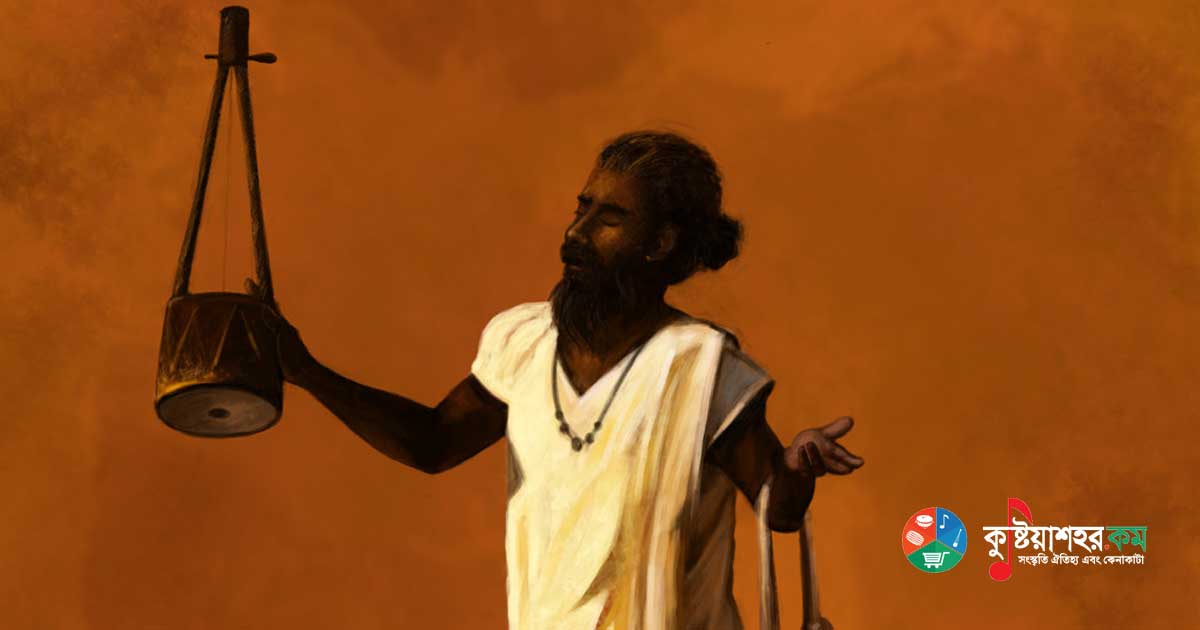
Lalon was a baul sage of metaphysical knowledge. From the demand of his community's sadhana he composed his padas. The scholars refuse to accept the baul doctrine as a religious doctrine. But within the rites of this doctrine, many elements of religious sadhana are present. The holders of the baul doctrine are the people of the lower strata of society. At every stage of history these people have been the victims of the exploitation of the ritualistic religion. So scriptural religion is, to them, essentially something to be abandoned and contrary to the liberation of their lives. The people of the baul community are the simple folk of society. They did not find their liberation at the hands of any social God. So they have taken refuge in man for the liberation of life. For this very reason these doctrines are so humanist.
We have come round the path of the history of India's dynamic humanism. We saw that the history of humanism in India is very old. In the various stages of history, Indian humanism was practised precisely as a counter-doctrine to the religion of society. With Lalon this humanism took on a still brighter form. The reason, it seems, is the European Renaissance and the rule of the East India Company. By then the East India Company had struck its roots in this land. They had begun the introduction of manifold kinds of education in this country. As a result appeared the city-bred humanists - Raja Ram Mohan Roy, Ishwar Chandra Vidyasagar, Henry Louis Derozio, Debendranath Tagore, Akshay Kumar Datta, Krishna Mohan Banerjee, Ram Gopal Ghosh, Rasik Krishna Mallik, Shib Chandra Deb, Har Chandra Ghosh, Radhanath Sikdar, Keshab Chandra and others. Lalon was a man of the village. It was rural society in which his activities were engaged. Lalon was perhaps not educated in modern learning like the city-bred humanists mentioned above, and perhaps he never came to know of European humanism, but he is the successor of India's dynamic humanism. So in his philosophy humanism is perhaps somewhat different in shape and size from the humanism of modern Europe. But that at root and in doctrine it is the other face of the same philosophy, I believe everyone will accept. Across most of Lalon's philosophy there is man and humanism. He refuses to accept anything other than man. Lalon is a sage of the mystic stream. The chief aim of his sadhana is to be united with the man of the mind. This man of the mind is that supreme entity. But as the dwelling place of that supreme, in Lalon's philosophy this embodied human being receives the greater importance. Through me they searched for that unseen luminous being. At this point lies the difference between Lalon's philosophy and conventional religious philosophy. In Lalon's philosophy it is said that if there is anything called God or Allah, it is manifested through this very human being. So all bhajan and worship should merge into this man. Lalon refuses to accept any other doctrine outside this man.
For whom the truth of man is true in the mind,
does he accept any other doctrine?
This 'manush-tattva' is the doctrine of the embodied man. Through this body to seek that bodiless one is the chief aim of the baul's sadhya-sadhana. Because the baul believes that in this very man the supreme man dwells full of lila. So to catch him, this man must search for him. Lalon said,
In this man he is, O mind,
the one they call the jewel of man.
Fakir Lalon says, having won that wealth,
I could not recognise him.
Accepting the Sufis' 'Innallaha khalaqal adama wa lahu suratihi' - that is, I created Adam in my own image - and going a little deeper, Lalon said that this man is the very likeness of God. That is, Lalon saw Allah and Adam as one in form and one in being,
As the lam hides in the alef,
so does Sai dwell in man.
Or else, would all the luminous bodies
offer obeisance to Adam's body?
Here Sai and man are complementary to each other. Allah, creating Adam in His own image, sat within him as soul and gave Adam consciousness. So this Adam is the likeness of the Creator, an exact copy. Lalon says,
In that Adam's trunk
He built chambers without number,
in the middle He set the mill to the crank,
and the Doer of deeds took His seat there.
So that Doer of deeds and Adam are not different things. That is why Allah commanded His angels to bow down to this man. According to scriptural religion, prostrating to anyone but Allah is haram. But Allah Himself commanded His angels to bow to Adam. Why? Lalon says,
Had Allah not been Adam,
the bow would have been a sin;
that which they call shirk, the great sin,
in this faith and this world.
Whether anywhere there is a proclamation of man's glory greater than this is a thing to ponder. Whether anyone else has thought such a humanist thought as installing man in God's own place is also worth thinking about. Man is the very likeness of God. So the worship of man itself is the worship of God. For that reason Lalon again and again stressed the worship of man.
Worship the simple man - see, O mind, with divine knowledge,
you will win the priceless treasure in the present.
To Lalon this present itself is the most precious. Because man's life revolves around the present. And to make this present glorious, through the worship of this man one must become the golden man. Lalon gave the verdict that the worship of this man is the root of everything. He said that if this man is not worshipped, all would be destroyed root and branch. Lalon said,
Worship man and you will become the golden man.
Or else, later in the madman's market you will lose your root.
Not only that; he said further that without this man there is nothing in the world. Without the knowledge of the worship of man, this world is full of darkness. And it is through the worship of this manifest man that human life will become meaningful.
Without man, O my mind,
you will see all darkness.
Lalon says, worship man in his manifest form
and you will win him.
Whether we speak of the European Renaissance or of the worldwide humanist philosophy that followed it, its keynote was to discover the inherent being of man and to present man in his fullness. To place man above all and discover the reservoir of infinite power within man. Lalon did precisely that work, and with great firmness. Going so far, he even raised man to equality with the Creator. And he spoke of making human life meaningful only through the worship of man. Again and again he spoke of placing this human life above all and making it blessed. To him, more precious than everything was this human life. He said most fittingly that once this human life is gone it will not be got again. So, while there is time, human life must be made active and meaningful. Lalon said,
Will there ever again be such a human birth?
O mind, whatever you do, do it quickly in this world.
By great fortune we have won this human life. The baul's belief is that the living being, wandering through the eighty-four lakh wombs, at last receives human life. So it is most precious. This life should not be squandered carelessly. The humanist Lalon did not believe in a life hereafter. So he gave the greater importance to this very life.
By what fortune, who knows,
have you won this human boat?
Cross swiftly your ferry,
laden with hope, lest it sink in the shoals.
Lalon said that this human birth is a treasure even the gods aspire to. The gods and deities, adoring again and again, have prayed to the Creator for this human life. That is, Lalon placed this man above the gods and goddesses and glorified him. He said that in this man the finest manifestation of Allah's form has taken place. So Allah has manifested Himself in this world through this man. So the gods and goddesses of heaven are smaller than this man.
In this man will be the worship of sweetness,
so Niranjan fashioned the human form.
The gods and deities adore,
praying to take birth as this man.
So with unshakable faith this man must be worshipped. Or else that steadfast treasure will not be found. Not in any Veda or Quran, not in any temple or mosque - this man must be sought in this man; or else that 'Aleek' man will remain unknown, unmet -
In disbelief one cannot find that treasure of man.
Had I known man, I would have met him in this man.
So in simple, pure faith man must be worshipped. Taking the knowledge of the simple man, one must practise the sadhana of union with that man of the mind. Not some unseen God, not some bookish philosophy - only the human guru can give man his fullness. Only the human guru can make this worshipless man 'Insanul Kamil', the perfect man. So unconditionally the human guru must be worshipped,
He who keeps faith in the human guru in this world,
all his sadhana comes to attainment.
If this human guru is not worshipped, everything in life will come to nothing. This life will be a failure. And one will have to return to the eighty-four. That is why Lalon again and again spoke of the worship of this man's feet,
Worship man's two feet;
the eternal thing will become pure.
Or else all will turn to dust -
quickly, take this distinction knowing it.
The human guru can be the saviour; likewise this human body is, to Lalon, the place of the greatest pilgrimage. No pilgrimage site is holier than this human body in this world. Lalon said, not in Mecca of Arabia - making this man one's Qibla, one must offer the prayer.
Fall prostrate, offer the prayer knowing and hearing,
bind your intention toward the body, the Mecca of man.
To the believers of Islam, the Kaaba of Mecca is Allah's house, and it is the holiest pilgrimage ground for the Muslim. But Lalon said, not the Kaaba of Mecca - the Kaaba that is in this human body, that Kaaba must be made the Qibla; the hajj must be performed there. And that is the Kaaba in the true sense.
The primal Mecca is in this human body -
do you see it, O mind, in the stream?
Rushing from land to land,
why do you die panting?
To Lalon this body itself is the holiest pilgrimage ground. Through the scrutiny of this body, through bodily sadhana, man can attain siddhi. This belief of Lalon was also that of his contemporary poet Kazi Nazrul Islam -
I have never heard a lie, brother - there is no temple or Kaaba greater than this heart.
Through this man Lalon searches for religion and for the Creator. He did not go searching for man's release through religion. In his view, this man is the essence of worship. However much religion and rites we perform forgetting this man, nothing will come of it. We know that religion and humanism are two opposite concepts. But Lalon saw these two concepts as one, through man. There is no God apart from man. In Lalon's view,
How many are the plays of the unrisen moon - the supreme play of man.
Not understanding, the mind has become lost, set against man (or quarrelling with him).
In the name of religion man has been exploited in every age, and inequality between man and man has been created. Because the theologians, giving religion the greater importance, diminished man in religion's name. But Lalon said - no, man is not for religion; rather religion is for man. So man cannot be smaller than religion. Kazi Nazrul Islam, another humanist poet of Lalon's own time, said,
Hear, all you fools:
man brought the scripture; no scripture ever brought man.
There is no scope for humiliating man in the name of religion. But it is precisely in religion's name that man has been suppressed the most. The humiliation of man in religion's name existed in Lalon's time, to be sure, and it was not less in the twentieth century either. The cruel paw of caste and creed had created such division between man and man in society that in the same society one man became impure by the touch of another. In the welter of castes and creeds, the people of the lower tier were being exploited and deprived in many ways. Lalon came and said this inequality of caste is not right. He declared revolt against caste and creed. The following chapter discusses this in detail, so there is no need to repeat it here. Still, relevantly, a few facts are set out very briefly.
Before Lalon, no one in his society had the courage to reject caste so strongly. Lalon did. Because he did not accept inequality between man and man on the plea of caste. He accepted man, in the true sense, as the jewel of man. Nothing was greater to him than man. The religion on whose plea the ritualistic beneficiaries of society had infused the poison of caste among men and fragmented humanity - Lalon rejected that religion. He said with firmness: what the lords of society call the exploitation of the lower classes in the name of caste, pleading the scriptures, is not right. And in the scriptures there is no proof of such caste and creed.
What is caste by ordinance?
Hindu, Muslim, Buddhist, Christian -
what proof does caste have
if you search the scriptures?
Not only that; Lalon said that the inequality of these lords of society in the name of caste is not of any scripture; rather it is the harvest of man's ignorance. Because men did not know one another, taking advantage of this, the self-interested lords of society drew lines of inequality among themselves for the sake of their own gain. Lalon therefore raised his voice against exploitation, persecution and social division in the name of religion. He said in a firm voice that the inequality of caste and creed prevailing in society is not the creation of religion; rather it is the harvest of man's ignorance. The more ignorant the people of a society, the greater the social inequality and the exploitation of social classes in that society. So, seeking to awaken the ignorant people of society, striking at these self-seeking quarters, he criticised in harsh language the divisions prevailing in society and said: caste and creed are the harvest of ancient man's ignorance.
The very caste on whose plea men make themselves out to be great is itself a creation of man and the harvest of their ignorance. So it is not caste but man who is great. He thought this world to be full of men, made for men. In this world it is man who stands by man in his peril and gives him comfort. In this no divine man ever came to stand by man. So everywhere in this world Lalon saw only man, and seeing this man his eyes were soothed. Lalon said,
Wherever I go I see man;
seeing man my eyes are soothed.
This attempt to establish human dignity above caste, religion, scripture, kitab and God - in history it is seen in very few lands, among very few people. But Fakir Lalon, in that dark rural society of the nineteenth century, dared to argue against the scriptures and to raise man above all. For this he too had to face much resistance. But before no resistance did he desist from proclaiming the glory of man. Sitting today in this twenty-first century, perhaps we will not be able to imagine the rural society of the nineteenth century. A society ravaged by illiteracy, miseducation and superstition, a society in which the traders of religion and the lords of society were the masters of fate - in that society Lalon sat alone and sang the songs of humanity with an open heart. The city society of the nineteenth century perhaps had manifold education and the practice of humanity, and many humanist philosophers appeared. But the rural society was its opposite. In that opposite society Lalon practised his sadhana of humanity fearlessly. The eminent novelist Annada Shankar Ray said most fittingly: 'In Bengal's new awakening, the role Ram Mohan played in the public mind of Bengal, Lalon's holds the same importance in the Deuali Utsab.'
Notes
- Abu Ishaq Hossain - The Bengal Renaissance and Fakir Lalon
- Nagendranath Basu, Bishwakosh (Encyclopaedia), Calcutta, 1359, Vol. 14, p. 583; Bangladesh Darshan - Gatishil O Prokriti Anusandhan (Bangladesh Philosophy - the Dynamic and the Search for Nature), 2nd volume, p. 623.
- Wakil Ahmed, Swami Vivekananda and Humanism; source - Bangladesh Darshan - Gatishil O Prokriti Anusandhan, 3rd volume, p. 419.
- Sri Sanat Kumar Mitra (edited), Baul, Lalon, Rabindranath, page 181.