বাংলা
 English

Baul Emperor Fakir Lalon Shah was a lifelong protester against communalism, religious bigotry, the varnashram caste system and superstition; a truth-seeker about the world and life, a lover of humanity, and the pioneer of awakening the simple people of the rural countryside.
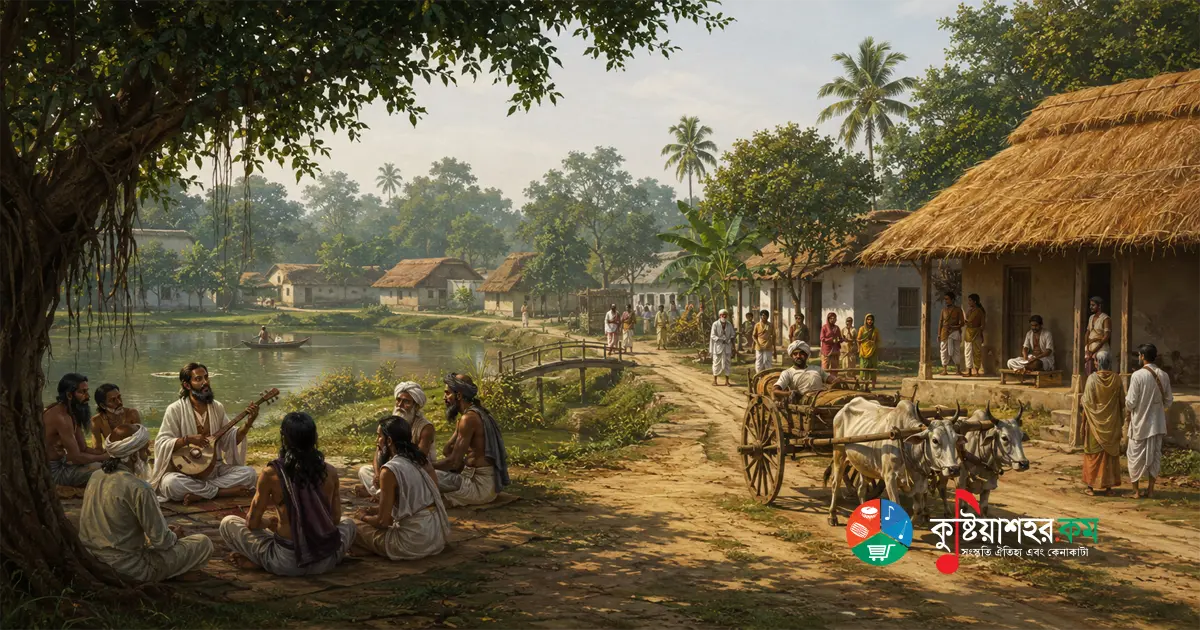
Our land is called the land of song. In this land melody is mingled in the water, the land, the air and the sky. The minds of the people of this silt-made land, it is said, are as soft as silt itself. They are easily drenched by the touch of melody. They are readily soaked in its rasa, in the rasa of devotion. For this reason, age after age, many poets and artists have made the people of Bengal laugh and weep with their songs, poems and melodies.
Through sayings and the refrain of melody they have taken lodging in the jewel-chamber of the human mind. Many of them have been lost; others live on among people. Even so, not everything is lost. Many things rise up and stand, and they stir the new people of a new age. Fakir Lalon and his songs are such a turn-of-the-age guide. The songs he composed in his lifetime are a hundred and fifty years past, yet his songs still give thought to people of every age and kind, give joy, stir them in bhaba-rasa and drench them in devotional rasa. In the songs of the Bauls the wordplay of many doctrines is spread out — Sufi doctrine, the doctrine of the body, the doctrine of creation, the doctrines of the self and of mind, the doctrine of sadhana, the supreme soul, the doctrines of form and true form, and so on.
These things are not for the ordinary listener to grasp, and yet nearly one and a half hundred years ago they were in Lalon's songs. But why then do Lalon's songs still sway our minds? Because Lalon gave his songs the usefulness of our time. That is why Lalon's questions of life and society remain extremely relevant even today. The distinctions of society, pride and arrogance, caste discrimination, the inferiority complex, anti-social conduct — these roused a deep anger in Lalon's mind. So that is what he expressed in his songs.
The flaws and discord in the human character of society, at which Lalon pointed his finger that day, exist to this day. In the present day, Lalon's songs attract and give strength to anyone in society or in the mind. Pointing a finger at hypocrisy in the name of religion, Lalon said:
''Inside lies the pouch of desire,
over it water is poured and poured — Lalon says, my mind is a Mussalman,
yet your real work was never done, O mind.
And again he said:
I see all this, a bazaar of the half-blind,
the scriptures half-blind after the half-blind law of the Creator.
And another half-blind mind is mine
the pundit half-blind with arrogance, the sadhu half-blind in wrongdoing
the moneyed chief half-blind, a tax-squeezing wretch
who has planted, by guesswork, a single boundary post.
He does not know whose the boundary is.
It is clear how fiercely, in his songs, he attacked the religion-traders and the social hypocrites. The hint of direct class exploitation is also found in his songs:
''Rajeshwar the king is even the crown of thieves
where shall I lodge my complaint, and with whom?
Gone, gone is my wealth and goods
I see only an empty house, Zamai
Lalon says, the burden of the tax
when will that ever be cleared at the office?
The divisions of caste in society scarred him over and over, and so he attacked that dividing line with all his strength.
''Everyone says, Lalon, what caste have you in this world''
Lalon says, what the shape of caste is
I have not seen with these two eyes of mine
He examined the matter of caste-distinction with real knowledge.
''What caste were you when you were to come
what caste did you take when you arrived
what caste will you be when you go
think, and then speak''
He said further — in Lalon Shah's thought the reflection of one undivided, divisionless human society was cherished in his heart. The centre of his sadhana was man; in the language of the Baul sadhaks it is the doctrine of man.
Lifting up the seven hundred maxims of humanity, one poet said:
Hear, O man, my brother
above all is man, the truth; above him there is none
Echoing that maxim, Lalon said:
''Within this human being dwells the mind — they call him the jewel, man''
Or:
The doctrine of man becomes truth in whose mind
would he accept any other doctrine''
And so Lalon's verdict: in the sadhana of man lies the real sadhana.
''In this world, whoever holds devotion to man as guru''
all his sadhana is fulfilled.
Or:
''Worship the two feet of man ''
daily you shall find the true beloved
clay itself will become precious
and you will know the difference in that crossing''
And through this sadhana the genuine man will be found.
''On the simple man, the feast — set your eyes, O mind
in divine knowledge you shall find the priceless treasure, present here and now.
In many, the humanity voiced in Lalon's throat, or something close to it, is not of this world. It is a spiritual humanism. That phrase is open to debate. But to understand this humanism one must turn our gaze to that particular juncture of history. It was then that Lalon practised his musical sadhana. The Sepoy Mutiny, the British seizure of power, the Permanent Settlement of 1793 establishing private property ownership — the direct patronage of colonialism, the clothing of industrial goods — all together, at that time an age of collapse was running through the society of Bengal and of India.
The ill effects of the Permanent Settlement — zamindari exploitation and oppression, caste divisions, the varna system, the high-caste Hindu's arbitrariness — all together made for an anarchic situation in the rural regions. Against the reality of such a society, at that very time the rise of nationalism took place. The spark of the longing for independence and rights. On one side a decadent feudal society, and on the other capitalism growing under colonial rule. The conflict and synthesis of these two was then under way.
And within that synthesis rose the wave of the new awakening, whose centre was Calcutta. The main tune of that new awakening was humanism. On one side of this humanism stood Rammohan, Vivekananda and Rabindranath, who sang the triumph of humanity standing upon idealist thought. On the other stood people like Vidyasagar, Sarat Chandra, Nazrul Islam and Begum Rokeya, who sang the triumph of a dispassionate, youth-lit humanism. So if Lalon's humanism is placed even on the foundation of idealism, it is not at all lacking in progressive character.
Because the Baul community is syncretic, but at its core rebellious. Lalon was a partner in that rebellion. By overstepping religious dogma and the harsh bonds and excesses of the scriptures, Lalon became the companion of the sorrows and joys of ordinary people. The fence of idealism could not hold him in.
The Bauls' common creed: detachment, freedom from the bonds of the world. But Lalon was not cut off from society. Real awareness, the feeling of human tenderness, brought him close to the people of the soil. Today we remember Lalon at just such a time, when our society is in the grip of a terrible moral and cultural decay; and on the other side, as a result of capitalist exploitation, want, poverty and the uncertainty of survival stalk the lives of ordinary people. Consumerist tendencies have unsettled society like an earthquake. Compassion, mercy, affection, love, social consciousness, the sense of responsibility — nothing can hold on any more.
In such a state, finding that simple man of Lalon's is our duty. So before today's progressive, democratic, socially conscious people, the sadhana of that simple man of Lalon Shah's remains immortal even now, as a source of inspiration in the struggle to transform this decadent society.
Source: Dainik Andoloner Bazar, Kushtia.