বাংলা
 English
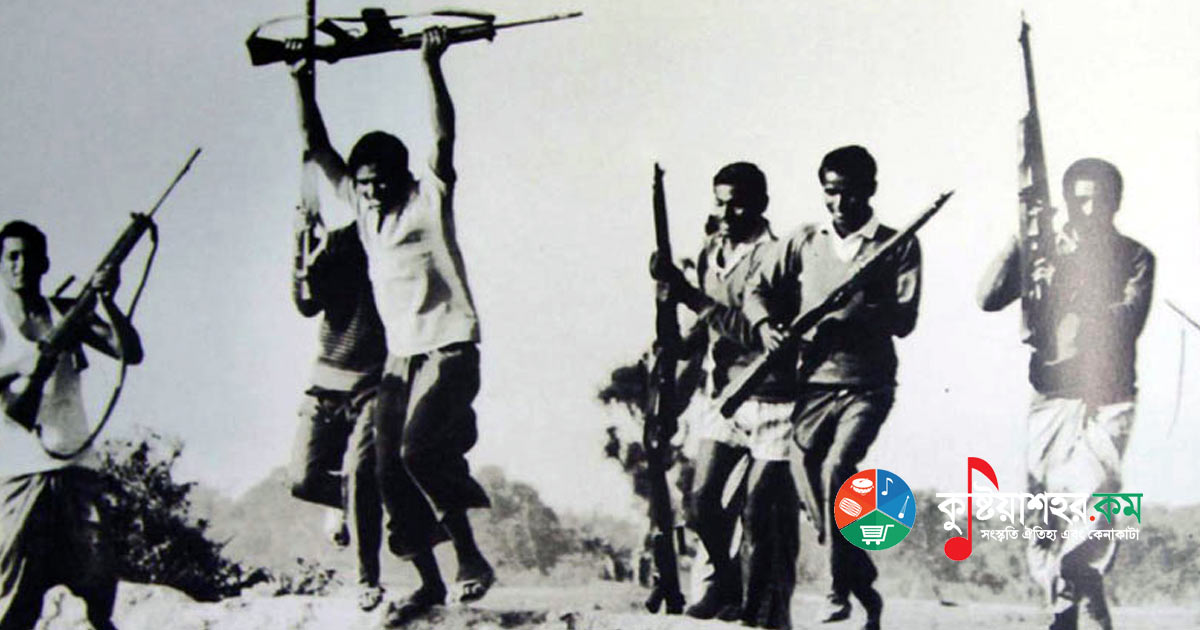
In 1971 the turbulent wave of contemporary Bangladesh swept over Kushtia quite strongly. In the 1971 independence movement of the country, Kushtia district's role was a leading one. We have chosen March 1971 as the starting period of our article.
On 3 March 1971, at a public meeting of the Swadhin Bangla Chhatra Sangram Parishad held on the field of Kushtia Islamiya College, a flag studded with six red-and-green stars was hoisted as the flag of independent Bengal by Abdul Jalil, convener of the Kushtia District Swadhin Bangla Chhatra Sangram Parishad and president of the District Chhatra League. The declaration of independent Bengal was read out by Shamsul Hadi, general secretary of the Kushtia District Chhatra League and leader of the Swadhin Bangla Cell. Under the leadership of Marfat Ali, Abdul Momen and Shamsul Hadi, the Joy Bangla Bahini was formed. On 23 March, on the field of Kushtia High School, Golam Kibria, MPA (member of the East Pakistan Provincial Assembly), and Abdur Rauf Chowdhury again hoisted the flag of independent Bengal and received the salute of the Joy Bangla Bahini. Preparations for war went on. Joy Bangla Bahini units were formed in every village of Kushtia.
Around midnight on 25 March 1971, 216 soldiers of D Company of the 27th Baluch Regiment, led by Major Shoaib and with Captain Shakil, Captain Samad and Lieutenant Ataullah Shah as second-in-command, attacked the Kushtia Police Lines and disarmed the members of the police force. The police on duty fled with their weapons, crossed the river and took shelter in various nearby villages. The Pakistani soldiers took position at the police lines, the district school, the telegraph office, the thana and the Aruapara wireless office. They had M.M.R.R, S.M.G, L.M.G, H.M.G, automatic Chinese rifles and plenty of ammunition.
On 26 March the Pakistani troops imposed a 24-hour curfew on the whole town and kept patrolling all over it. The next day, on 27 March in the afternoon, language-veteran Nazm Uddin Ahmed's brother-in-law Roni Rahman was martyred as he set out to launch a bomb attack on the invaders. On 28 March, after the curfew broke, many people were wounded by the merciless firing of the Pakistani soldiers in the crowded Kushtia municipal market.
The then MNA Azizur Rahman Akkas, MPA Abdur Rauf Chowdhury, Khandaker Shamsul Alam, M. A. Bari, Professor Nuruzzaman, Anwar Ali, Abdul Momen and Shamsul Hadi gathered information about the position of the Pakistani army in Kushtia, its troop strength and its weapons, drew up a map for a possible attack and contacted the EPR forces of Chuadanga, Meherpur and Daulatpur.
Under the leadership of Abdur Rauf Chowdhury, the then Awami League leader Mangan Miah and several others were in charge of recruiting soldiers.
Based on the map of Kushtia's leaders, on the night of 28 March EPR Sector Major Abu Osman Chowdhury of Chuadanga and Captain Azam Chowdhury decided in the plan to attack Kushtia from all four sides at 4 o'clock in the morning of 29 March. Although the plan was agreed, as the EPR forces could not reach their positions in time, the battle began at 4 o'clock in the morning of 30 March.
Under the leadership of Subedar Mozaffar, a group of EPR, Ansar and police members, together with the students, people and Joy Bangla Bahini, took position at the house of Judge Saheb adjacent to the police lines and in the surrounding area.
To attack the invaders' positions at the thana and the telephone exchange office from Rauf Chowdhury's house at Traffic Mor, Jahed Rumi, Shamsul Huda and other boys of the Student Union and the Chhatra League, along with the police members who had taken shelter in Haripur on 25 March, took position.
The EPR forces stationed at Kamalapur took position to the south-east and west of the Arua Para wireless office. Nur Alam Jiku, Abul Kashem and Advocate Abdul Bari, with the students, people, EPR, police, Ansar and the Joy Bangla Bahini, took position to the south-east of the wireless office.
Captain Azam Chowdhury sat in the house of the DC (Food) and directed the battle. At 4 o'clock in the morning of 30 March, as planned, the power supply to Kushtia town was cut off from the Bheramara power station, and with the opening fire the Pakistani troops were attacked from all four sides of Kushtia.
Against their state-of-the-art weapons, the freedom fighters plunged into battle with just a few ordinary rifles, a handful of LMGs and unfailing morale, indomitable courage and love for the country. Thousands of Bengalis, armed with sticks, spears and brickbats, surrounded the whole of Kushtia town chanting Joy Bangla. This broke the morale of the Pakistani invaders, and under the freedom forces' ferocious assault the police lines, wireless office and thana came into the freedom fighters' hands within a few hours. Many invader soldiers were killed. Along with officers, quite a few troops took shelter in the district school. Except for the district school, Kushtia town was freed of the enemy. The freedom forces kept the district school under siege. The invaders failed in their appeal for help to the Jessore cantonment. On 31 March an aircraft came, rained HMG fire around the district school and left.
At dawn on 1 April, 40/50 Pakistani soldiers along with all the officers boarded a dumper truck and two jeeps and tried to flee with the vehicle lights off. As soon as they came out of the gate, they fell into the EPR's trap: everyone in the first jeep was killed or wounded, and the remaining two vehicles managed to escape. During this flight along the Jhenaidah road, an ambush had been laid at the mouth of the Garaganj bridge. Fleeing at high speed, one jeep fell into that pit. Major Shoaib and the other officers, along with the soldiers, were wounded and killed. When the others stopped the dumper truck and tried to flee to the nearby villages, Lieutenant Ataullah Shah, along with all his soldiers, fell into the hands of the villagers and was wounded and killed by blows from spears, brickbats and clubs.
On 1 April Kushtia became the first enemy-free area in Bangladesh. Of all the districts of Bangladesh, Kushtia alone remained enemy-free for 16 days. For that reason the renowned national leaders were able to come to this district, and the swearing-in of the government on 17 April became possible. In this war the women too came forward with boundless enthusiasm on the side of the Liberation War.
Of the freedom fighters martyred in this battle, the identities of 6 are known.
- Hamed Ali — father Omod Ali, village Dhudh Kumra, Kumarkhali
- Delwar Hossen — father Alam Hossen, village and thana Mirpur.
- Khandaker Abdur Rashid — father Abdur Rahman, village Baman Para, Meherpur.
- Fazlur Rahman — father Nasir Uddin, village Meherpur.
- Ashraf Ali Khan — father Hachen Ali Khan, village Moshan, Mirpur.
- Golam Sheikh — father Nazir Sheikh, village Moshan, Mirpur.
Abdul Momen (father Abdul Karim, Kotpara, Kushtia), Ansar Ali (father Azgar Ali, village Chapaigachi, Kushtia) and many others were wounded.
When Kushtia was freed of the enemy on 1 April, the EPR forces took the weapons, ammunition and vehicles left behind by the Pakistani soldiers and left for Chuadanga. The Kushtia freedom fighters kept them in custody. On 3 April, at an all-party meeting chaired by MNA Azizur Rahman Akkas, the “Kushtia Swadhinata Sangram Parishad” (Kushtia Independence Struggle Council) was formed with MPA Advocate Ahsanullah as convener. Making M. A. Majid (an insurance personality), a member of that council, its convener, and with the cooperation of MPA Abdur Rauf Chowdhury, Abdul Jalil, Shamsul Hadi and the then Chhatra League leaders, a control room was opened at the Kushtia dak bungalow to maintain law and order and control the markets.
On 31 March the Pakistani troops destroyed parts of the Kushtia telephone office, the most important in East Pakistan, as they left. On 3 April the victory story of Kushtia's brave freedom fighters was printed at length in The London Times, which shook the conscience of the world. Until the final victory, countless battles were fought in Kushtia between the freedom fighters and the Pakistani soldiers.
On humanitarian grounds the freedom fighters harmed no non-Bengalis or Biharis. For their safety they were kept in the jail. Later these non-Bengalis, along with the Pakistani soldiers and the Razakars, killed countless people.
Having failed in their attacks by road and rail, the Pakistani invader forces attacked Kushtia by air. On 11 April the Pakistani air fleet attacked Kushtia and Kumarkhali. Many Bengalis met their deaths. On 12 April, when the air raid came again, a Pakistani fighter aircraft crashed over the jail under the freedom fighters' return fire and was wrecked. On 15 April, under the cover of the air fleet, the Pakistani infantry reached Bishakhali from the Jessore cantonment, while another infantry force crossed the Nagarbari Ghat from the Dhaka cantonment and came to take position on the other side of the Pakshi bridge. Fierce battles with the freedom fighters took place at both places. Facing the bombardment of the Pakistani troops' motor-mounted HMG and other state-of-the-art heavy weapons, the freedom forces were scattered and forced to retreat. The Pakistani invader forces kept advancing towards Kushtia.
On 17 April the Pakistani air attacks took on a ferocious scale. Under the air force's cover, the Pakistani forces wrought widespread devastation along both sides of the Bheramara–Kushtia road. Setting fire to and burning down many houses, they killed hundreds of innocent civilian Bengalis and occupied Kushtia.
From 16 April to 30 April the Pakistani soldiers killed about 20 (twenty) thousand people of Kushtia district. From Kushtia town alone they looted property worth about forty crore taka. In one World Bank report about Kushtia of May 1971 it is said that about 90 per cent of the town's houses, shops, banks and so on were completely destroyed.
Those who were martyred in this resistance battle:
- Intaj Ali
- Ansar Ali
- Hasan Faiz
- Sabur Miah
- Samsul Huda
- Hamid Khan and many more.
The districts of Kushtia, Pabna, Faridpur and Jessore were formed into Sector No. 8. Its first sector commander was Major Abu Osman Chowdhury, and later Major M. A. Manzoor. This region became part of the South-Western Zonal Council, whose chairman's responsibility was held by Abdur Rauf Chowdhury. The council gave primary training to prepare the people for the war.