বাংলা
 English
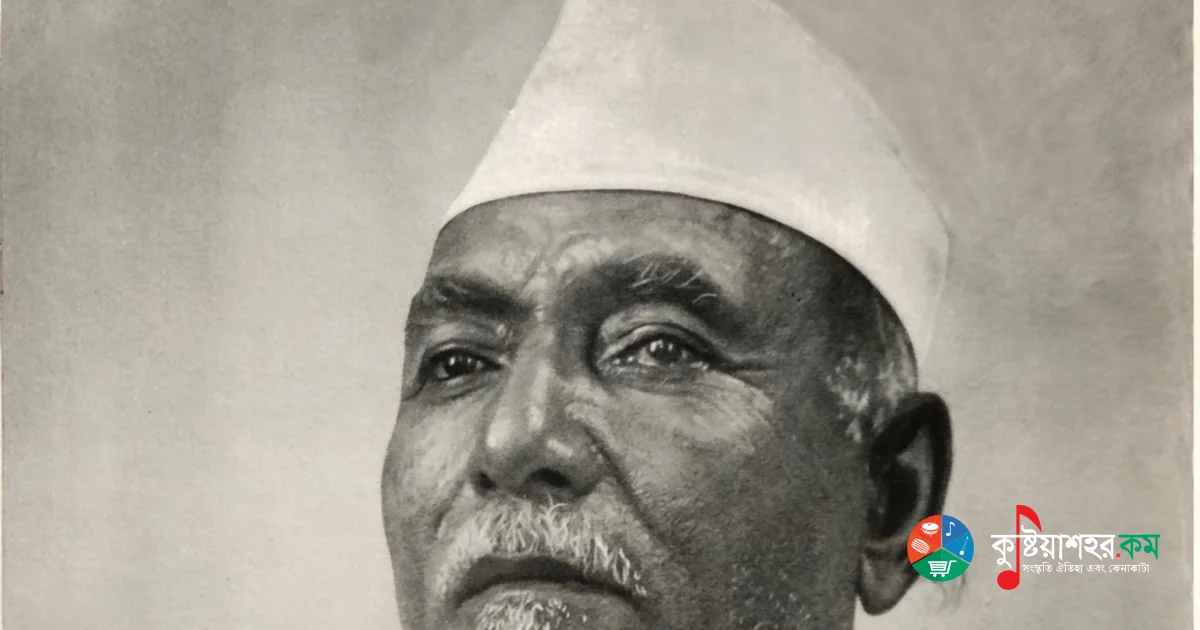
Few figures in the history of Hindustani classical music have ranged as wide as Ustad Allauddin Khan — a musician who played the sarod, sitar, flute, shehnai, violin and even the saxophone, rebuilt old instruments, invented new ones, composed new ragas, and trained the most extraordinary lineage of disciples the music world has seen: Ravi Shankar, Ali Akbar Khan, Nikhil Banerjee, Pannalal Ghosh and Annapurna Devi. The guru of all of them, the "Sur Samrat" (Emperor of Melody), was a Bengali — born in the village of Shibpur in Brahmanbaria district, in a family of musicians. The child who ran away from home at ten in search of music spent the last half of his life in the hill town of Maihar in Madhya Pradesh, where he built the world-famous Maihar gharana — and earned a single, affectionate name from generations of listeners: Baba.
A child who ran away in search of music
According to Banglapedia, Allauddin Khan was born in 1862 in the village of Shibpur in Nabinagar upazila of present-day Brahmanbaria district, into a family of musicians. His father Sabdar Hossain Khan, known as Sadhu Khan, was himself a noted musician — a disciple of Kasem Ali Khan, a rabab player of Tansen's daughter's lineage; his mother was Sundari Begum. Among five brothers and two sisters, this middle son's childhood nickname was "Alam". Books could not hold his attention; the young boy's heart ran to music, and his first lessons came from his elder brother Fakir Aftabuddin Khan. The English Wikipedia preserves a vivid picture: enrolled in school at five, he would slip away to sit in the Shiva temple of Shibpur instead of studying. Eventually, at the age of ten, he ran away from home to join a travelling jatra (folk theatre) troupe. Those wandering years introduced him to jari, sari, baul, bhatiali, kirtan and panchali songs — the very vocal traditions that later shaped his instrumental playing.
Historians do not fully agree on his birth year: Banglapedia and Bengali Wikipedia give 1862, while other accounts cite 1872 or 1881. Whatever the exact date, one thing is certain — across nearly a century of life he carried the world of Hindustani music through two or three generations of upheaval.
Seven years in Calcutta: mastering every instrument
The search for music finally led to Calcutta. There he became a disciple of the vocalist Gopal Krishna Bhattacharya, known as Nulo Gopal, whose only condition for accepting a student was years of uninterrupted dedication. Seven years of vocal training ended when the guru died of plague. Allauddin then abandoned vocal practice and began a campaign of instrumental study that Banglapedia sums up as making him a master of every instrument. Under Amritlal Dutta (Habu Dutta), music director of the Star Theatre, he learned the flute, picolo, sitar, mandolin and banjo; under Lobo, a Goanese band master, the violin in the Western style, and under the musician Amar Das in the Indian style; from Mrs Lobo he learned staff notation. In the same period he studied the shehnai, nakara, tikara and jagajhampa with Hazari Ustad, and the mridangam and tabla with Nanda Babu. At one point, drifting for the sake of music, he even worked — under a pseudonym — as a tabla player at the Minerva Theatre. This encyclopedic versatility is what later made him not just a sarod master but a universal teacher of music.
From Muktagachha to Rampur: the sarod and Tansen's line
His life turned when the zamindar Jagat Kishore Acharya Chowdhury of Muktagachha in Mymensingh invited him to perform at his court. There he heard the famous sarod maestro Ustad Ahmad Ali Khan play — and his heart settled on the sarod. Jagat Kishore presented him with a sarod, and Allauddin took five years of training under Ahmad Ali Khan. Then the road ran long to the north: Rampur, where he became a disciple of Ustad Wazir Khan, court musician to Nawab Hamid Ali Khan and a descendant of Tansen. In Banglapedia's account he spent as long as thirty years mastering the most intricate subtleties of the Senia gharana — the tradition founded by Tansen himself. The English Wikipedia adds a detail of courtly drama: Wazir Khan initially refused him, and only after a "Nara" ceremony arranged by the Nawab could Allauddin be accepted as a disciple. Through those decades he composed prolifically, signing his songs with the pen-name "Alam" — his childhood nickname.
1918: a new musical republic at Maihar
In 1918 the Nawab of Rampur sent him to the princely state of Maihar in central India. Raja Brijnath Singh of Maihar seated Allauddin Khan in the position of his own music guru, and he settled there permanently for the rest of his life. The English Wikipedia preserves vivid details of the court: he declined a salary — the Maharaja granted him land instead — and, according to legend, once threw a tabla tuning hammer at Brijnath Singh over a mistake in a performance.
In the same year, Allauddin Khan gathered children orphaned by the 1918 influenza pandemic and founded the famous Maihar Band — an ensemble in the style of an orchestra, built entirely from Indian instruments. Under his guidance new instruments were invented: Banglapedia names the Chandra Sarang and Sur Shringar, the English Wikipedia adds the Nal Tarang, Saranga and Sitar-Banjo. The band embodied his deepest belief: that music should not be a privilege of the leisured, but a livelihood offered to the destitute. Later in life he also founded the Maihar College of Music in Maihar and served as its all-in-all director — Banglapedia calls this one of the greatest contributions of his musical life.
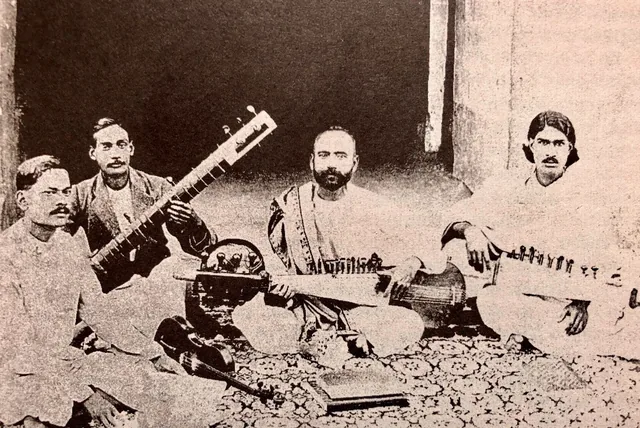
Ustad Allauddin Khan with his early disciples at Maihar, 1920s (Image: Wikimedia Commons, public domain)
1935: the world stage with Uday Shankar, and the title of Sur Samrat
In 1935 he toured the world with the dance troupe of Uday Shankar — by Banglapedia's reckoning, the first time the raga music of the subcontinent was presented to Western audiences. Around the same era he played sarod in the background score of Kalpana, the classic dance film directed by Uday Shankar. Bengali Wikipedia relates that it was during this world tour that he received the title of "Sur Samrat" (Emperor of Melody) from the Queen of England — the name by which the subcontinent has remembered him ever since. Earlier, the British government had honoured him with the title of "Khan Saheb" (Banglapedia).
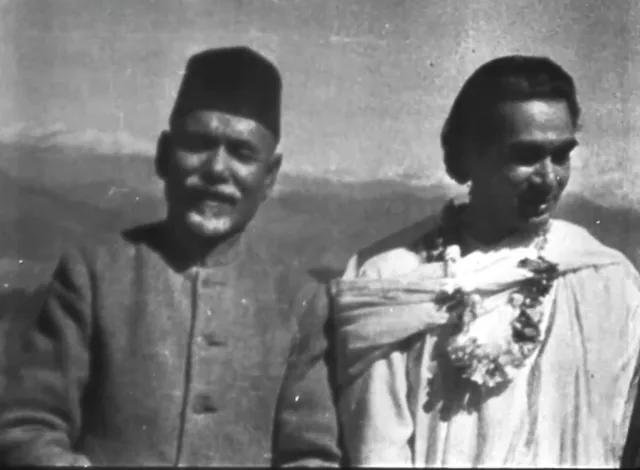
Ustad Allauddin Khan with the dancer Uday Shankar, 1935 (Image: Wikimedia Commons, public domain)
The Maihar gharana: his greatest creation is a list of disciples
Allauddin Khan did not merely play; he changed how instruments speak. On the sarod he replaced the "diri diri" technique of plucking with a new "dara dara" method, and applied the sarod's technique to the sitar, transforming sitar playing (Banglapedia). The English Wikipedia records that under his hand the sarod gained fifteen sympathetic strings, and the sitar a deep kharaj bass string. His training was legendary for its severity: disciples were forbidden to play the alap section for years, and fingers bled from relentless practice. The reward, however, was historic. Among his successful disciples (Banglapedia) were his son Ustad Ali Akbar Khan (sarod); his daughter Annapurna Devi (surbahar), whose husband was the sitarist Pandit Ravi Shankar; Nikhil Banerjee (sitar); Pannalal Ghosh (flute); his nephew Bahadur Hossain Khan; Sharan Rani; Timirbaran; Pandit Jotin Bhattacharya; Ustad Fuljhuri Khan; Ustad Khadem Hossain Khan; Ustad Mir Kashem Khan; grandsons Aashish Khan and Dhanesh Khan; the violinist V. G. Jog; and even Sri Lanka's celebrated musician W. D. Amaradeva. He also created new ragas — Hemant, Durgeshwari, Meghabahar, Prabhatkeli, Hem-Behag, Madan-Manjari, Muhammad (Aradhana), Manjh Khamaj, Dhabalshri, Shobhabati, Bhubaneshwari and others (Banglapedia). The raga Madan-Manjari, named after his wife Madina Begum, remains one of the tenderest memories of his life.
The Bengal connection: Santiniketan to Dacca's Bardhaman House
Much of this great life was woven back into Bengal. At the invitation of Rabindranath Tagore he served as a visiting professor at Visva-Bharati in Santiniketan, and Dhaka University's Salimullah Muslim Hall granted him lifelong honorary membership (Banglapedia). In 1955 he toured Dacca — a visit preserved today in a handful of photographs: the moment he sat with the folk singer Abbasuddin Ahmed and the writer-professor Motahar Hossain Chowdhury at Bardhaman House of Dhaka University, and the moment he sat with the painter Zainul Abedin. These photographs, from the collection of Professor Rafiqul Islam of Dhaka University, are now preserved openly on Wikimedia Commons. Even in distant Maihar he did not forget his birthplace: in Shibpur he built a mosque and had a pond dug for drinking water, and the mosque still carries his memory (Banglapedia).
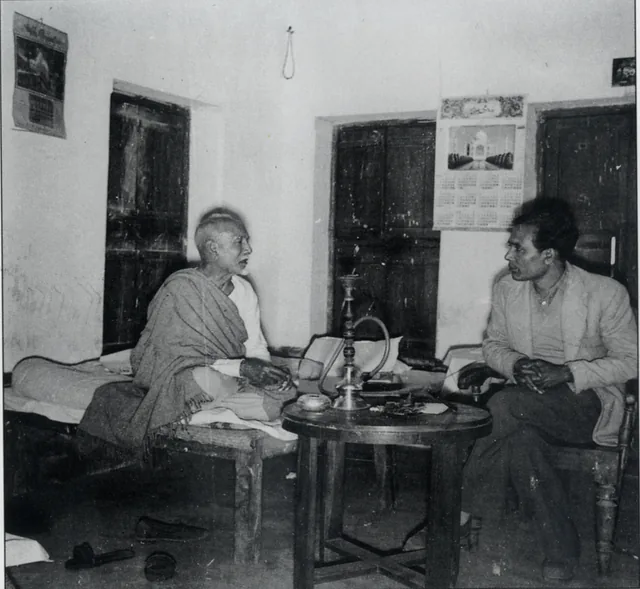
Ustad Allauddin Khan with the painter Zainul Abedin during his 1955 Dacca visit (Image: Professor Rafiqul Islam / Wikimedia Commons, public domain)
The honours, and "music is my caste, melody my tribe"
The list of honours is astonishing: the Sangeet Natak Akademi Award (1952) and election as a Fellow of the Akademi in its very first batch (1954); the Padma Bhushan (1958) and the Padma Vibhushan (1971) — by the English Wikipedia's account, the first Hindustani classical musician to receive the Padma Vibhushan; the title of Vadya Acharya from the Bhatkhande Music University (1944), the Desikottama of Visva-Bharati, an honorary D.Litt. from Rabindra Bharati University (1963), and a Doctor of Law degree from the University of Delhi (Banglapedia). Documentary films kept him alive on screen — Ritwik Ghatak's Ustad Alauddin Khan (1963) and Harisadhan Dasgupta's Baba Alauddin Khan (1965) — and in 1999 India Post issued a commemorative stamp in his likeness. He died in Maihar on 6 September 1972; the English Wikipedia notes that his funeral was attended by thousands of Hindus and Muslims alike.
His immortal words are the summary of this life — spoken by a man who offered namaz and played ragas of devotion to Hindu deities in the same breath: "Music is my caste, and melody is my tribe." The boy who grew up in the fields of Brahmanbaria, who had to run away from home to learn music, ended by opening the doors of music to the whole world — and the disciples he created are still playing that melody on stages across the earth.
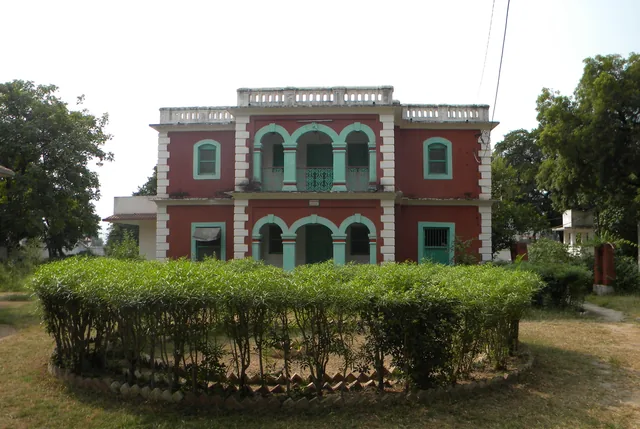
Ustad Allauddin Khan's residence at Maihar, Madhya Pradesh (Image: Ankit Saha / Wikimedia Commons, CC BY-SA 4.0)