বাংলা
 English
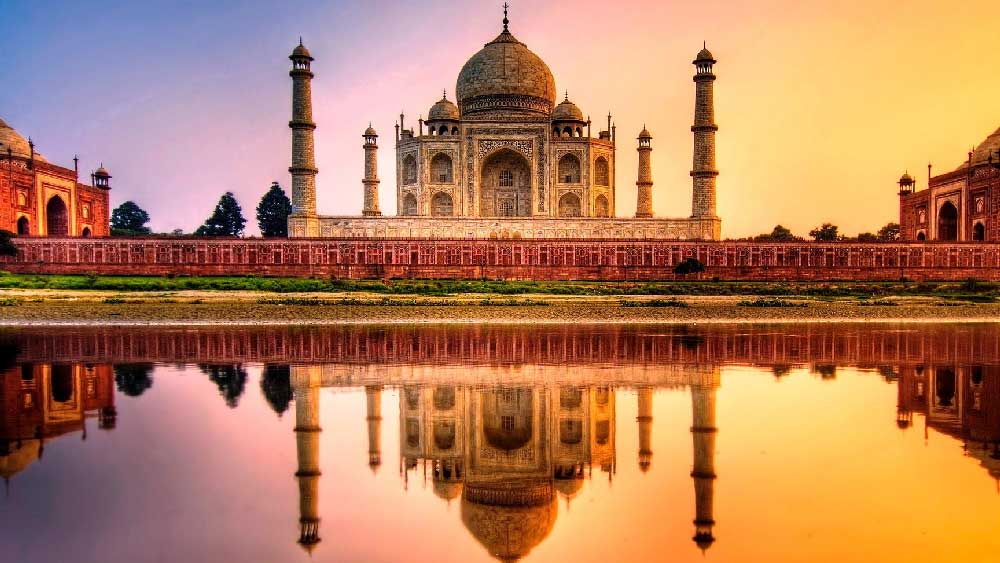
Be it daytime or a full-moon night, the beauty of the Taj Mahal is different at different times. The builder of this ancient monument of Agra was Mughal Emperor Shah Jahan himself. It was built at his command in memory of his late wife Mumtaz. Some say this mahal is a token of the emperor's love for his wife. In others' view, the emperor built this mahal out of remorse after the death of his tormented wife. On all this, different sages hold different opinions. In the nooks and corners of this memorial made of white stone lie hidden various facts, various mysteries and tales of various unknown history.
On a full-moon night the beauty of the Taj Mahal cannot be expressed in words. "Not a drop of tear - upon the cheek of Time gleams this shining white Taj Mahal."
World poet Rabindranath Tagore gave exactly this simile while describing the beauty of the Taj Mahal. But to tell the truth, however much description one hears, one cannot grasp how beautiful the Taj Mahal really is without seeing it with one's own eyes. Thousands of foreigners come to this country just to lay eyes once on this seventh wonder of the world. The locals too cannot resist the temptation of seeing the Taj. Be it daytime or a full-moon night, the beauty of the Taj is different at different times. From that bygone age to this one, tourists cannot resist the urge to take photographs in front of the Taj Mahal.
The king of several begums, Shah Jahan had a married life of 19 years with Mumtaz Begum, his third wife. Yet in only 19 years of married life Mumtaz bore Shah Jahan 14 children. Needless to say, it was for this very reason that she was physically extremely weak. Unable to bear the physical strain, Mumtaz Begum lost her life at only 39 years of age while giving birth to a child.
It was after the death of this third wife that the Mughal Emperor Shah Jahan began building the Taj Mahal in 1632 in her memory. About 20 thousand people were engaged in building the Taj to turn his dream into reality. The mahal took about 20 years to build. The work of building the Taj Mahal was completed in 1653, although another two years were needed to finish minor works. It cost about 3 crore 20 lakh rupees to build it.
The Name of Allah Across the Mausoleum
Most of the calligraphy used on the Taj Mahal's walls was taken from the Quran Sharif, the holy book of the Muslim faith. Besides the walls of the Taj Mahal, such verses were also carved on the tombs of Mumtaz Mahal and Emperor Shah Jahan. At various places of the Taj Mahal, the 99 different names of Allah are carved as calligraphic inscriptions.
In 2007 UNESCO listed the world heritage Taj Mahal among the seven wonders of the world. The Taj Mahal secured this place through 100 million votes. One of India's most scenic and beautiful monuments, the Taj Mahal draws about 4 to 8 million visitors to India every year. At special times more than 40 to 50 thousand visitors a day view this mausoleum.
Construction of the Taj Mahal
The materials used for building the Taj Mahal were brought mainly from India and from various places across the continent of Asia. It is said that more than 1,000 elephants were used to transport these construction materials. The marble stones required for building the Taj Mahal were bought mainly from various countries and various places of India.
Among them, the transparent white marble was bought from a place called Makrana in Rajasthan. Jet and crystal were bought from China. Jemper was bought from Punjab. Lapis lazuli from Afghanistan, and carnelian from Arabia. And the marble stone known as firoza was bought from Tibet.
The Mystery of the Graveyard
Not only Mumtaz; Shah Jahan's other wives and favourite servants were also buried in the Taj Mahal. However, these lie in the outer part of the Taj Mahal. Although almost every part of the Taj Mahal is symmetrical, the graveyard is not symmetrical. According to Islamic tradition, a grave should never be decorated. Perhaps for this reason Shah Jahan and Mumtaz were buried in a flat tomb chamber below, in the interior room of the Taj Mahal.
Inside the Taj Mahal, Lord Curzon's name is carved on a lamp. The stone weighs about 60 kg and is placed right in front of the Taj Mahal's main door, so that visitors can see it as soon as they enter the Taj Mahal.
The Taj Mahal's four pillars or minarets stand not straight but slightly tilted outwards. The main reason behind building them this way is that no natural disaster such as an earthquake should be able to damage them in any way.
The Taj Was Hidden During the War
Many believe that during the Sepoy Mutiny of 1857 a number of British soldiers took away the precious stones from the walls of the tomb.
So that it would not be destroyed, during the Second World War the Archaeological Survey of India covered the Taj Mahal with a bamboo scaffold. From above it looked like a stock of bamboo. In the same way the Taj was covered during the war of 1971.
For century after century, this monument of love has faced neglect or decline. Among Indo-Islamic architecture, the Taj Mahal is the largest structure. Its construction is so flawless and beautiful that it sets it apart from all other architecture. There are dense clouds of mythological tales about it. There are some fascinating facts about this world-famous monument which everyone should know. Take a look at them at a glance:-
# The Taj Mahal's construction began in 1632 and was finished in 1653. It took a total of 22 years to complete the construction of this monument.
# The Taj Mahal's architecture is a blend of Indian, French and Islamic styles.
# The Taj Mahal's architect was Ahmed Lahauri.
# About 20 thousand people worked day and night for 22 years to complete the construction of the Taj Mahal.
# The construction of the Taj Mahal cost about 320 million rupees.
# The Taj Mahal was built using marble of the finest quality from Rajasthan, Tibet, Afghanistan and China.
# The Taj Mahal appears in different colours at different times of the day. Some believe these changing colours depict the changing moods of a woman.
# The Taj Mahal is one of the wonders of the world and is marked as a UNESCO world heritage site.
# There was a popular myth that Shah Jahan planned to build a black Taj Mahal across the Yamuna; this is not true.
# Another popular legend surrounds the Taj Mahal. One of these is that after the construction of the Taj Mahal, Shah Jahan cut off the hands of all the workers so that no such structure could ever be built again. Fortunately, this is not true.
# There is a mosque within the Taj Mahal's premises, which is why the Taj Mahal remains closed on Fridays and only those going for customary prayers are allowed inside the Taj Mahal.
# In the late 19th century the Taj Mahal was vandalised by British soldiers. Precious stones were pried from the monument's walls. In the late 19th century the British Viceroy, Lord Curzon, ordered the monument restored and also gifted a large lamp hung in the interior chamber of the Taj Mahal.
# In 2000 the Indian writer P. N. Oak claimed that the Taj Mahal was in fact a Shiva temple and filed a petition in the Supreme Court of India to excavate the Taj's site for evidence. The Supreme Court dismissed his petition.
# In 2001 UNESCO recorded more than two million visitors at the Taj Mahal.
# India's Nobel laureate Rabindranath Tagore referred to the Taj Mahal as "a teardrop on the cheek of time".
# The calligraphy on Mumtaz's tomb identifies and praises her.
# The Taj Mahal's four minarets were built slightly outward so that if the minarets fell, they would fall away rather than onto the main structure.
# After his death, Shah Jahan was laid to rest in the Taj Mahal beside the tomb of his wife Mumtaz.