বাংলা
 English
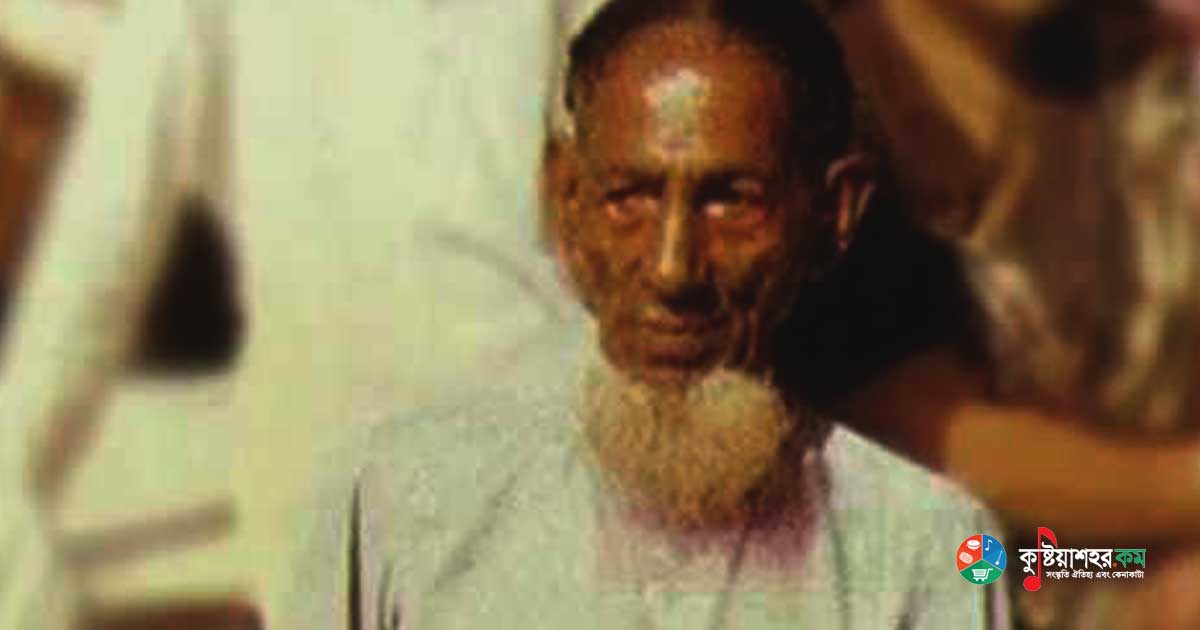
His name was Gagan Das. His home was in Shilaidaha, Kushtia. He was born around 1845 into a Kayastha family of Arpara village and died in 1910.
It was around the middle of the nineteenth century. Not much is known about his parents. However, the name of one of Gagan's sons, Kiran Chandra Das, is known. Even two decades ago the homestead of Gagan and the traces of its orchard still existed. It is said by word of mouth that Gagan Harkara had a large fruit orchard.
It is worth noting that a farmer named Asamuddi lived at Gagan's homestead, and that house is still known as 'Dasher Bhita' (Das's homestead); at that time the Dases were also known as 'Mol'. Sachindranath Adhikari of Shilaidaha wrote that Gagan was versed in only rudimentary education, and as a result of it he obtained the post of dak-harkara (post courier) at the then post office of Shilaidaha.
He delivered letters from village to village and also sang. At Shilaidaha he sang 'Sokhi Sangbad' with such mournful expression that listeners were captivated by the song. About Gagan, the scholar Kshitimohan Sen Shastri said, 'One of the line of Lalan's disciples was Rabindranath's dak-harkara of Shilaidaha, whose name was Gagan. Rabindranath introduced Gagan to everyone in various ways, made him famous and gave him as much recognition as he could.'
From 1889 to 1901 Rabindranath Tagore went regularly to Shilaidaha and Shahzadpur in Bangladesh to look after the zamindari. It was then, at Shilaidaha, that Gagan met him. Gagan sang for him. At Shilaidaha, through Rabindranath Tagore, Gagan Harkara came to know Gosain Gopal, Sarbakhepi Bostomi, Gosain Ramlal and countless disciples of Lalan.
Rabindranath's first meeting with Lalan's disciples took place then, and from the very beginning of these meetings Gagan came to know Rabindranath. Enriched by listening to the songs of the Bauls and fakirs, he himself collected and spread many Baul songs from the Shilaidaha and Cheuria regions. Later he arranged for them to be published in various newspapers and periodicals. The aim was one and the same: that the educated society should form some idea of the Baul songs of Bangladesh.
In the introduction to Professor Monsur Uddin's book Haramani, Rabindranath wrote: 'When I was at Shilaidaha, I constantly met the Baul party and conversed with them. In many of my songs I have taken the tunes of the Bauls, and in many songs, knowingly or unknowingly, my melodies have merged with those of the Bauls.' From this it can be understood that the tune and message of the Bauls had, at some time, mingled naturally within my mind.
Among Lalan's disciples, Rabindranath liked Gagan the most. About Gagan Harkara's song 'Kothay Pab Tare Amar Mone Manush Je Re' he wrote that the words are utterly simple, yet through the melody their meaning rises radiant in matchless light. This very saying is heard in the language of the Upanishads: 'Tam bedyam purusham beda ma bo mrityuh paribyathah.' Know the very person whom you ought to know, or else you shall know the pain of death. From Apati's mouth I heard these words in his rustic tune and simple language: the one whom you must know above all others, the pain of not knowing him above all others — the child who cannot see his mother in the dark, whose cry of pain rings in his voice. When I heard, from their mouths, the Upanishadic saying 'Antaratar yadayamatma' spoken of as the 'Man of the Heart', I was greatly amazed.
Coming to Shilaidaha, Rabindranath was influenced by Sain Lalan, and after Lalan he was influenced by Gagan Harkara. The new conception of religion that arose in his mind he found support for in the songs of the Bauls. Indeed, from that time on he even tried to harmonise the Bauls with the Upanishadic philosophy he cherished all his life. The echo of the truth he had heard in the verses of the Upanishads he found again in Baul songs. To the tune of Gagan's song 'Ami Kothay Pab Tare', Rabindranath composed 'Amar Sonar Bangla / Ami Tomay Bhalobashi'.
Earlier, Sarala Devi had published the musical notation of the original song in Shatgan (Baishakh 1307). Rabindranath wrote: 'If we once examine the tunes of our Bauls, we shall find that the fundamental ideal of our music is preserved in them, and yet those tunes are independent. Now and then we catch hints of one raga or another, but they cannot be grasped. Many kirtan and Baul tunes come very close to baithaki songs and yet never touch them. By the ustad's law this is an offence. But the Baul's tune stands apart — however fiercely the ragas glare, what does he care!' These tunes may not be confined to the cage of any aristocracy of ragas, yet their lineage is never mistaken — it is clearly understood that this is the music of our own country, not the foreign tune.
In 1915 Rabindranath wrote the play 'Falguni' and in it played the character of a blind Baul. In 1916 Abanindranath Tagore painted a picture of Rabindranath. In the picture the Baul Rabindranath is seen dancing, entranced, with an ektara in hand. The song Amar Sonar Bangla Ami Tomay Bhalobashi was sung during the Partition of Bengal of 1905. Prashanta Pal wrote in his book Rabi Jibani that by then Calcutta was seething with Rabindranath's new swadeshi song 'Amar Sonar Bangla Ami Tomay Bhalobashi'. The manuscript of the song has never been found, nor is the date of its composition known. Satyen Ray wrote: at the meeting held at Calcutta's Town Hall on 7 August (1905 AD) in protest against the Partition of Bengal, Rabindranath's new song 'Amar Sonar Bangla' was sung to a Baul tune on that occasion. The song was first published under Rabindranath's signature in the newspaper 'Sanjivani' dated 7 September 1905 (22 Bhadra of 1312).

O mind, lost in unfeeling attachment, you will remain.
Ami Kothay Pab Tare... (Gagan Harkara)
It could never be established from whom Gagan took his training in song, but Gagan was a great devotee of Lalan's songs. Rabindranath Tagore was very fond of the songs of Lalan and Gagan and of Gagan's company. Poet-guru Rabindranath Tagore was a great admirer of Gagan's songs; he would listen to Gagan's and Lalan's songs from Gagan himself.
Influenced by the tune of Gagan's song Ami Kothay Pab Tare, Rabindranath Tagore wrote Bangladesh's national anthem. That Rabindranath Tagore wrote the play 'Dakghar' under the influence of Gagan Harkara's life is proved by the character Gagendranath Thakur in the play. In Gagan's songs, man and his society were what mattered most.
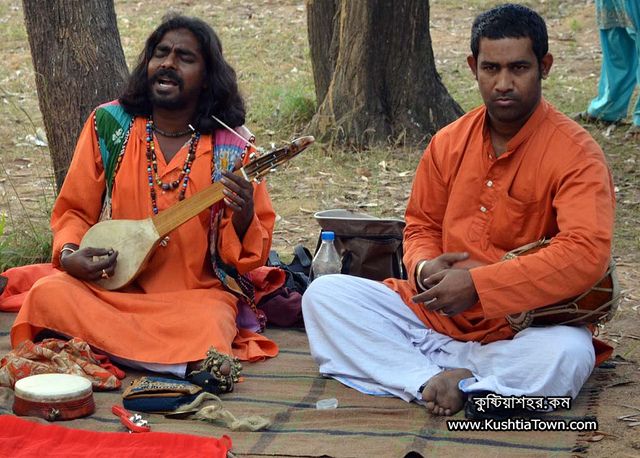
Gagan believed that in the midst of all human beings dwells the Man of the Heart. He gave humanism the highest place above all else. There is no accurate record anywhere of how many songs he composed. It is presumed that the Man of the Heart is mentioned in many of his songs.
He believed that the Man of the Heart has no religion, caste, race, gender or lineage. Man's visible body and the invisible Man of the Heart are separate from each other. 'God dwells in the heart of every human being.' The philosophy of this expressed in Gagan Harkara's songs cannot be brought within any religious creed. Lalan conceived of the human soul as a mysterious, unknown and untouchable being.
In the song Khachar Bhitor Ochin Pakhi (the unknown bird within the cage), he compared the being within the mind to a bird that moves freely in and out of the cage-like body and yet can never be caged. Gagan thought exactly the same.
Delivering letters all day and practising the Man of the Heart was Gagan's only work. In the times of Lalan Sain and Gagan, all manner of oppression, the unresisting passivity of men, religious bigotry and superstition, greed and self-centredness stood as obstacles before the society of that day and its progress.
Just as Lalan questioned the various customs of society through his songs, so too there was questioning in Gagan Harkara's songs. For this reason their struggle attracted many genteel zamindars, historians, editors, intellectuals and writers, and even the unlettered common people of the villages.
In a spiritual vein Gagan composed a great many songs. In these songs of simple, plain words are expressed the mysteries of human life, humanity and a non-communal outlook. From Gagan's writings it can be inferred that he was extremely sensitive about religion, clan, race and sect. When, in the British era, communal discord and conflict between Hindus and Muslims was growing, Lalan was a protesting voice against it. He did not believe in any discrimination between one human being and another.
The essence of Lalan's humanist philosophy is man. And to spread this philosophy he chose art. Baul Gagan Harkara was bound up in the very fibre of this ideal and its spirit.
It was a bustling noon at the kuthi bari of Shilaidaha. Deputy Magistrate Dwijendralal Ray had come to the house as a guest. He was a friend of the zamindar, and busy people were engaged under his supervision. At such hospitality there was, of course, song and music. Dwiju-babu did not have to be asked twice. Jokes, plays and songs lived in the nib of his pen; he had only to sit down and spread out paper. Playing the harmonium, he performed with much relish 'Bahba, Bahba Nandalal' (Bravo, Bravo Nandalal). Everyone began to cry bravo, bravo.
The zamindar-moshai's throat was a little sore today. He said to his friend, 'You have heard my songs many times; today listen to his.' Pointing to a lean, gaunt man sitting huddled on the farash, he shrank back even further, his look as if to say, 'Are you really calling me?' Everyone in the area knew him. Dwiju-babu was introduced to him: 'This is the post courier of the local post office; his name is Gagan. You have surely heard the songs of Lalan Fakir; now listen to his.' Glancing once at Gagan, who offered his namaskar to someone, Gagan struck up his song.
Where shall I find him,
the Man of my Heart!
Having lost that man, in search of him
I wander from land to land and abroad,
Absorbed in that moon of my heart, my life ever yearning;
If I found him, how happy my heart would be, filling my eyes.
I am dying in the fire of love, dousing the flame and kindling it again — what a state
I die, alas, alas
In his separation, how my soul aches
O see, friends, how it rends the heart.
...A song of a soaring voice, a song of the soul, the song of this very earth. For a long while after it ended, no one could find words.
When the ceremony and the feasting were over, they went out for a stroll around the neighbourhood with Dwiju-babu. Dwiju-babu was an educated man who had come after studying agriculture abroad. He said to his friend: 'Here on the river's char there is so much fertile silt, gone to waste as a jungle of kachu weeds. Clear it and cultivate potatoes here. I shall send good potato seed; you will see, it will grow very well here.'
The zamindar-moshai nodded his approval, whereupon a crowd of people came from somewhere and set about clearing that mankachu jungle. At the time of farewell, along with other keepsake gifts, that mankachu was given to each of the guests. The zamindar-moshai said, 'This is our most ancient food. Of course I shall cultivate potatoes here, but it would be wrong to neglect this. What a variety of delicacies can be prepared from it — do try.' The zamindar's wife smiled gently, listening from behind. Only a few days earlier, at the insistence of his stubborn wife, he had been made to make a mankachu jilipi; in that test he had passed with honour.
A few weeks later there was a musical soiree again at that house. Dwijendralal, Gagan, the mandal of the para and the postmaster — all had come. Dwijendralal's wife had cooked a kalia of mankachu; the mandal's wife had brought kopta made of mankachu.
Today the zamindar-moshai did not have to plead with Rabindranath. Before anyone could say anything he struck up a song: 'The king grants honour to all; may you regain that honour...'
Gagan Harkara was altogether unlike other men. After finishing his deliveries he would go to Lalan Sain's akhra and sing for the joy of his heart. He thought his liberation lay in song. Gagan's habit was to sing as he walked, the sack of letters on his shoulder through the midday heat — anyone hearing his song from afar knew it could be none other than Gagan. Men of learning such as Mir Mosharraf Hossain and Kangal Harinath were captivated by this song of Gagan's.