বাংলা
 English
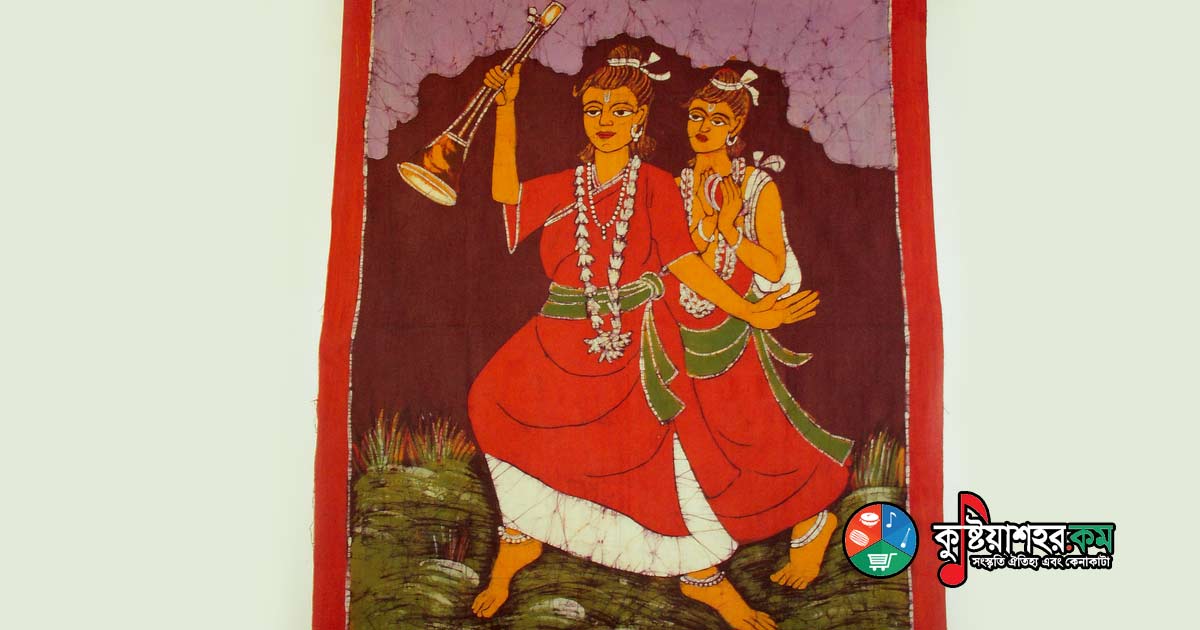
The Baul doctrine is called a Purana of the mind. The consciousness that dwells in the vessel of the body is itself the soul. The search for this soul is the principal aim of the Baul doctrine. Seen from a religious standpoint it appears to be a distinct philosophy. But in fact it is not any distinct creed.
It is an emanation of the thought of the created soul, distinct from religious philosophy - which is essentially the manifestation of the inner consciousness of the soul. Researchers have written about it in works on the folk literature and folk history of Bangladesh, on Lalan Shah's biwecchana (realization) and the purbabiwecchana (ancient realization); on the other hand, the Sufi doctrine was born in revolt against royal power. Persia, Central Asia and the Middle East nurtured it. Later, while it kept advancing towards the East, the mingling of ancient Oriental thought kept taking place in it. Crossing into scorching Asia, the esoteric song was transformed into the Charya songs. Then, with the arrival of the Sufi dervishes of the Middle East through the Turkish conquest, the humanism of the Buddhist siddhacharyas mingled with Sufism and was transformed in bhava-sangeet (emotional song). As a result, the Sufi philosophy came to be highly complimentary to Buddhism.
Once, on one side Sufism and on the other side Buddhist sadhana, all of these together grew into mystic bhava-sadhana. Researchers Syed Mustafa Kamal, Dr Ashraf Siddiqui and many others nourish this view; in the early middle ages Chaitanyaism spread in India through the fertile land of Bengal in the fifteenth century. Then the Vaishnav religion manifested itself through the mingling of the Bhagavat religion, the Adi Ram religion and the Krishna religion. Thereby ancient mysticism merged indissolubly in the Vaishnavi method of sadhana.
Consequently, words of mystic literature such as purbarag (first love), anurag (attachment), bangshi (flute), birah (separation), dehkancha (the cage of the body) and soya-moyana, etc. are given direct due importance in the name and meaning in Vaishnavism or Vaishnav literature. In this way, songs composed with a vocabulary steeped in the mysticism of mystic thought manifested as Baul songs and gave birth to a new community, known today by the name Baul. Many think that 'Baul' may have derived from 'Bahul' or 'Byakul'.
Again the word may also have come from the Arabic 'Aul' or the Hindi 'Baur'. Whatever the etymological meaning may be, essentially its meaning is this: a group of truth-seeking sadhaks, free of the marks of caste or community, wanderers. The medium of the expression of the minds of the Bauls is the inner-consciousness songs known by the name Baul songs. On this Dewan Mohammad Azraf said: controversies have now arisen among various debates over the origin of the word Baul. Some think it is the apabhramsa of the Sanskrit word 'Vatul' (unbridled, mad, agitated, frivolous, undisciplined). But whatever the origin of the word Baul, today the Baul doctrine has been transformed into a distinct doctrine.
Period of origin
The time of origin of the Baul and Baula doctrines is estimated to be the 16th century. Professor Upendranath Bhattacharya holds this view in the book 'Banglar Baul O Baul Gan' (The Bauls of Bengal and Baul Songs). Rabindranath Tagore believes that the Bauls emerged from the Mahayan followers of the Buddhists. The Bauls have various branches and sub-branches.
In about 1470 AD, Jagomohan Gosai was born in the village of Baghasura of Madhabpur upazila in Habiganj district. His father's name was Sudhabananda and his mother's name Kamala. He is considered the pioneer of the Jagomohini Baul community. He is also credited as the pioneer of the Adi Vaishnav religion. His akhra exists in the village of Machhulia of Habiganj Sadar upazila. It is known that he performed penance sitting in the Bijanban of Machhulia. He had two sons named Shyam and Sudam. To learn about their father, they returned and practised austerities near Jagomohan in the forest of Machhulia. At the pitiful cry of father and son, Gobinda Gosai, the first disciple of Jagomohan Gosai, beheld it.
Eventually, in the lap of Jagomohan Gosai, his first disciple Gobinda Gosai took initiation. Jagomohan's disciple Gobinda Gosai, Gobinda's disciple Shyam Baul Gosai, Shyambaul's disciple Ramkrishna Gosai. The main mantra of the initiation of the Jagomohini community is 'Guru Satya' (the guru is truth). One disciple of Jagomohan Gosai was Ramkrishna Gosai. Birthingal of Banaiachang upazila holds his main akhra. Under this akhra there are nearly forty branches and akhras, small and large. There were and are many Baul, Vaishnav and Vaishnavis of this community in Habiganj, Netrakona, Kishorganj and Sunamganj. Twelve branches have been established in the names of Ramkrishna Gosai's twelve disciples. There is also a large akhra of this community in Faridabad of Dhaka.
Beliefs of the Bauls
The origin of the Bauls is the Jagomohini community, whose main mantra of initiation is 'Guru Satya'. These people worship the guru's paduka or footwear with care and devotion. Marriage is also in their own way. They do not attach importance to any kind of caste distinctions. Among them there is no question of untouchability either. The Bauls of this community are divided into three parts: grihi (householder), sanyogi and udasi. This is a very ancient division. They believe that in this one life the love of the Creator is sufficient, but that love cannot be found very easily. For this, abundant sadhana must be performed.
In later times (estimated: from the beginning of the 19th century) the influence of one class of Muslim Bauls prevailed among them. As a result, even though the Baul poets were Muslim, they did not attach importance to the injunctions and prohibitions of Islamic Sharia. These faqir groups are divided into different communities and sub-communities, such as Aul, Baul, Kartabhaja, Sahajiya and so on. These attract ordinary people through various kinds of witty and eloquent language.
(For larger reading: essay - Vaishnav Tirtha, Birthingal Akhra Darshane: Nikunj Bihari Goswami. Selected words: Krishna Kumar Pal Chowdhury. History of the Muslims of Bengal: Abbash Ali Khan, page 66, sixth edition. Selected towns and parts in sequence: essay - in search of the origin of the Sheikh, Abhiatra, Hachhan Rajar Bari: Syed Mustafa Kamal.)