বাংলা
 English
Barak Valley of Bangla Language Movement
The Bengali Language Movement in the Barak Valley of Assam was a protest against the Assam government's decision to make Assamese the sole official language of the state, since the majority of the region's population was Bengali-speaking. The most significant event of this mass movement took place on 19 May 1961, when the Assam provincial police shot dead eleven protesters at Silchar railway station.
Events of 1960-61
Background
In April 1960, a proposal was introduced in the Assam Pradesh Congress Committee to declare Assamese the sole official language of the state. Tension grew in the Brahmaputra Valley. Excited Assamese mobs attacked Bengali migrants. When the violence took a severe turn in July and September, some 50,000 Bengali Hindus fled the Brahmaputra Valley for West Bengal. Another 90,000 fled to the Barak Valley and elsewhere in the north-east. A one-man commission of inquiry was formed under Justice Gopal Mehrotra. According to the commission's report, 4,019 huts and 58 houses in 25 villages of the Goreswar area of Kamrup district were destroyed and attacked; this district was the worst affected area of the violence. Nine Bengalis were killed and more than a hundred people injured.
On 10 October 1960, Bimala Prasad Chaliha, the then Chief Minister of Assam, tabled a proposal to recognise Assamese as the sole official language of Assam. Ranendramohan Das, the legislator from North Karimganj, strongly opposed the proposal. But on 24 October the proposal was adopted in the Legislative Assembly.
Beginning of the movement
To protest against the imposition of Assamese on the Bengalis of the Barak Valley, an organisation called the Cachar Gana Sangram Parishad was born on 5 February 1961. Against this injustice of the Assam government, on 14 April the people of Silchar, Karimganj and Hailakandi observed Resolution Day. To create awareness among the people of Barak, on 24 April the Parishad began a long foot march. The march, which ended on 2 May, saw the satyagrahis taking part cover nearly 200 miles, going from village to village across the valley campaigning. At the end of the march the Parishad's chief leader Rathindranath Sen announced that if Bengali was not declared an official language by 13 April 1961, they would hold a mass hartal on 19 May. On 12 May the Assam Rifles, the Madras Regiment and the Central Reserve Police carried out a flag march in Silchar. On 18 May the Assam Police arrested three leaders of the movement: Nalinikanta Das, Rathindranath Sen and Bidhubhushan Chowdhury (editor of the weekly Yugashakti).
The events of 19 May
On 19 May hartal and picketing began in Silchar, Karimganj and Hailakandi. In Karimganj the agitators picketed government offices, railway stations, courts and the like. In Silchar they held satyagraha at the railway station. The hartal was to end after the train scheduled for 4 p.m. had passed. Not a single ticket was sold for the 5:40 a.m. train. The hartal passed peacefully in the morning. But in the afternoon the Assam Rifles arrived at the station.
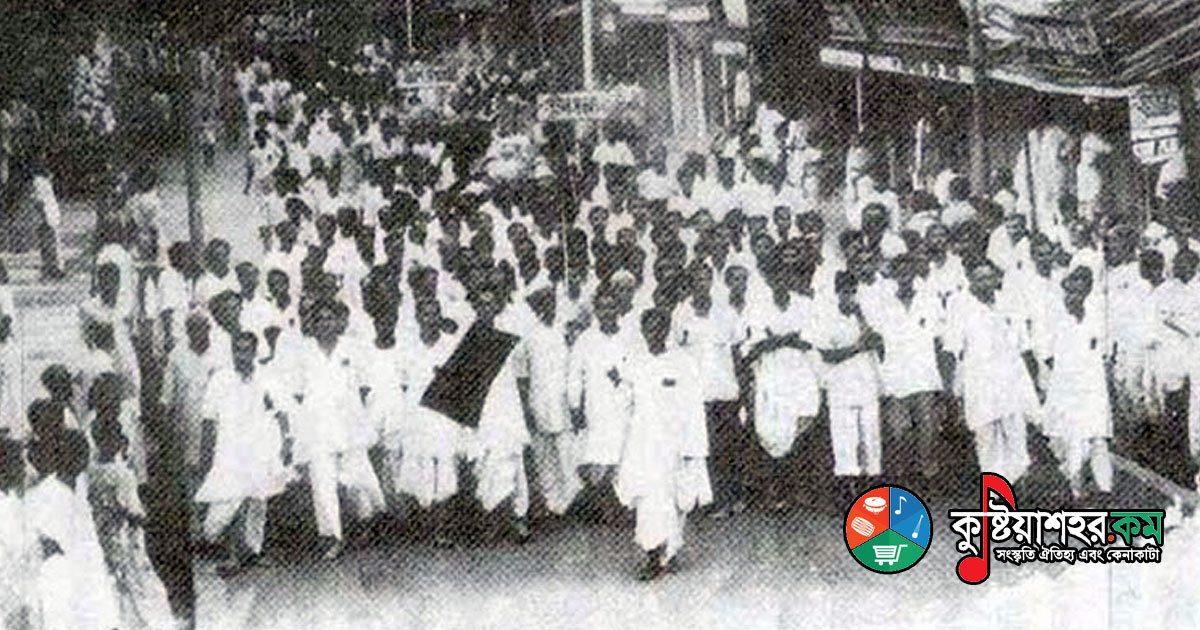
At about 2:30 in the afternoon, when a police truck carrying nine arrested satyagrahis from Katigorah was passing near Tarapur station (the present Silchar railway station), the picketers, seeing them being taken away under arrest, protested vehemently. Frightened, the police, along with the truck driver, fled with the prisoners. Then some unidentified person set the truck on fire, although the fire brigade arrived and promptly brought the blaze under control. Then at about 2:35 the paramilitary forces guarding the station began to beat the agitators with guns and lathis. Within the next seven minutes they fired 17 rounds at the agitators. Twelve people were hit by the bullets. Of them nine died that very day; two died later. On 20 May the people of Silchar, carrying the martyrs' bodies in a mourning procession, declared their protest.
After this incident the Assam government was compelled to declare Bengali an official language in the Barak Valley.
Aftermath
Every year, 19 May is observed as Bengali Language Martyrs' Day in the Barak Valley and in various parts of India.
Memorials
In 2011, on the occasion of the fiftieth anniversary of the Language Movement, on behalf of the Shaheed Kamala Bhattacharya Statue Installation Committee, Gopa Dutta Aich unveiled a bronze bust of Kamala in the courtyard of the Chhotelal Seth Institute.
List of martyrs
- Kanailal Niyogi
- Chandicharan Sutradhar
- Hitesh Biswas
- Satyendrakumar Deb
- Kumudranjan Das
- Sunil Sarkar
- Tarani Debnath
- Sachindra Chandra Pal
- Birendra Sutradhar
- Sukomal Purkayastha and
- Kamala Bhattacharya.
Besides, one more person laid down his life for Bengali in Assam itself on 17 August 1972:
- Bijan Chakraborty and
Two were martyred on 21 July 1986:
- Jaganmoy Deb and
- Dibyendu Das.