বাংলা
 English
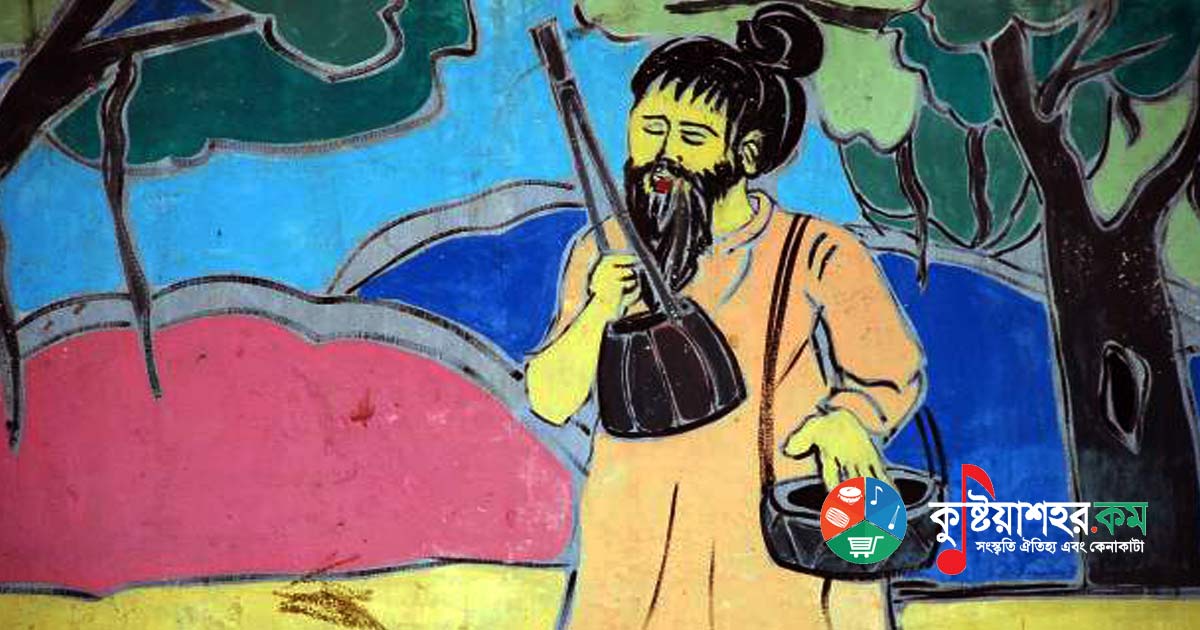
Lalon does not deny the body's hunger, thirst, desire and longing, yet neither does he wish to be the slave of body and senses. On the other hand the mind, to him, is an unrestrainable, unappeased, restless being that cannot be known or fathomed. All the while there runs there the misrule of six ministers. The mind therefore goes to the netherworld, fickle in the poison of objects. All search for nectar, but where is it? Again and again one only gets entangled in poison. So the sage performs sadhana holding the poison itself, with the longing to turn it into nectar. Without the sadhana of the body the mind is never purified, never calm, for the rasa-less mind remains subject only to the body. So the body must be mastered and known, its abode and chambers must be inquired into, the mystery of the body-river's current understood. Taught by the true guru in these hidden devotions of body-theory, the Lalon sage wishes to cross the turbulent Kamana river. A long journey.
In the sadhana of rasa the mystery of the exhaling kumbhaka is not all; the fakiri is not perfected merely in the steadfastness of preserving the seed. If one falls into a fierce storm, all these binding-and-casting barges flee in the mighty push of the waves. Then there is no way left but the trade of words. So Lalon, in this hour of great crisis, calls love the only refuge, the protecting armour of the farther shore. But the strength of love with which the turbulent river is easily crossed by the rasika magnate is no small thing. This love is drowned in pure raga. The lover of this love, dwelling in desire, is desireless, mad across the shore in causeless bhava-rasa. To show one stupendous example of it, Lalon again and again spoke of the love of the gopi-women absorbed in the thought of Krishna. In his view the gopis alone are the possessors of that priceless treasure, since the Lord Krishna is bound, bought on credit, only by their love.
The bhava of detachment is the Veda's rule
the gopi-bhava the unfeigned treasure.
In that the unbounded
rasika ones are drowned.
Him whom Yogindra, the lord of the mind,
cannot reach by yoga and contemplation
that Krishna at the gopis' doors
has been bought.
In exchange for the merit of former births the gopi women were born in the Dvapara age with only the hope of Krishna's darshan. Krishna's joy is their joy; if for this they must lose family honour and give up their own happiness, they will give even that - such is their state of mind. This love is causeless desire. This alone Lalon asks to be worshipped again and again. He in whom this love has sprouted, rising above the living essence, finds the search of an unknown 'my I'; this causeless desireless unknown I itself is the Sai-jewel.
Love is man's mysterious feeling and the chief mark of two divine qualities, 'freedom' and 'distinctness'. So that moral and aesthetic desirelessness of Kant's 'pure reason' becomes joyous only because of love. The unmoving Lord Krishna, to fulfil the taste of human lila, was born in the Kali age as Gaur of Nadiya, only to satisfy the longing of love - to repay the debt of Radha's love. Some call him Chaitanya, some Gora or Gauranga, and still others Nimai. Gora's bhava has no end.
Maddened in bhava as Gaur
raising his arms he dances.
Where his hands, where his feet
no reckoning in his within.
So Lalon says - Gora brought a new law to Nadiya; setting aside the Vedas and Puranas he preached only the glory of pure love. This love accepts no caste or creed, no religion or irreligion, keeps no rules of sin, virtue or knowledge. Amid all ages Gora shows a divine age.
If what is not in the Veda be so
why should I die reading the books?
Lalon says, I shall worship for ever
that Gaur Hari.
Come, who will go to Gaurchand's market?
Do not go without a firm mind
lest in the jostle your cloth tear apart.
When did He ever speak to me
of my own accord I die of my own rush.
Gaur came and sat in the heart
and stole my mind away.
What a lecherous beauty is Gaur
he cuts and gives away the rope of patience
shame and fear all rush away
whenever I recall that form in my mind.
The hearts of the people of Nadiya tremble at this new wave of Gaur-love. It is as if it wishes to break and shatter everything into one. Forgetting Hindu and Yavan, maulavi and priest, dull divisions, all became self-forgetful, immersed in the market of Gaur-love. The high-born Brahmin embracing the untouchable Chandala weeps profusely - such a scene no one had ever seen, and the great Lord Gauranga showed it to all. So Lalon, in the end, accepts this Gaur-love alone as the last means of the liberation of the people of Kali, making all else secondary. For this love is revolutionary, family-destroying, egalitarian; this love ordains the impossible possible.
Today's civilisation, its people, though dwelling in the boundless grace of the Creator, are tormented-souled, distressed, robbed of the fortune of nectar. Lalon says that of all the trees born on the Malay mountain, though all take the mountain's essence (virtue) and gain the fragrance of sandalwood, the bamboo is the exception. For the fault of a mind empty of love, the bamboo gets not the sandal's scent. Today's man is likewise in the bamboo's plight. For the present civilisation was not built on the foundation of any love. Knowledge never ripened into bhava, nor bhava into love. So there has been continuously established the vain history of man's pointless division from man, greed, malice and mutual destruction. Spending lavishly, on the path of enjoyment, the nur-power of Sai Niranjan carried at the root of the world, man today is blind with petty knowledge and pride. For love's not being attained, the eye's gem is turbid, clogged with husk. That is why even after so much knowledge today, that hidden emblem repeatedly woven in the Quran - the Creator's own form - man does not see amid the world's lila. Otherwise, completing himself in the glory of world-love, he would have gained the priceless treasure in hand. There would have come to the earth an ever-divine age drenched in the rasa of love. Humankind perhaps will one day see it; the husk will be separated from the milk, and then only the worthless whey will lie behind - the bones, marrow and ashes of deluded longing.
Collected from - Lal Jeeper Diary