বাংলা
 English
The life of Lalon Fakir stretched over more than a century. Within this span he composed and sang some ten thousand songs. Their literature has grown into such a wealth that there is no parallel to it anywhere in the history of the world's folk and mystic literature.
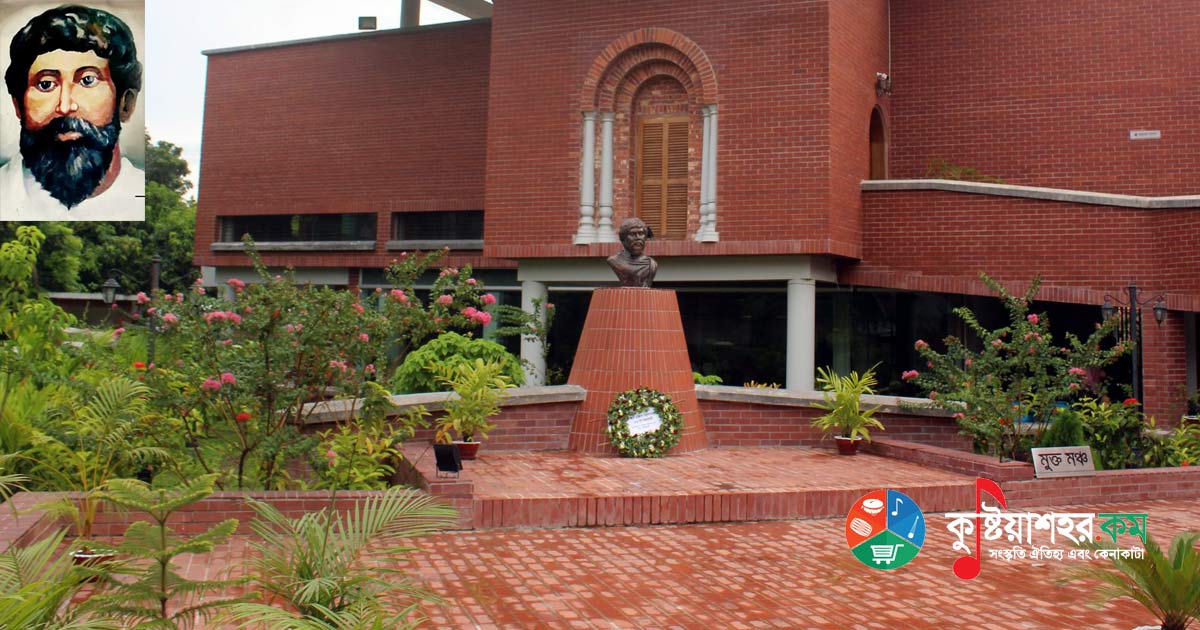
Lalon Fakir's ancestors' address, lineage, religion, caste, date of birth — even his own name — remain veiled in mystery. Professor Mohammad Mansuruddin devoted his whole life to collecting Lalon Fakir's songs, and by piecing together hearsay and argument he tried to establish a biography of Lalon.
Lalon was born in 1774 into a Hindu family in Chapra village of Nadia district of the Bengal of that time. Lalon died on 17 October 1890. Once, on the way to Murshidabad on pilgrimage, he fell gravely ill and lost consciousness. His fellow travellers took him for dead and threw him into the river. Drifting with the current, Lalon came to rest at a bathing ghat. Regaining consciousness, he cried out for help, and a Muslim family rescued him. To be cured of his illness he had to stay with that family a long time. There, at the inspiration of the family's spiritual guru, Siraj Sai of Jessore, he took initiation as a darwesh. After a long interval he returned to his own family and told them of his long stay with that Muslim family — and as a result he was ostracised. Lalon then became a Baul and devoted the rest of his life to the search for the Supreme Soul.
Even in his lifetime Lalon had become exceedingly famous. Two weeks after his death the local Hitokari newspaper published an editorial under the title "Mahatma Lalon Fakir". That editorial gave an account of Lalon's fame. In it was written:
He himself knew no letters, yet hearing the countless songs he had composed one took him for a supreme scholar. He read no scripture, yet in matters of religion he seemed an extraordinary master of the scriptures.
The same editorial said that at the time of his death Lalon had ten thousand disciples. The disciples addressed him as 'Sai', and for that reason the title 'Shah', used at the end of the darweshes' names, also became attached to his name.
Lalon was the greatest of the Bauls. In the second half of the seventeenth century the Baul ideology gained wide currency in Bengal, and by the strength of Lalon's creative sadhana it came to full maturity in the nineteenth century. The Baul ideology is not a separate religion, but only a way of perceiving Allah.
Among the Bauls are people of both the Hindu and the Muslim communities. A person engaged in household life too may follow Baul sadhana; yet the greater part of the Bauls are those who have renounced the world and own no means or wealth. By day they beg with an ektara in hand, composing songs and singing them among ordinary people. When night falls they return to their akhra, where collective debate on doctrine and bhajana-sadhana take place. The Bauls go neither to the mosque nor to the temple; they honour neither the shariat nor the scriptures. Though they believe in the guru, they seek no pir or swami. With their women they spend the night in the akhra itself, as the Sufis do not. In the Baul way, women are an inseparable part of sadhana; yet though they live together with their women, bearing children is forbidden to them.