বাংলা
 English

There is a wide range of opinion on whether Lalon was a Hindu or a Muslim. According to some, Lalon was the son of a Kayastha family — his father Madhab and his mother Padmavati; Lalon later converted. Among researchers, most believe that Lalon was the child of a Muslim tantubaya (weaver) family. His father's name was Daribullah Dewan and his mother's name was Amina Khatun.
Introducing his own caste, Lalon Fakir said —
People keep saying, Lalon Fakir, what caste are you the son of?
To whom shall I say what —
I find no shore.
A few days after recovering from his illness, Lalon Fakir bade farewell, saying that he was a man who had renounced the world; he had no place in this worldly life. It is said that Lalon miraculously walked across the Kaliganga river. Later, however, Molom, with his dinghy boat, crossed over, nearly ran and caught up with Lalon, and with an anguished heart pleaded with him to return to Cheuria. After pondering a while, Lalon said: I can come, but separate arrangements must be made for me. The childless Molom honoured the wish of his beloved son. On the bank of the Kaliganga river, in Molom's garden shaded with green trees, a four-roofed house and an akhra-bari were built. Lalon used the four-roofed chamber as his room of sadhana.
In the course of time the chhaya (thatched) house vanished, yet the door-leaf and the water-pitcher stand of the great sage Lalon's touch-suffused sadhana chamber are still preserved in the Lalon Academy museum. This akhra-bari gradually became a hallowed place of devotional worship. After the Fajr prayer Maulana Molom would recite the Quran, Fakir Lalon would listen to the recitation attentively and ask about the meaning. Lalon would interpret certain verses of the Quran, and hearing his interpretations Maulana Molom would be overwhelmed.
Inspired at one point by boundless devotion and love for Lalon, Molom and Motijan took initiation from him. Molom became Fakir Molom Shah, while Motijan became Motijan Fakirani. Fakir Molom Shah was the eldest of the disciples. Molom's other two brothers, Kolom and Tilom, with their wives, in due course took discipleship of Lalon.
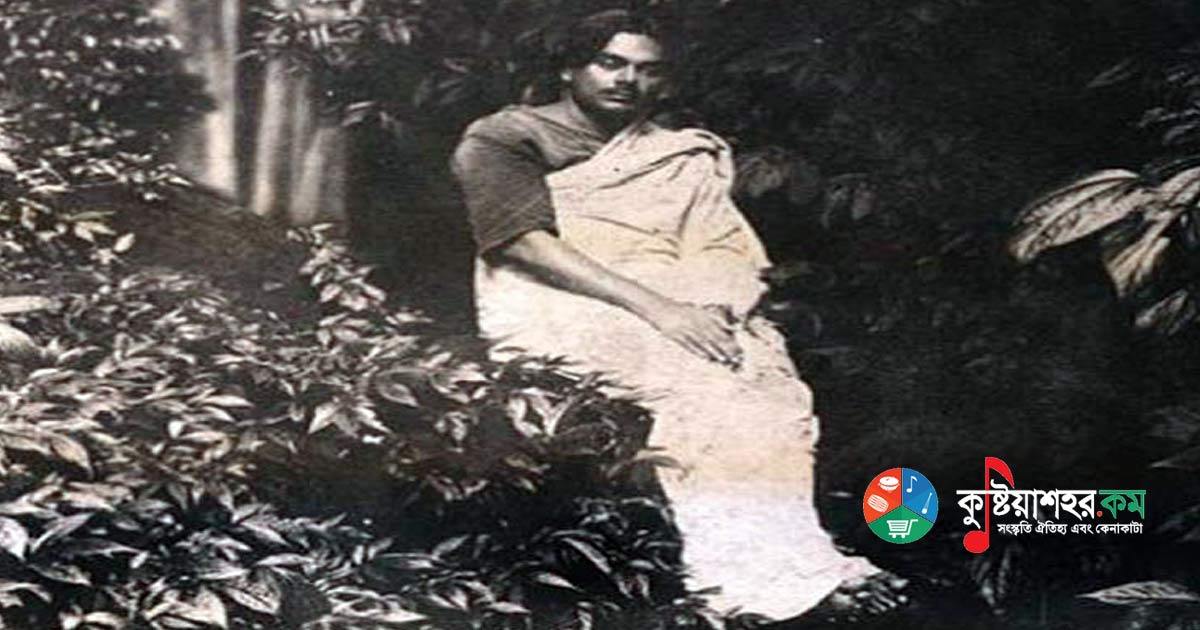
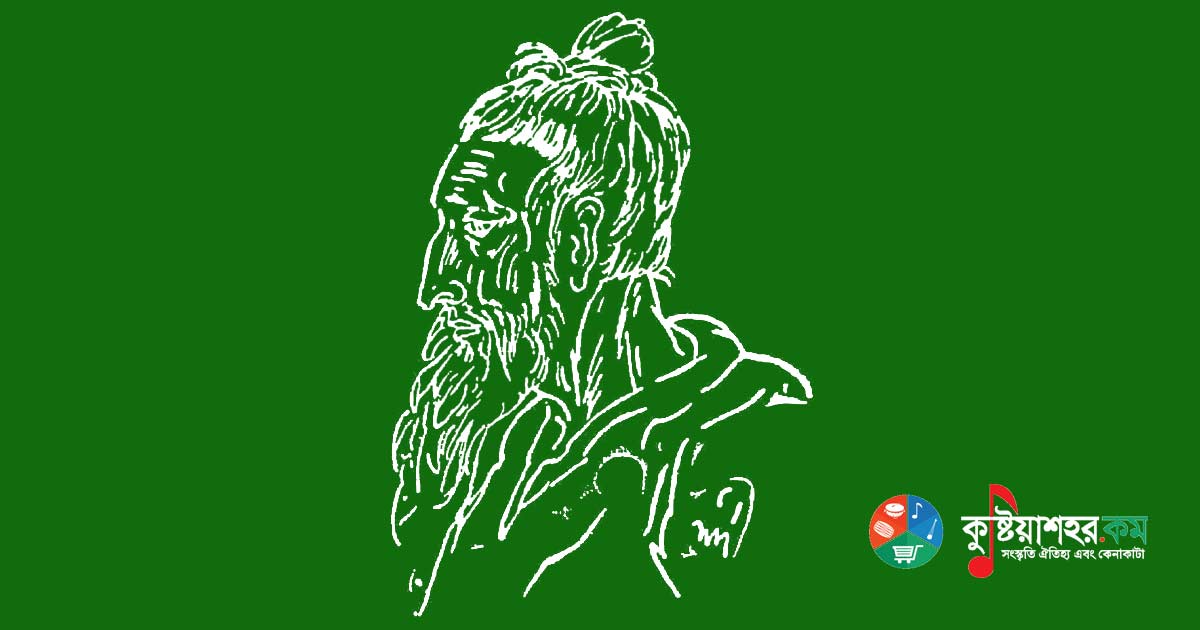
Lalon bore the marks of smallpox on his face; his hands were so long that when he stood, his fingers fell below his knees. High nose, lofty forehead — Lalon of fair complexion had deep, penetrating eyes. Babri (bushy) hair down to his shoulders, a long beard, a staff in hand, wooden sandals on his feet, a khelka over his body, a turban, an anchla, a tahban — all together he looked like an accomplished sage, a perfect seeker.
Lalon composed the verses of songs orally. When a new song arose in his mind, he would call his disciples and say, “A shoal of fish fry has arrived.” Lalon would sing for them to hear, and Fakir Manik and Moniruddin Shah would write those songs down. Even during Lalon's lifetime his songs gained immense popularity. Fakir Manik Shah was one of the finest singers of that time. In the belief of Lalon's disciples the number of his songs exceeds ten thousand. But in reality such a vast number of songs cannot be found. It is heard that after some of Lalon's disciples died, their song notebooks were buried in their graves. Besides, many devotees took song notebooks away and never returned them.