বাংলা
 English
The priceless treasure is that great joy which man, finding it within, longs to become complete; a supreme knowledge or primal power at whose dawning breaks the impregnable fortress-prison of existence. The priceless treasure is unfeigned as well. For deceitful guile or hypocrisy are not its marks. This treasure is steadfast; even after the joy of attaining it, it does not run out. This treasure is Sai Niranjan.
How shall I attain him? This search is man's unceasing urge. That is why even in the primeval mythic age the idea of animism could be born, in which man knew the omnipotent as his own spiritual power, and beheld Him active in the form of a living world, nowhere else. Yet in the later age of religion, after this power had been assigned to gods and God, in today's age of science this same man has turned into a spiritually powerless brute creature, an ignorant wise man. In the world of science there is no priceless treasure. Its gaze is bound to the glass of cause and effect, turbid and incomplete. World-conquering science has therefore always failed to conquer man's mind, for without the unceasing search for that unfeigned treasure there can be no contemplation in the deepest province of the human mind.
Where does this unreachable one dwell? What is his form, his nature? - Failing to find the answers to such questions in the flow of the world, man's God finally became invisible, formless - the world became maya, the afterworld eternal, the truth. All urges to action and all knowledge seem restless with the longing for release from the world, ever hastening towards an unknown dark God.
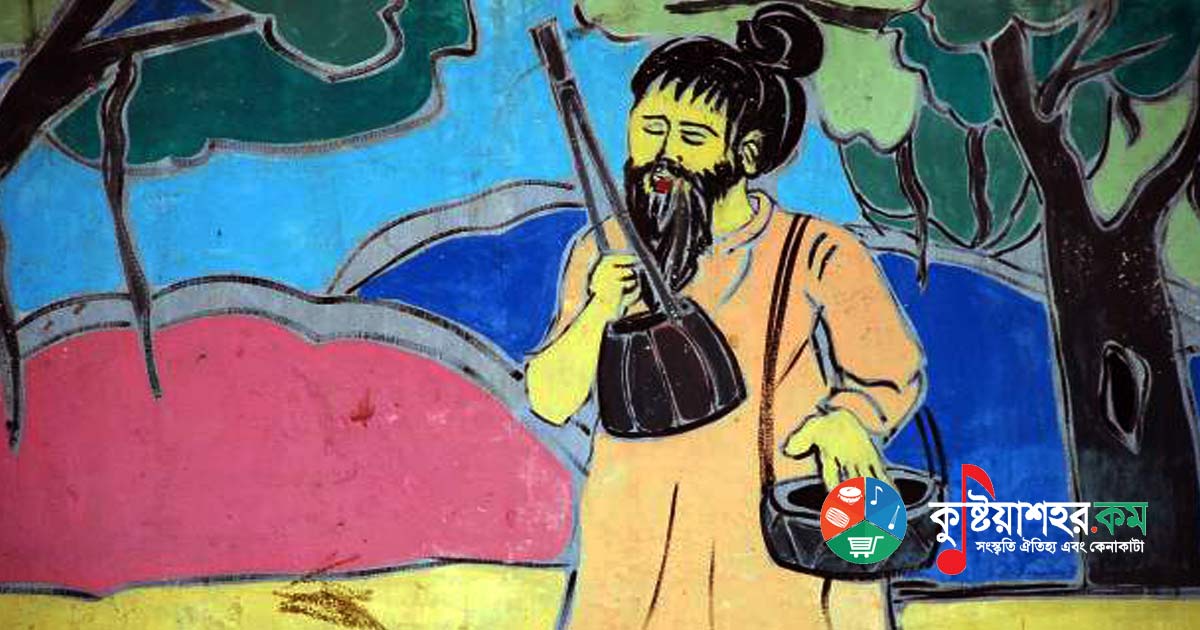
From precisely such a haze-shrouded situation Fakir Lalon seeks the root of the primal truth. Nowhere else - what man is searching for, that priceless treasure, is to be found only in the present, and the greatest present is man - the man of this moment, the living simple man.
Serve the simple man - see, not with divine knowledge.
You will find the priceless treasure in the present.
Worship man's two feet - the real thing will remain pure.
If you die, all turns to earth - take this distinction knowingly.
But is Lalon fakir, after all, averse to God? No, never. The truth is that his thought of God, interrogated in terms of attainable things, gradually built a non-Vedic path in which God is far more this-worldly than miraculous. To reach the depths of this meaning, if we try to know Lalon fakir's creation-theory and its historical links, we shall see that there Lalon strives in the search of Semitic esoteric spirituality. As far as is known, the esoteric sages of the Torah, the Injil and the Quran in every age believed in a different interpretation of scripture; particularly on coming to creation-theory they were intensely heterodox. Its wide influence is seen in the Sufism of Islam as well.
The Kabbalah-following Jewish esoteric sages believed, or still believe, that the supreme or primal God is an unconscious 'No'-being. He is not created, nor does He create. He is without want, desireless. So beyond this God they imagined a needy God, active in the longing for the joy of creation, who is neither different from nor identical with the primal God. His name is Jehovah - this world is His creation. In the beginning God was indeed one, and nothing else existed then besides that eternal God. Thus perhaps for hundreds of thousands of crores of years He was alone! Then at some time, for some causeless cause, as it were, the desire for a second awoke. Apart from creating another being like Himself, that solitary God in truth had no other means. To taste the second, God thus kept contracting Himself until He reached a level where the nature of His primal being dissolved in grossness. This awakened God is Jehovah - the great Creator.
In Kabbalah Jehovah has ten avatari. The first avatar is another eternal luminous form emerged from Jehovah. One after another, in the same way, the succeeding nine avatars are fulfilled from the first. Each avatar again divides into three branches. At last from these ten avatars is formed the primal man Adam Kadmon, who dwells in heaven, and we are his representatives. From the avatar-born Adam Kadmon again arise the four worlds, of which the earthly world is one. Such is the esoteric tale of creation of the mystic Kabbalah sages.
Like Jehovah, in Lalon's philosophy too we find an avatari Allah in the form of Nur-Tajalla. This Nur-Tajalla is the Creator. In the glory of an indescribable, inexhaustible, incomparable nur, Allah's power is revealed. It is as if a descent from the unmanifest subtle level to the joyous gross. Then, in the longing for the second, nur trickles down from Nur-Tajalla and gives birth to the nur of the prophet, the prophet-being, the essence of the world. From the prophet's body itself are born air, fire, water and earth - this marvellous universe mixed of the simple and the subtle. In various verses of Lalon fakir we find support for this idea again and again.
It should indeed be known, judging the distinction of the two nurs.
The Prophet and the formless God's nur - of what kind is it?
Say, the nur touches because the prophet had form.
In what manner does the nur of the formless God touch?
I hear the world is born of the prophet's body.
That form - what became of it? Determine it.
Sky, earth, water and wind
are created in which prophet's nur
tell me, where is that prophet's seat
purusha or prakriti - what form was there then?
In Lalon's philosophy the creeper of creation, from man, at last goes and merges in Allah. Or the infinite stream flows on within the One itself. Both are true, for that 'One' is detached from nothing. From this thought, then, we see the expression of the names Ahad and Ahmad, born of Sufi spirituality. Before creation there was nothing but the Ahmadi nur. What the Kabbalists call Jehovah is in Lalon Nur-Tajalla, in another sense the Ahmadi nur. In the longing for creation, Ahad separated from the Ahmadi nur, and the prophet-being or primal nature was formed. Then, hiding the remaining letter 'mim', as 'alif' at the root of creation awoke 'Aleke Sai'. Yet even afterwards, to taste the human lila, the Creator joined the 'mim' to Ahad and made known His name 'Ahmad'. That is why we see Sai Niranjan revealed in the Rasul Muhammad, to become mankind's helmsman and to teach that zahir and batin, these two ways, are the root-sadhana of worship - which no one ever did before. Forgetting all else, Lalon therefore asks us to accept the truth of the Rasul's this din alone.
In Ahad became Ahmad
in man the Sai took birth.
Lalon fell into the great whirl
the Sai's lila finds no end.
Coming as Ahmad in Ahad
He made known the name of the Prophet.
He who wove the creation
where did He keep that body?
.....Why in the name Ahad, O brother
did the Sai play the human lila?
Lalon says, then why do I go
into the band of unseen dreamers.
To go deep into creation one should indeed know the seed-tree theory. Before creation, Nur-Tajalla or the Ahmadi nur, immersed in that primal power, is nothing but a supreme seed-power, born of the hidden sound. In expression, in form, this seed-power itself is the tree, and that tree itself is the prophet - neither different from the seed nor identical with it. From this tree-being prophet-body itself arises the world, and through the union of seed and tree the universe keeps advancing unceasingly. In Lalon's view, to know the seed one must first know the tree - its root, trunk, leaves and flower must be known. Likewise, knowing the prophet in the form of prakriti, it becomes possible to know Sai in the form of purusha.
O mind, do you think it is this that will gain you Allah
without knowing the Prophet?
To whom do you say, Prophet, Prophet
while showing no direction?
The seed is Malek-Sai, the tree the Prophet
rummaging the heart you will come to know.
What shall I say of that tree's excellence -
on one branch din
and on another dun.
Hard to fathom is the Creator's intent
the Prophet is the tree, Saiji its fruit.
If you would pluck that fruit, climb that tree
Lalon says, in a piteous mood.
Of the ninety-nine names of Allah, the abode of all virtues, two are 'Al-Zahir' (manifest) and 'Al-Batin' (unmanifest). Though Lalon never denies the invisible formless Allah, all his contemplation, all his search, is only to attain that manifest Allah. To him the sadhana of the invisible is like catching a snake in a dark room. That path is not the fakir's; within that visible present alone he searches for Niranjan.
Him I have not seen with my eyes
in what manner shall I worship Him?
Without counting the sand below
you grasp the sky in the dark.
Catching a snake in a dark room
where there is no snake - such conviction.
Lalon, likewise bereft of wit
near to madness.
In Lalon's philosophy Allah is attained by knowing the prophet; apart from the prophet the distinction of God is impossible. But the prophet - to whom shall I say it - that meaning must be known from the root of creation. So, in visible form, in the present, in Ahad, Lalon wishes to see that deathless ever-living prophet, that saviour of the world abiding through the four ages. And the notable truth is that Lalon received this from the Quran.
Called Hayatul Mursalin
I see it written in the Quran.
Siraj Sai says, foolish Lalon,
knowing the Rasul you will gain the akhirah.
The prophet who is the helmsman of the farther shore
lives on through the four ages.
Hayatul Mursalin is his name
that is why He is so called.
In what form the prophet will be attained in the present - in Lalon's view the search for this is the sage's work. Not the invisible formless, not an avatar of another age, not a historical figure - Lalon wishes to perfect this nur-sadhana by worshipping only the man of the present.
Indeed the truth is, man is the present
do it now.
Little by little in the heart's lotus
will play the play of nur.
Lalon fakir's philosophy is essentially a guru-oriented karan-sadhana. On this path the guru is the redeemer of the fallen, the supreme God, Dayal Chand - though the man of blood and flesh is nothing other. Setting aside this living guru-form, the sage searches for his own essence. In the four kinds of feet - the teaching guru, the initiating guru, the sadhana guru, the consciousness guru - sadhana is perfected. Devotion is the strength of this sadhana, for the guru is subject to devotion. At the guru's touch iron becomes gold, the blind see, the lame dance - such is his glory. There is no scripture of the theory of sadhana. The deep hidden esoteric truth must be known by following the true guru's instruction and developing realisation through the living of life, for this is a sadhana of life. Little by little, brightening the heart's lotus, one comes to know one's own 'I'. And once one can know oneself, all can be known.
Whose mind will be fixed at the guru's feet
all his difficulties will go
that very one will gain the priceless wealth in hand.
Where Alek's home is the abode
Safiullah is his stair.
Lalon says, the mind's fence
is fastened to the guru's feet.
In Lalon's philosophy the body is a great matter. Whatever is in the universe is in the body's vessel. Within the body itself is the play of Sai Niranjan, the light of the prophet's nur, the throne-abode. Apart from the body the Lalon sage has no other tirtha. Yet it is also true that Lalon's sadhana at last seeks its completion in a gemini-like paired sadhana. Only in the union of the body-pair is Sai-darshan possible, in nothing else - that is the seed-mantra. In this esoteric practice of reaching the unreachable through a pair, the body itself is the temple, and union the worship. Here another thing is important to know: in this sadhana it is not the sage but rather the sadhana-companion who is the chief helmsman, without whose grace crossing is impossible. She becomes the consciousness guru, in another name Sri Guru. In paired sadhana, at the climax of union, the purusha (Sai) becomes prakriti, and prakriti (body, prophet) becomes purusha. But knowing this unknown knowledge of body-theory is no small matter, for this body, this world of the five elements, is ceaselessly conflict-ridden in indissoluble causal bonds - maya-appearance is its nature. The body's desire does not stop, is never satisfied. To feed the bird that wishes to suck up all the seas is truly an impossible task. So the clever sage first tames that hungry wild bird, and then makes love - he goes by that path.
Love is the life of Lalon's philosophy. Unless steadfastness comes into love's purity, this philosophy is mere hollow dry talk. In Lalon's view it is in love that the sage's perfection lies, in love release from bondage. All sadhana-devotion, all binding and casting, all fakiri dealing finally turns false if there is no love in the mind. Immersed in love's desire is that priceless treasure, the way to grasp the unreachable sweetness. In Lalon's various verses that appeal returns again and again.
My mind stays drowned in the raga of pure love.
Immerse your body in the current, do not give in to malice - swim along upstream.
Having put out Madan, light him again - play the game on the icy peak.
Beholding both, palms upward - that is the mark of love.
At the root of the muladhara is that very nur
the distinction of nur, the boundless ocean.
In whom has sprouted love's seedling
he it is who gleams.
Arrow against arrow, the hurling - the earning of poison
the movement is downward, both are the ending.
If with the weapon of love you cut the five arrows
man's karan will be accomplished.
One pure deed of love is the essence of Lalon's philosophy; and yet Lalon does not speak of any strange love devoid of desire. Love without desire, in his view, is meaningless. But the sage does not dance to desire; he makes desire dance. Desire to him is the wave - a turbulent river (the path), love the goal (the farther shore), and this body the ferry to that shore, the guru the helmsman. But the sight of the farther shore, or the attainment of perfection, for which one must know the causeless karan or the causeless pursuit of love - that bhava is not the work of small knowledge. The sage who dwells on the summit of rasa alone attains it; the rest drown and die in the storm.
Is causeless bhava possible at all? To understand the argument, let the famous idea of the philosopher Immanuel Kant concerning 'pure reason' first be known. That power of knowledge which can express itself in the freedom of its own distinctness, without man's worldly and sensory urges or the necessity of the law of cause and effect - that, in Kant's judgment, is 'pure reason' - the only transcendent existence of the human mind. Expectation-free morality and desireless rasa-thinking (aesthetic feeling and love) prove it again and again in certain special moments of life. From these two marvellous dispositions of the mind, the materialist Kant was at last compelled to accept the existence of God or the supreme being in man's pure reason, though in his language this God is unreachable, unproved. Kant believes that man is in truth a dweller of two worlds. As he dwells freely in a phenomenal world bound to cause and effect with a sensitive body and senses, so with the urge of pure reason he may range in a transcendent world where distinctness itself is the rule. As if one soul in two forms. Therefore, crossing worldly delusion and dull bondage, to illuminate the inner transcendent distinctness should be the aim of human life - that, in Kant's view, is self-culture. To see the intent of God in any external object, in a historical person or in a great book is, in Kant's view, sheer idolatry. Rather, the word or command of religion can arise only from man's own soul, illuminating the world of the mind through the awakening of pure reason. This much alone does the materialist Kant understand by religion.
In Lalon fakir's philosophy too we find much the same opinion. 'God in all beings' - this Upanishadic word of the Brahma faith Lalon perhaps does not deny, but not in all beings - Fakir Lalon searches for God only in man, in the heart's lotus in the depths of man, in the mind-body, in form and in the present. To Lalon, man alone is the root sadhana.
All sadhana bears fruit for him
whose devotion in this world is fixed on the human guru.
The luminous one who is formless
he takes a visible, embodied form.
The divya-jnani comes to know it
in the Kali age man is the avatar.
Adam-Qaaba is within this human body
see it, O mind, do not sneer.
Running from land to land
why do you die panting?
As I said before, in Lalon's philosophy the human body is a spiritual matter - the vessel of nur, the holy chalice. From Kant's philosophy it is at this stage that Lalon's distinctness is clear. Kant's 'pure reason' is no substance, it is a power of knowledge, while in Lalon it is substance-power as well, to be known through the yoga of sadhana. Detachment is wasted; there is no liberation in the woods - in his own body Lalon searches for the tirtha, the strength of sadhana, resting on the belief, like Kant's, that man is a dweller of two worlds.
One day I did not see Him.
Beside the house is Arshinagar
there dwells the neighbour.
How can I have the power to know that form?
Day and night, in eyes of knowledge clogged with maya's husk.
I and the unknown are one
in one place we two dwell.
Between us drifts a hundred thousand yojanas
I do not get to hold.
Lalon does not deny the body's hunger, thirst, desire and longing, yet neither does he wish to be the slave of body and senses. On the other hand the mind, to him, is an unrestrainable, unappeased, restless being that cannot be known or fathomed. All the while there runs there the misrule of six ministers. The mind therefore goes to the netherworld, fickle in the poison of objects. All search for nectar, but where is it? Again and again one only gets entangled in poison. So the sage performs sadhana holding the poison itself, with the longing to turn it into nectar. Without the sadhana of the body the mind is never purified, never calm, for the rasa-less mind remains subject only to the body. So the body must be mastered and known, its abode and chambers must be inquired into, the mystery of the body-river's current understood. Taught by the true guru in these hidden devotions of body-theory, the Lalon sage wishes to cross the turbulent Kamana river. A long journey.
In the sadhana of rasa the mystery of the exhaling kumbhaka is not all; the fakiri is not perfected merely in the steadfastness of preserving the seed. If one falls into a fierce storm, all these binding-and-casting barges flee in the mighty push of the waves. Then there is no way left but the trade of words. So Lalon, in this hour of great crisis, calls love the only refuge, the protecting armour of the farther shore. But the strength of love with which the turbulent river is easily crossed by the rasika magnate is no small thing. This love is drowned in pure raga. The lover of this love, dwelling in desire, is desireless, mad across the shore in causeless bhava-rasa. To show one stupendous example of it, Lalon again and again spoke of the love of the gopi-women absorbed in the thought of Krishna. In his view the gopis alone are the possessors of that priceless treasure, since the Lord Krishna is bound, bought on credit, only by their love.
The bhava of detachment is the Veda's rule
the gopi-bhava the unfeigned treasure.
In that the unbounded
rasika ones are drowned.
Him whom Yogindra, the lord of the mind,
cannot reach by yoga and contemplation
that Krishna at the gopis' doors
has been bought.
In exchange for the merit of former births the gopi women were born in the Dvapara age with only the hope of Krishna's darshan. Krishna's joy is their joy; if for this they must lose family honour and give up their own happiness, they will give even that - such is their state of mind. This love is causeless desire. This alone Lalon asks to be worshipped again and again. He in whom this love has sprouted, rising above the living essence, finds the search of an unknown 'my I'; this causeless desireless unknown I itself is the Sai-jewel.
Love is man's mysterious feeling and the chief mark of two divine qualities, 'freedom' and 'distinctness'. So that moral and aesthetic desirelessness of Kant's 'pure reason' becomes joyous only because of love. The unmoving Lord Krishna, to fulfil the taste of human lila, was born in the Kali age as Gaur of Nadiya, only to satisfy the longing of love - to repay the debt of Radha's love. Some call him Chaitanya, some Gora or Gauranga, and still others Nimai. Gora's bhava has no end.
Maddened in bhava as Gaur
raising his arms he dances.
Where his hands, where his feet
no reckoning in his within.
So Lalon says - Gora brought a new law to Nadiya; setting aside the Vedas and Puranas he preached only the glory of pure love. This love accepts no caste or creed, no religion or irreligion, keeps no rules of sin, virtue or knowledge. Amid all ages Gora shows a divine age.
If what is not in the Veda be so
why should I die reading the books?
Lalon says, I shall worship for ever
that Gaur Hari.
Come, who will go to Gaurchand's market?
Do not go without a firm mind
lest in the jostle your cloth tear apart.
When did He ever speak to me
of my own accord I die of my own rush.
Gaur came and sat in the heart
and stole my mind away.
What a lecherous beauty is Gaur
he cuts and gives away the rope of patience
shame and fear all rush away
whenever I recall that form in my mind.
The hearts of the people of Nadiya tremble at this new wave of Gaur-love. It is as if it wishes to break and shatter everything into one. Forgetting Hindu and Yavan, maulavi and priest, dull divisions, all became self-forgetful, immersed in the market of Gaur-love. The high-born Brahmin embracing the untouchable Chandala weeps profusely - such a scene no one had ever seen, and the great Lord Gauranga showed it to all. So Lalon, in the end, accepts this Gaur-love alone as the last means of the liberation of the people of Kali, making all else secondary. For this love is revolutionary, family-destroying, egalitarian; this love ordains the impossible possible.
Today's civilisation, its people, though dwelling in the boundless grace of the Creator, are tormented-souled, distressed, robbed of the fortune of nectar. Lalon says that of all the trees born on the Malay mountain, though all take the mountain's essence (virtue) and gain the fragrance of sandalwood, the bamboo is the exception. For the fault of a mind empty of love, the bamboo gets not the sandal's scent. Today's man is likewise in the bamboo's plight. For the present civilisation was not built on the foundation of any love. Knowledge never ripened into bhava, nor bhava into love. So there has been continuously established the vain history of man's pointless division from man, greed, malice and mutual destruction. Spending lavishly, on the path of enjoyment, the nur-power of Sai Niranjan carried at the root of the world, man today is blind with petty knowledge and pride. For love's not being attained, the eye's gem is turbid, clogged with husk. That is why even after so much knowledge today, that hidden emblem repeatedly woven in the Quran - the Creator's own form - man does not see amid the world's lila. Otherwise, completing himself in the glory of world-love, he would have gained the priceless treasure in hand. There would have come to the earth an ever-divine age drenched in the rasa of love. Humankind perhaps will one day see it; the husk will be separated from the milk, and then only the worthless whey will lie behind - the bones, marrow and ashes of deluded longing.
Collected from - Lal Jeeper Diary