বাংলা
 English
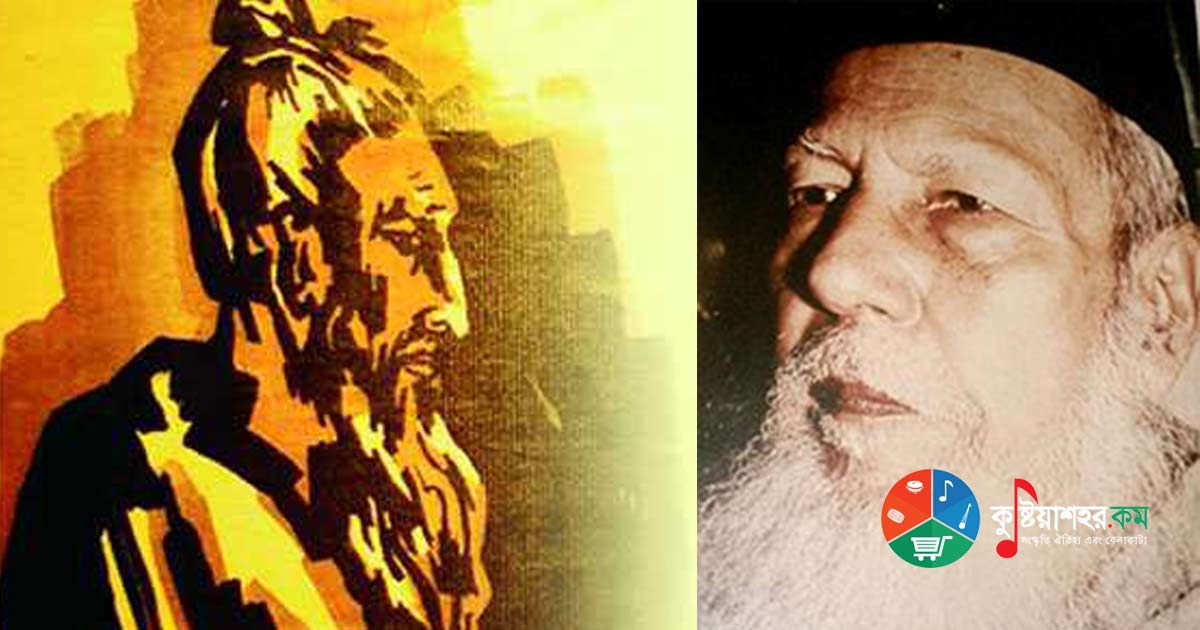
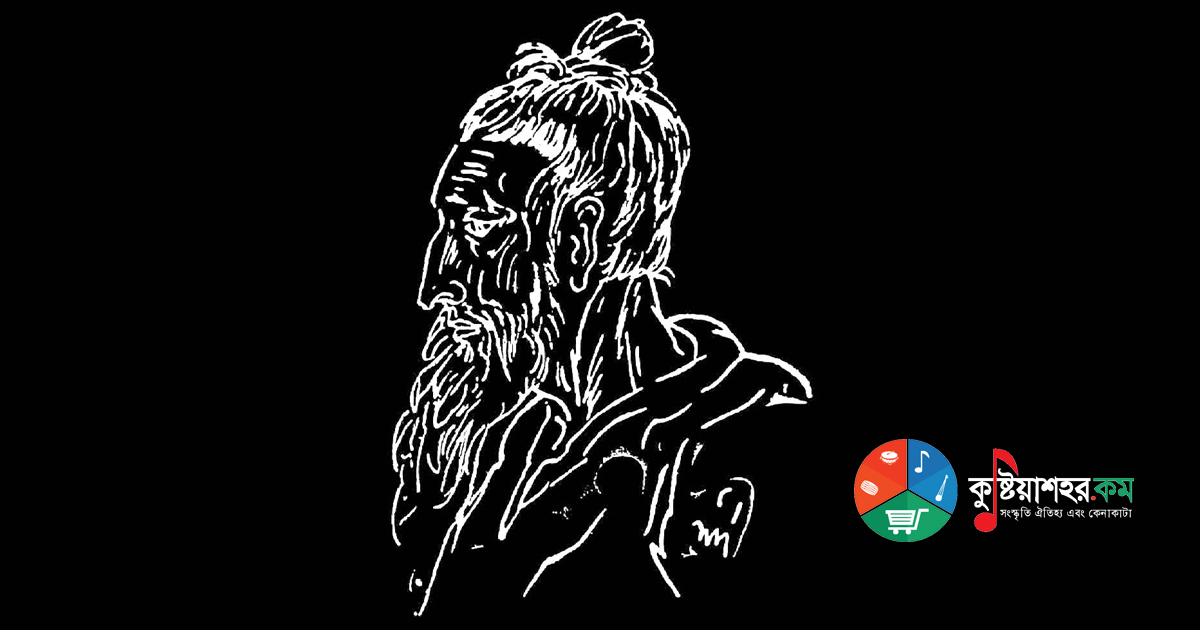
In the music-loving indigenous society of Bengal, sage Lalon Shah has left such countless and matchless contributions in the field of folk song that, by virtue of the simple expressive sweetness and polish of these paramartha-pointing mystic songs, he will be able to stir waves of feeling in the hearts of the Bengalis for several centuries. The very nature of mystic songs is that transcendental feeling must be expressed through various metaphors. Often they cannot be fathomed by the intellect; people are satisfied only by feeling them with the heart.
Even though this state — where the feelings carry the mind, as it were, to some delightful height — does not last long, what less is the joy of that momentary attainment? Because no suitable language exists for all mystic feelings, a mood-seeking singer perhaps sometimes has to coin strange words, or convey the feeling by hint with plenty of metaphorical ornaments, and sometimes, perhaps, divine inspiration suddenly opens the eyes — in that state the 'unknown', as it were, appears in the form of the 'known'. Who will explain to whom these mysteries? Each has his own gauge, takes a meaning as he pleases. Thereby one object or scene is received by each person in a different form. There is no definite answer to the question of this uncertain field.
It seems to me that the true guru teaches everyone, and the murshid is content with whatever one can absorb — though to one of greater capacity the guru's grace is also somewhat greater. I have no special claim to speak of these unreachable realms — so I do not wish to enter into argument or debate. Yet from a little experience of mathematics I can say: when, despite many efforts, I cannot solve a problem, then from time to time in the subconscious mind or in a dream the knot of the problem suddenly seems to untie and the solution becomes clear. How can I say this cannot happen in the spiritual world too? I believe that suddenly the darkness of the heart's closed chamber is rent and there appears “a divine light like a flash of lightning”. It is heard that before the death of a distinguished aulia, Satan came and asked, “You say 'Allah exists' — can you prove it?” “I can,” said the aulia sahib, and began giving proofs one by one. But Satan demolished each of his proofs with logic. Thus, ten or twenty proofs being refuted, the aulia sahib was in great distress. Suddenly in divine vision he saw his murshid saying to him, “O fool — why do you not say that Allah exists, that I believe in it bil gayab (without seeing)?” The moment the Satan heard this word of the murshid, he vanished. In truth Allah is 'alakh sai' (the Unseen Lord). Sometimes he is in suluk, but most of the time he remains 'alakh' — beyond perception. In geometry too there are many such 'truths' that cannot be proved; they are called axioms.
Above, the true guru was mentioned in the matter of learning. Certainly gurus remove ignorance and give knowledge. In this matter it is comparable to rebirth. Hence, like parents, the guru too is honourable. But one cannot seat the guru in Allah's place, and prostration to anyone other than Allah alone is haram, utterly abominable. Yet Allah himself commanded the angels created of fire, and Iblis, “Prostrate all of you before Adam”. What secret mystery lies in this, Allah alone knows, nobody else. Besides, the saying in the scriptures that a bone was taken out of Adam's rib and with it Hawwa Bibi was created, and Adam and Hawwa were given the right to roam freely together in Behesht, and the fruits of all trees except one were given to enjoy or eat at will — what is the significance of these? This question naturally arises. Finally, Iblis being made to take the form of a serpent, Bibi Hawwa was seduced through him into eating the forbidden fruit, and later Adam too, along with Hawwa Bibi, was made to eat that forbidden fruit — why all this? Then shame arose in the minds of Adam and Hawwa; with the vines and leaves of the trees of Behesht they covered, respectively, the male and female organs, and they were expelled from Behesht and sent to the earth. More wondrous still — at Satan's request he too was given the right, for life on earth, to lead Adam, Hawwa and their descendants astray. Did all these primal mysteries, and the later first murder — the tragedy of Habil and Qabil — happen by Allah's will? No, are these all Iblis's intrigues? We know on the one hand that Allah alone is the controller of all events. Then has he no responsibility at all for the deceptions and misdeeds now going on all over the world? Does he only accomplish good deeds, and does Iblis do all the evil? Has there been, as it were, some pact of sharing between Allah and Iblis? These are grave questions. Again, by our faith we see that man is made to recite — “I believe in Allah, in his angels, in his scriptures, in his rasuls, and in the Last (that is, of Qayamat) Day, and in the tenet that all good and ill of taqdir happens from Allah's side.” Some believe this iman indiscriminately (bil gayab), some believe after probing. Such grave questions will inevitably awaken in the mind. The purport of what Allah himself has said in answer to these is: I have given my servants some power to choose good and ill, and some I have kept fixed; in truth I act according to people's understanding — I forgive errors and mistakes, I consider the condition of the incapable, I pardon the truly repentant, but the hypocrite and the arrogant truth-hater I can in no way forgive or pity. That is, Allah acts according to his own judgement; he is infinitely merciful and omniscient. Even the judgement of the best of men can err, but Allah Pak cannot err. In short, in the vast field beyond limited knowledge and science, the journey of human life is not easy or near. Hence the poet Nazrul says in protest:
“Why did you give these thorns, if you gave the flowers?
Would not the flowers bloom if the thorns did not pierce?”
By now perhaps some idea has been given of the difficulty and complexity of man's path of journey — now let us probe with a few examples from Lalon's songs how the mind and movement, the meditation and conception of this self-taught (or untaught) individual were. Was he a person of awakened mind? Did manifold curious questions arise in his mind? And if they did, what sort of solutions did he leave to them?
Ferry me across, O merciful Chand, forgive my offence; my feeling is a prison.
Else who can accomplish sadhana-siddhi by your grace?
I am a sinner, so I call; give devotion in my heart.
The sinner and the afflicted are your creatures; if you do not ferry them across,
revealing your mercy,
who else will call you the purifier of the fallen, the destroyer of sin?
In water and on land, everywhere, all is your glory; in the threefold world
without understanding, the simpleton Lalon has fallen into dire peril.
Here it is seen that Lalon has made complete self-surrender to one 'dayal chand' (merciful) Allah. Lalon knows that no human being has the power to accomplish all his duties perfectly; so he repents as an offender and seeks astaghfar from Gafur-ur-Rahim. He has said: I know you are merciful, yet I dare not — will you dispel my fear of sin? I am overcome with fear. This is truly the mark of the 'muttaqi'. He has called himself the simpleton Lalon, with piteous entreaty. This is the devotee's devotion. What prophet has come to Allah's court and not wept in fear, not sought deliverance from the fire of Dozakh? Finally the severe word 'ghorotor' signifies 'grave peril' — grammar has changed in the surge of feeling. Yet this is no serious mistake; rather it is 'poetical license'.
Everyone says, Lalon, what caste are you in this world,
Lalon says, what is the form of caste — I have not seen it with these eyes.
If circumcision makes a Muslim, what then is the ordinance for a woman?
I know a Brahmin by his sacred thread; how do I know a Brahmin woman?
Some wear the rosary of beads, some the tasbi round the neck — does that tell that caste differs?
At the hour of going or coming, whose body bears the mark of caste?
Roaming the world they speak of caste; people boast here and there as they please.
Lalon says, the noose of caste — it has been sold in seven markets.
Hearing such a message of 'inner-national' humanity from the mouth of letter-less Lalon, one understands what profound generosity reigns in the heart of that 'ummi'. Where is the root of this power? In meditation, in sadhana. It is doubtful whether even one in a hundred thousand can rise so high. Is judging his virtues befitting for small folk like us? Does Allah not see all men with an even eye? Yes, he does; but the judgment of merit he holds — can that be found on this mortal plane? Are the merits of men not apportioned by the yardstick of humanity by means of the tupi (cap), the sacred thread, the tiki, the cap, the lungi, the dhoti and the rest?
Can he be deceived by the trickery of empty words and pompous show? Making the song quite wonderful, the question of how to know the Muslim men and women and the Hindu Brahmin men and women has been raised.
The unknown bird in the cage — how it comes and goes.
If I could catch it, I would put fetters on its feet, O mind.
Eight chambers, *nine doors*, fitted with shimmering mirrors between them.
Above them is the chief chamber — a hall of mirrors.
Mind, you are lingering by the cage; but the cage is made of green bamboo.
Lalon says, when the cage opens, where does that bird flee?
A very beautiful song. Its question: inside the cage of our body there is a living bird (the prana, the life-breath); by which path does it come and go? If I had the power, I would keep that bird stored forever in the body-cage. But that is not to be. Man is mortal; like green bamboo 'I' too will give way. Yet it is fastened and fenced at all the doors, and the gaps too are covered with mirrors — that is why it feels wondrous: by which path will those life-birds fly away?
Lalon Shah knows more about the theory of the body (dehotatta) even than our graduates. The stock of words of this ummi man too is seen to be abundant. He must therefore be called a man of culture outright.
I have not seen him even for a day.
Arshinagar lies close to my house; a neighbour lives there.
Roaming the village there is bottomless water; no boat of his, no raft on the bank.
In my mind I wish to see him — but how shall I go to that village?
What shall I say of that neighbour — he has no hand, no feet, no shoulder, no head.
For a moment he dwells upon the void, and again for a moment he floats on water.
If the neighbour would touch me, my torment of Yama would go far away.
Yet he and Lalon abide in one place, and still there is a gap of a hundred thousand yojanas.
The hint of this poem seems hard to grasp — as if it describes some concealed feeling with deep intoxication. By 'him' is meant the 'neighbour'. But who is that neighbour? The answer may be 'Pitam Piyari' — some woman, swakiya or parakiya. In this sense, without crossing the water created by the act of love, union is impossible. Therefore, though there is terrible thirst in the mind, according to the Vaishnava custom (or the Baul custom) it is unlawful for the sage to enjoy or consume the object before him; he must subdue the enemy of the senses by self-restraint. Again, the woman is right there with Lalon — perhaps rolled in quilt and bedding in such a way that of her 'hand, feet, shoulders, head' nothing is seen; and though there is immense longing, not even one touch of the woman can be had. Is that attainment so easy? She knows, “In the woman's mind, O friend, is the wealth of a thousand years of sadhana.” Perhaps the woman's mind lies elsewhere; hence Lalon cannot obtain even a touch. The beloved, though near, seems to abide a thousand yojanas away (4,000 krosh or 8,000 miles) — what a small sorrow this is. And another answer to the aforesaid question is: the neighbour is the Maker of the world. He does not abide far away; rather he is nearer than every man's jugular vein.
In the language of the Quran, 'Akramu min hablil warid'. He has no 'hand, feet, shoulders, head'. Here Arshinagar perhaps signifies the Arsh of God itself. To go to that village one must commonly pass through the door of Malikut-Maut. But if somehow one can reach there, the torment of Yama will not have to be endured a second time. He abides above the highest Arsh. The phrase 'again for a moment he floats on water' is mysterious. In Allah's book it is said, and science too says — in the earth the first creation was water; then foam upon the water; then water creatures; then clay; then water and land creatures, grass and leaves, mountains and the rest; then man. Perhaps those lines 'for a moment floats on water' were written to hint at these different ages. Of course, all the mysteries of creation have not yet become known. The sages have perhaps from time to time received some hint or ishara with divine vision. Even these hints are not to be cast away.
Due to the misuse of the meaning of the aforesaid 'rosa-keli', many weak-hearted yogi-sages have come to ruin. Of course, with a good instrument both good and evil deeds can be done. Therefore the pious and the good must maintain balance with the utmost care. This slippery path is certainly beset with mishap. Yet human weakness too must be remembered. Fall is man's, and within one's lifetime one gets the chance to set it right. Islam too has a kind of 'Muta' practice on one side, rather like a half marriage or a temporary marriage. I mention this only by the way: seeing the immoral conduct of weak yogi-rishi-sages, many people, in the fundamental ideals of the Hindu, Buddhist, Vaishnava, Shakta, Shia, Sunni, Mujaddidia, Naqshbandia and other sectarian observances, taunt one another's ideals. In every society there are new kinds of weak people, and ideal people too. The moment the limit of the ideal is crossed, things go to rot; the true pious and good ones easily cut through danger and pass on; it is the weak who muddy the water and work mischief. The Maker, I suppose, finds amusement watching these plays. Perhaps these are the Maker's own manifest plays — otherwise why would he grant Satan so much licence? And then there is the mystery of discerning the good from the ill.
O mind, whatever form one does not comprehend, one becomes.
He — Ram, Rahim, Karim, Kala — is one Allah pervading the world.
'Kullo shay'in' is with God; he says it in his own tongue.
One who has no conduct or judgement piles up knots upon the Vedas.
The manifest becomes unmanifest; in the One, the infinite arises.
In the lonely house one beholds the form — without the One what can be seen?
Behold the One, give, O my mind; worship him, look upon that.
Lalon says, he plays in one form; on the stage of the pot it is in all places.
The feeling of this song is utterly clear, without a speck of doubt. The question whether this man is Hindu or Muslim is vain. None but Allah can reach anyone's mind. He has said, “The manifest becomes unmanifest; in the One the infinite arises”. Truly, the many dwell in the One; as one's vision, so one sees. Let me quote a bit of another song of this kind (composed by Sri Ramdulal):
I have known, I have known them: you know the wares of the show
However one calls upon you, in that you are willing, O Mother.
The Magi call you Farah-vara, the Firingi calls you God, O Mother,
The Mughal, the Pathan and the Saiyid Qazi call upon you as Khoda.
Sri Ramdulal says, be not unwilling in this world,
Deliberating in doubt over the one Brahma, my mind has become the knave.
Who fathoms the mind — the stakes of the Maula's alley
What meaning of the Quran comes, he construes by his own mind's reckoning.
(All) study the same Quran; some are Maulvis, some are Maulanas,
How many stay in the literal? He accepts not the ruling of the Sharia-bound qazi.
All cry, Roz and Qayamat are come; none fixes their date,
The reckoning is to be — how is it going, always? In which word do I set my mind willing?
Some know the soul lies in Illiyyin-Sijjin — till when will the Roz reckoning not be done?
Some say the soul dies and is born again — then where now are Illiyyin-Sijjin?
I hear of the ordinance of A'raf — a created man has no death,
Which of my brothers is he? Says Lalon — whom shall I ask?
In this song it is seen that through the contrivances of the Maulanas and Maulvis the one written Quran has been given different meanings, creating manifold misinterpretation; and again, reading that very Quran someone has become 'dahriya' — that is, he regards this material world, or Allah's created ordinance, as Allah itself; and he does not accept the fatwa or ruling given by the qazi. Lalon says: I hear from everyone's mouth that Roz and Qayamat have arrived, that the last age has come — yet none fixes the date, none reckons and gives a definite opinion. If so, which one shall I believe? From one I hear that at death the soul is kept in two stations called Illiyyin-Sijjin, awaiting the reckoning of Roz Qayamat. Again someone says that the dead soul itself becomes alive again — then where have Illiyyin-Sijjin gone! Again I hear that between Behesht and Dozakh there is some high station, a great waiting-house; its name is A'raf. The people there, it is said, have almost equal likelihood of going to Behesht or Dozakh by their deeds and merits; so their judgement is suspended for a while — soon they will be dispatched to their proper places, some to Behesht, some to Dozakh. The people of A'raf, it is said, gazing toward Behesht from on high, when they sight an acquaintance, call him again and again, salute him and express their satisfaction, so that Allah Pak, through their intercession, may be a little gracious and grant them shelter in Behesht. The Maulvis and Maulanas have invented at least two more kinds of tales about this A'raf itself. However, hearing all this Lalon says: to hear so much bewildering talk is enough to drive one out of one's mind — I do not know whether my own dear brothers are in this tribe or party; then to whom shall I tell all this? In truth the words and the mass of feeling of the holy Quran have been distorted to create a tangle — that is why he is hesitant to trust such alim.
From the research of scholars it is known that Lalon Shah was born in a Hindu household in 1774 AD, and died on Friday, 17 October 1890. His original home was Bharala, the twin village of Chapra. His father's name was Madhabkar, his grandfather's Bhosmadas, his mother's Padmavati, and his own name was Lalon Kar. The quarter of Bharara in which he lived was called Daspara (the same name still exists). Later, by chance, Lalon found shelter and affection in a Muslim household. Six parts of his long life of seven parts he passed living within that Muslim society. During the childhood and boyhood of his life, for some seventeen or eighteen years, he remained within the meditations and conceptions, rites and usages, legends and puranic tales of Hindu society. Therefore it was completely natural for him to compose songs about both the Hindu and the Muslim communities.
Mark the following poem:
In the town, sixteen bombetes,
Making one mad, they have looted everything.
He who is the king of the realm, Rajyeshwar Raja,
Is himself the crown-jewel of thieves too,
Where shall I lodge my complaint, and with whom?
There were five rich men; they have all gone bankrupt,
They broke up the business some time ago, and are gone.
My wealth is gone; I see an empty room in the treasury,
Lalon says, the debt of the revenue remains — some time ago it went up to the Lat.
Meaning: in the town (within the body) sixteen of two conditions are dwelling — they are the ten senses (2 eyes, 2 nostrils, 2 ears, 1 mouth, 1 navel, 1 urinary organ, 1 anal organ), and the six enemies (lust, anger, greed, infatuation, pride, envy):
The ten doorkeepers of the ten senses ply their oars with might,
Who will come to cross the shoreless sea of Bhava? Who comes, O who comes?
(ancient song)
By another reckoning, the five organs of action (hands, feet, voice, the generative organ, the organ of excretion), the five organs of perception (eyes, nostrils, ears, tongue, skin) and the six enemies — these are the sixteen bombetes. Within man's body these sixteen mischievous household enemies dwell.
And who is he, the King of kings? That self or Purushottama lies hidden; he is not seen — from the invisible he watches man's activities and takes account. Again, within the body itself were five rich men (discrimination, knowledge, self-restraint, dispassion and devotion). Defeated in struggle with the senses and the enemies, they too have fled the field and are now on the way to death. The man Lalon, as it were, stands dejected; to keep his dignity remains a debt. And again, at the hour of reckoning with Parameshwar, the expenditure-room is seen full, the income-room empty. From him we have received life, sustenance, health, wealth, parents, the treasure of wife, the affection of friends and companions, praise and the rest — even the revenue of gratitude for that has not been paid. Meanwhile evening has fallen; nothing of the work has been done; all of Lalon's property has gone up to the Lat. What will Lalon do now?
In all this I see nothing to catch as fault. All the talk of life's mystery cannot be properly understood; and with effort, mistakes are easily understood. Many secret mysteries of life are beyond my intellect; therefore it would be mere temerity on my part to express comments, especially on the high sadhana-bhajan of bhakti-yoga or matters of that order. So here I end the tale — and I desire that on the Day of Judgement the gracious gaze of the King of kings may fall upon me and upon the whole of human society of past, future and present.