বাংলা
 English
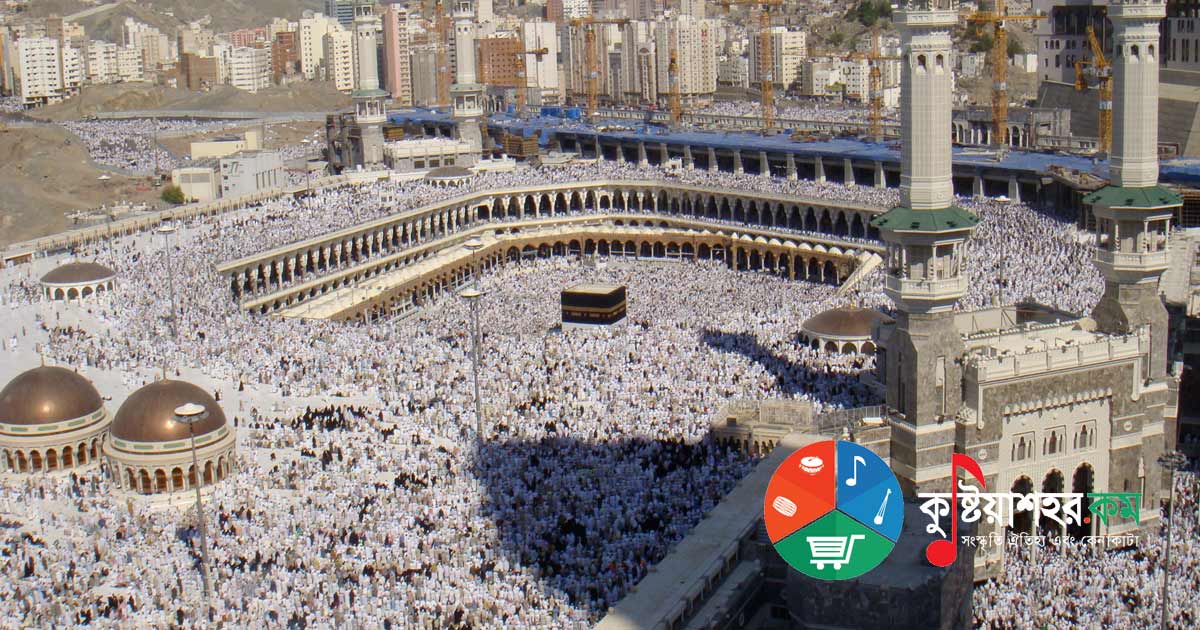
Islam (in Arabic: الإسلام) is a monotheistic and Abrahamic religion; it is governed by the Quran (a book that is wholly the word of Allah) and by the teaching system and life-model given by the last prophet Muhammad (SAW), which is recorded under the name of Sunnah and Hadith. The followers of Islam regard Muhammad (SAW) as the last prophet.
The word Islam (Arabic: الإسلام) comes from the Arabic س-ل-م, which has two meanings: 1. peace, 2. submission. In brief, Islam is submission to the One and Only God (Allah) with the aim of establishing peace.
Many think that Muhammad (SAW) is the founder of this religion. But according to the Muslims, he is not the founder of this religion; rather he is the last and final messenger (prophet) sent from Allah's side. In the seventh century AD he re-propagated this religion. The Holy Quran is the principal scripture of the religion of Islam. Those who believe in this religion are called Muslim (however, according to the ordinance of the Holy Quran, mere belief in this religion does not entitle one to be called "Muslim". Whoever he may be — of any religion, race or tribe of the world — only those who can surrender themselves a hundred per cent to this religion will be called "Muslim". Source: Surah Al-Baqarah, verse 208). The Holy Quran is the word of Allah, and Muslims believe that it was sent by Him through the angel Jibra'il (AS) to Muhammad (SAW). According to their belief, Muhammad (SAW) is the last prophet. The Quran is interpreted on the basis of his directed works and teachings found in the Hadith. However, if the meaning of any hadith goes against the Quran, it is deemed annulled.
Muslims believe that Islam is a complete and universal religion which was revealed to many prophets and messengers before. They also believe that the Quran is the last code of life sent from Allah's side.
Muslims firmly believe in the resurrection after death. This day is called the Day of Hashr. On this day every person's deeds will be judged, and in return they will be sent to Paradise or Hell.
Muslims believe that the good and bad of destiny is all determined from Allah's side.
Like the Jewish and Christian religions, the religion of Islam too is Abrahamic. In the present world the number of Muslims is estimated at 2.7 million, and they are the world's first largest religious group. As a result of the propagation and war conquests of Muhammad (SAW) and his successors, Islam spread quickly across the world. At present Muslims live across the whole world, especially in the Middle East, North Africa, South Asia, East Africa, West Africa, Central Asia, South-East Asia and Eastern Europe. Although this religion had its inception in Arabia, most Muslims are non-Arabs. The Muslims of the Arab countries are only 20 per cent of the total Muslim population. In the United Kingdom and quite a few Balkan countries, Islam is the second largest religion.
Religious Belief
The fundamental basis of the Muslims' religious belief is the unity of Allah. Muslims believe that Allah sent down His word for mankind through the angel Jibra'il to the messenger Muhammad (SAW). On the basis of the 'Khatm-e Nubuwwat' described in the Quran, Muslims believe him to be the last bearer of the word (messenger). They also believe that their holy book, the Quran, is perfect, unaltered and Allah's last word revealed for mankind and the jinn race, which will remain valid and in force until the Day of Resurrection or Qiyamah. However, some annulled communities, a community named Ahmadi or Qadiani, hold that Muhammad (SAW) is not the last prophet, but that the current of prophethood will continue according to the demands of the age. And among a large section of the Shias — especially the Ismailis — there is a belief current, as among the Jews, that Imam Ismail was the last prophet.
From Adam onward, all the men sent by Allah have propagated the message of Islam. In Surah Fatir of the Holy Quran it is said,
“Surely We have sent you (Muhammad) with the truth as a bearer of glad tidings and a warner. And there is no community but that a warner has been sent among them.” 35:24
In the eyes of Islam, both the Jewish and Christian faiths are the tradition of Abraham's teaching. Both faiths are addressed in the Quran as 'Ahl al-Kitab' (People of the Book). They are called upon in Surah Al-e Imran of the Holy Quran,
“Say (O Muhammad): O People of the Book, come to the word that is common between you and us: that we worship none but Allah, associate nothing with Him, and take none of us for deities besides Allah. If they turn away, then say: Bear witness that we are Muslims.” 3:64
The Quran also mentions various events and matters of the books of these two religions, but in most cases there are differences. According to the Islamic belief, the followers of these two religions made semantic and manifold distortions of Allah's word given to them; the Jews of the Tawrat (Torah) and the Christians of the Injil (the New Bible).
The religion of Islam is the beginning and the end and the only acceptable religion in the sight of the Creator.
'Whoever chooses any religion other than Islam will never succeed, and he will be of the greatest losers.'
Allah
Muslims address the Creator of the world as 'Allah'. The principal belief of Islam is the oneness of Allah, or tawhid. Islam is absolute monotheism and is in no way relative or pluralistic. The unity of Allah is the first of the five fundamental pillars of Islam, which is called the Shahadah. By reciting it one affirms that (1) there is no deity except Allah and (2) Muhammad [(SAW)] is His sent bearer of the word or messenger. In Surah Ikhlas Allah is described thus, [قُلْ هُوَ اللهُ أَحَدٌ. اللهُ الصَّمَدُ. لَمْ يَلِدْ وَلَمْ يُولَدْ. لَمْ يَلِدْ وَلَمْ يُولَدْ. وَلَمْ يَكُنْ لَهُ كُفُوًا أَحَدٌ] {Al-Ikhlas: 1-4}
“Say: He is Allah, the One. Allah, the Self-Sufficient. He begets not, nor is He begotten. And there is none equal to Him.” 112:1-4
The word Allah is formed of Al and Ilah. Al means definite, and Ilah means deity, that is, the definite deity. Although the Christians claim that the Christian religion is monotheistic, Muslims reject the Christians' belief in trinity (trinity) — the union of Father, Son and Holy Spirit within one God — as a polytheistic notion. Because 1+1+1=3 but 1+1+1=1 does not hold. In the Islamic conception Allah is wholly incomparable and beyond any comparison with idolatry; any corporeal description of Him is impossible. Muslims describe their Creator through His various attributive names and attributes.
In Kitabul Iman the description of Allah is thus:
'Allah is One, without a second, incomparable. He has no part, partner or associate. He depends on none; rather all depend on Him. He has need of nothing. He alone is the fulfil of the needs of all.
He is the father of none, the son of none; there is none equal to Him. He alone is the Creator, Protector and Sustainer of everything.
No knowledge or eye can encompass Allah Ta'ala.
He is and will be for all eternity. He is without beginning and without end.
There is no deity except Allah. He alone is worthy of worship. ' He is All-Powerful. Allah Ta'ala can see and hear everything happening in the world. In essence, the description of Allah cannot be perceived by human imagination, science or philosophy, because the power of the human brain is limited.
Angels
Ferishta or Pari is a Persian word. The Arabic equivalent of ferishta is 'Malaika'. Belief in the angels is a fundamental principle of belief in the religion of Islam. They, like all other creations, are another creation of Allah. They are essentially Allah's messengers. They are ever and everywhere engaged in carrying out Allah's various commands, and they have no power to disobey Allah. The angels are made of nur, that is, light. Being spiritual beings, they take no food or drink. They are fond of fragrance and dwell in pure places. By Allah's command they have the power to travel to any place and to change their form.
The number of the angels is countless. Although Islam makes no classification of them, the names of the four chief angels entrusted with great responsibilities are noteworthy:
Jibra'il (AS) — He is Allah's messenger and the greatest of the angels. This angel's name is mentioned three times in the Holy Quran (Surah 2:97; 98, 66:4). In verse 16:102 the angel Jibra'il is called Ruhul Qudus, the Pure Spirit. Jibra'il is the chief of those angels charged with conveying Allah's commands and prohibitions and the exchange of tidings. Jibra'il alone travels to the prophets with Allah's word. The prophet of Islam, Muhammad (SAW), saw this angel in his own form a total of two times. In Surah An-Najm of the Holy Quran it is said,
“He is at the highest horizon. Then he drew near, and then came closer, until he was within two bow-lengths or closer. Then he revealed to His servant that which he revealed. The heart did not deny what he saw. Will you then dispute with him over what he saw? And he saw him yet another time, near the Lote Tree of the Uttermost Boundary.” 53:7-14
Relevant hadiths: Muslim Sharif 329, 330, 332, 333, 334 and 336
- Angel Mika'il (AS) — this angel's name is mentioned in verse 2:97 of the Quran. He is charged with rain and the production of food.
- Angel Israfil (AS) — the moment this angel receives Allah's command, he will bring about the Resurrection or the end of the world by blowing the horn. Though he is not spoken of in the Holy Quran, he is mentioned in the Hadith.
- Malak al-Maut or Azra'il (AS) — he is the angel of death and takes away souls.
The angels of the special class whom the Quran calls 'Kiraman Katibin' (meaning: the honoured writers) keep the account of every man's good and bad deeds. Two angels named Munkar and Nakir question man in the grave about his deeds. The angel named Malik keeps Hell or Jahannam, and another angel named Ridwan looks after Jannah or Paradise, so it is narrated. Apart from Islam, Christianity and Judaism, the existence of angels, that is, heavenly messengers, is spoken of in Hinduism too.
The Heavenly Books
There are 4 principal heavenly books. Namely: 1. the Tawrat, 2. the Zabur, 3. the Injil, 4. the Quran Majeed. Besides these, another 100 Sahifa or small heavenly books were revealed.
Al-Quran
The Quran is the Muslims' principal scripture. They believe that this holy Quran is the Creator's unaltered, verbatim word. Before this the Creator sent each nation various books, but these were distorted. The Quran is also called "Al-Quran" or "Quran Sharif". In Bengali one sometimes sees "Koran" or "Qoran" written in place of "Quran", according to spelling.
According to the religion of Islam, Allah sent down His word at various times through the angel Jibra'il (AS) to the prophet Muhammad (SAW) from 610 AD until his death on 6 July 632 AD. These words were within him (Muhammad SAW); for preservation they were also written by his followers on stone, leaves and hide.
Most Muslims treat any manuscript of the Holy Quran with extreme reverence, performing wudu before touching it. When the Quran becomes worn and unusable, it is not thrown away as rubbish; rather it is laid beneath the earth in the manner of burial or immersed in the water of a clean stream.
Every Muslim commits some part of the Quran to memory in its original language, Arabic, at least as much as the verses recited in performing salat. Those who memorise the whole Quran are called Hafiz (preserver). Muslims believe only the Arabic Quran to be perfect. Since all translations are the work of man, errors may remain in them, and the original inspiration of the subject matter and the sonic presentation may be absent from the translation; therefore the translations are never considered equal to, or as perfect as, the Arabic Quran; rather they are called at most 'interpretations of meaning'.
The Quran cannot be distorted under any circumstances. Allah Himself has taken the responsibility for maintaining this Quran. Every day hundreds of thousands of students across the whole world memorise this Quran and conduct research on its various subjects.
The Prophets and Messengers
Muslims believe that from Hazrat Adam (AS) to Hazrat Muhammad (SAW), Allah sent about 1,24,000 (approximately) prophets and messengers to the earth.
Muslims believe that Isa (AS) is not Allah's son; rather he is Allah's messenger. The Injil was revealed upon him. He will come to the earth again before the Resurrection and die as a follower of Hazrat Muhammad (SAW).
The Great Prophet Hazrat Muhammad (SAW)
Muhammad (SAW) was one of the widely honoured Quraysh lineage of the Arabia of his time. Before receiving prophethood, because of his special virtues he was honoured in Arabia with the title 'Al-Amin' or 'the Trustworthy'. After receiving prophethood from the Creator, he called people to the religion of Islam. He is revered and honoured as the greatest bearer of the word (prophet) of Islam. Muslims do not see him as the founder of a new religion. To them Muhammad (SAW) is rather the last prophet of the prophetic line sent by Allah, who maintained the continuity of the same monotheistic religion propagated by Adam, Ibrahim and the other prophets. The preceding monotheistic religion had been altered and distorted at various times. Therefore Muhammad (SAW) presented Islam from Allah's side as the final sent religion.
According to the religion of Islam, from the age of forty until his death he received the revealed word through the angel Jibra'il (AS) for 23 years. The collected form of these words is the Holy Quran, which he committed to memory and had recorded by his followers (the Companions). Because he himself could not write or read.
“You did not read any book before this, nor did you write any book with your right hand, or the disbelievers would have entertained doubt.” 29:48
Muhammad (SAW) was a man of the finest character. All Muslims believe that Muhammad (SAW) propagated this word flawlessly, and added nothing to it.
“Had he fabricated any speech in Our name, We would have seized him by the right hand, then severed his neck. And none of you could have protected him.” 69:44-47
Muslims believe that Muhammad (SAW) and above all all the prophets never erred in propagating the revealed word. But in making some human and worldly decisions, (the Ahlus Sunnah wal Jamaat, or Sunnis) believe, he gave his own view as a man. But the Shias hold that all the prophets and their imams were flawless in every state, which is contrary to the scripture, the Quran, and the authentic hadith. Because Allah Himself corrected all of Muhammad's (SAW) human and worldly decisions. As an example, the following verse is discussed:
“O Prophet, why do you make unlawful for yourself what Allah has made lawful for you, seeking the pleasure of your wives? And Allah is Forgiving, Merciful.” 66:1
In this way the Quran corrected Muhammad's (SAW) works in several other places too. These verses are used as proof of propagating Allah's word flawlessly and unaltered, for if he had not wished to propagate flawlessly, he would never have propagated anything that brought him dishonour. Muslims believe that when decisions had to be given as a man, Muhammad (SAW) sometimes erred. But in propagating the divine word he never erred. During his lifetime he attained the Mi'raj in an entirely supernatural manner.
Muslims, upon uttering the name of the last bearer of the word, Muhammad, must say "Sallallahu 'Alaihi wa Sallam". Its meaning is: 'May Allah shower His mercy and peace upon him.' This is called Darud Sharif. Many other daruds are narrated in the Hadith too. Of these, this is the shortest. If his name is taken in any sitting, saying the darud once is obligatory (wajib).
Hadith
'Hadith' (اﻠﺤﺪﻴث) is an Arabic word. Its lexical meaning is: speech, word, message, discussion, talk, news, information, story and the like. In Islamic terminology, Muhammad's (SAW) speech, works, approvals and all his physical and character traits are called Hadith. During Muhammad's lifetime his Companions preserved his hadiths by memorising them. At first there was no permission to write down hadith, lest the hadith and the Quran be confounded with each other. Later Muhammad (SAW) himself granted some of his Companions or associates permission to write hadith. After Muhammad's (SAW) death, his Companions regularly practised his hadiths and narrated them to their students. The students of Muhammad's Companions, that is, the Tabi'in, preserved the hadith in written form under state patronage during the reign of Umar ibn Abdul Aziz.
When the accounts of Muhammad's (SAW) speech and works were thus collected, compiled and preserved by oral tradition, his statements were opened up to later generations. Various famous scholars devoted themselves to this work. Among their compiled hadith-collection books, six books have become famous. These are given the name of 'the six books of hadith' (Kutub al-Sittah). But it would be wrong to think that outside these six books there is no authentic hadith. Beyond them too there are many compilations of authentic hadith. There are various standards for verifying the authenticity of hadith. The most important is the verification of the hadith's sanad or "chain of receipt of the hadith".
Qiyamah
Belief in Qiyamah or the Day of Final Judgement is one of the fundamental beliefs of Islam. In the religion of Islam, Qiyamah is that day on which all the men and jinn created by Allah in this world will be resurrected for judgement. All will give the account of their deeds, and at the end of the result of their deeds, after fixing the measure of reward or punishment, they will be sent to Jannah/Paradise or Jahannam/Hell. The prophet Muhammad (SAW) gave some advance signs of Qiyamah, such as:
- The number of women will increase in comparison with men;
- Imam Mahdi will appear;
- Sinful deeds will increase in the world;
- Power will pass into the hands of unworthy people;
- Adultery will increase;
- People will not think twice before doing sinful deeds;
- Several men will claim to be prophets, and the like.