বাংলা
 English
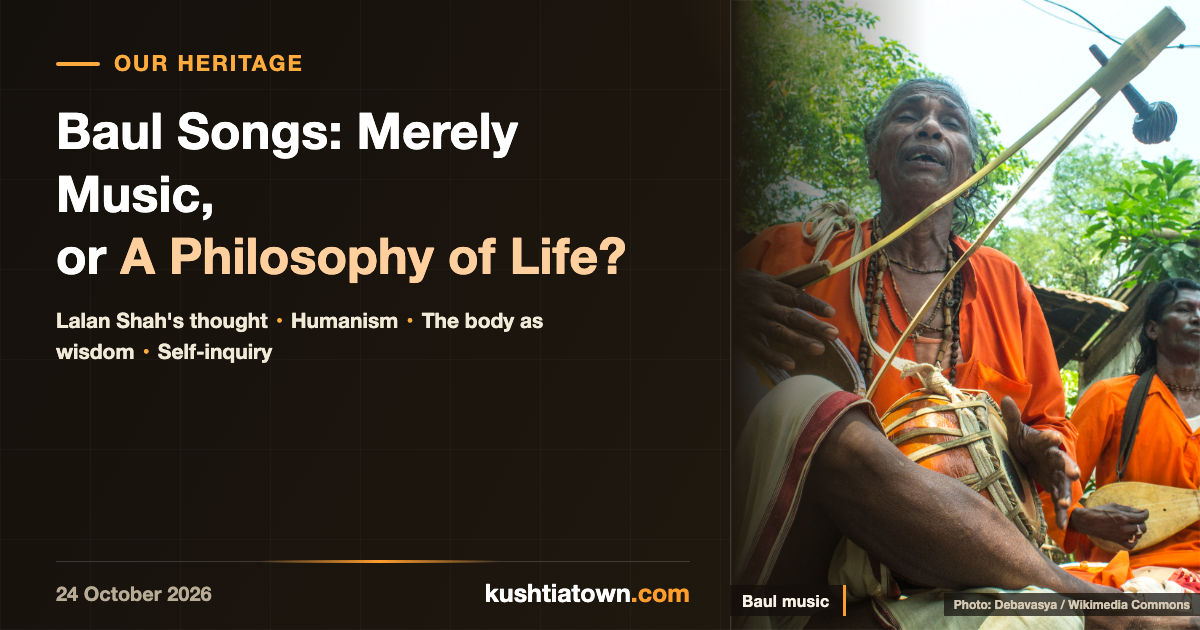
On the soil of Bengal a musical tradition has grown whose purpose is not merely to entertain; it teaches people to look within, to seek the meaning of life and to understand the relationship between human beings anew. This tradition is the Baul song. Rendered to the strains of the ektara, dotara, khamak or dugdugi, Baul songs stir the listener's heart. But entering deeper into their words, one finds profound questions of self-inquiry, love of humanity, spiritual practice, deha-totto (the wisdom of the body) and social division.
On the soil of Kushtia, it was the great mystic Fakir Lalon Shah who carried this tradition to a special height through his spiritual practice and music. In his songs, humanity, the mind, identity, caste, the guru and the mystery of creation return again and again. His songs do not merely express feeling through melody; they teach the listener to ask—Who am I? How shall I know another person? And where shall I look for the meaning of my existence?
To see the Baul song as merely a branch of folk music is to miss its full significance. For Baul practitioners, the song is often the language of sadhana, a vehicle of philosophy and a path to understanding life. UNESCO, too, has recognised Baul music as a tradition in which song, poetry, dance and the life of practice are bound together. According to UNESCO, Baul songs were proclaimed a masterpiece of the oral and intangible heritage of humanity in 2005 and inscribed on its official Representative List in 2008. UNESCO's page on Baul songs
The question therefore remains—are Baul songs merely songs, or a philosophy of life? To find the answer, one must understand the ideas embedded in Baul thought, the songs of Lalon Shah, and the historical context of Baul practice.
What Are Baul Songs?
Baul songs are a distinctive stream of Bengali folk music. Bound up with them are spiritual practice, love of humanity, self-inquiry and reflections on the relationship between creation and humankind. The Baul tradition flourished across Bangladesh and the various regions of West Bengal in India. It has many historical connections with the folk beliefs of Bengal, Vaishnava devotion, Sufi thought and other spiritual lineages.
Yet Baul philosophy cannot be seen as a simple copy of any single religious doctrine. Different Baul practitioners and lineages differ in their beliefs, methods of practice and interpretations of songs. This very diversity is what makes the Baul tradition distinctive.
Baul songs are generally composed in plain, accessible Bengali, but their substance is often expressed through metaphor, symbol and coded language. Words like 'mon' (the mind), 'moner manush' (the person of the heart), 'deho' (the body), 'guru', 'bhab' and 'ochin pakhi' (the unknown bird) are not used only in their literal sense; depending on context they may carry suggestions of a person's inner world, identity, spiritual realisation or the mystery of existence.
For this reason, although Baul songs are a pleasure to hear, grasping their deeper meaning requires attention, cultural context and some familiarity with the language of the songs.
Baul Songs and the Philosophy of Life
By a philosophy of life we mean how a person sees life, explains their own existence, builds relationships with others, and which values they hold important. A large body of Baul song expresses precisely these questions in various forms.
To the Baul practitioner, the song is not merely a performance. Through it they express their own realisation, teach the disciple, and move the listener toward self-inquiry. UNESCO's description likewise notes this educational and spiritual role of Baul songs. From guru to disciple, the songs and their practice have spread through oral tradition. UNESCO's safeguarding plan
Several important aspects of this philosophy of life stand out.
First, the attempt to know the human being. People often rely on external identities for their sense of self. Baul thought places weight on understanding a person's inner world, consciousness and conduct.
Second, questioning one's own mind. How aware are we of our own errors, desires, pride, fears and limitations? This question returns in Baul songs in many forms.
Third, the worth of humane relationships. The idea of valuing a person's human essence rather than judging them by social identity finds special expression in Lalon Shah's songs.
Fourth, self-inquiry. Alongside knowing the outer world, Baul philosophy holds that knowing one's own inner world is equally necessary.
From this standpoint, the Baul song is at once music and a method of understanding life. Yet not every Baul song can be explained by a single philosophical formula; the language of each song, its author and its lineage of practice must be considered.
Why Does the Human Being Matter So Much in Lalon Shah's Philosophy?
Any discussion of Bengal's Baul tradition must specially mention Fakir Lalon Shah. His songs give deep expression to the longing to know the human being, the search for identity, and questions about prevailing social divisions.
One important aspect of Lalon's thought is his questioning of the habit of fixing a person's identity through external marks alone. Society divides people by religion, caste, colour, dress or social standing. But what is a person's real identity beyond these markers?—that question returns again and again in his songs.
His famous song "Sab loke koy Lalon ki jat sangsare" (Everyone asks what faith Lalon belongs to) gave this question a special place in the history of Bengali music. To grasp its central idea, one sees that here the habit of confining people to fixed categories of identity is put to self-inquiry.
Lalon's humanist vision is not confined to criticising caste. It is a larger call to understand the human being. His songs reflect the need not to rush to judgement about another's identity but to perceive their human essence.
Research published in the Bangla Academy's Folklore Journal has also discussed the cultural significance of Lalon Fakir's humanist and anti-discriminatory thought. Bangla Academy Folklore Journal
However, explaining Lalon's philosophy purely in the language of modern human rights does not capture all its dimensions. His songs also embrace spiritual practice, deha-totto, the guru-disciple bond and the search for the moner manush. Only by considering these together can the breadth of his thought be understood.
Caste and Social Division in Baul Thought
Identity-based division in human society is ancient. Religious identity, caste, colour, occupation, wealth or social rank—for many such reasons people drift away from one another.
An important stream of the Baul tradition questions these external divisions. Especially in Lalon Shah's songs one finds a deep inquiry into human identity and the very notion of caste. If we judge a person only by birth-identity, how much of their human essence do we truly know?—that question belongs to the inner logic of his songs.
From this philosophy it follows that in judging human worth, a person's humane conduct, realisation and relationships deserve more weight than external identity.
Yet the social standing of the Bauls was not always in harmony with their philosophy. Historically many Bauls and fakirs lived on the margins of society. UNESCO's description likewise notes that the Bauls are a marginalised group in various ways, and that their condition has grown harder in recent decades with the general impoverishment of the countryside. Distance and misunderstanding between conventional society and their practice and way of life have arisen at many times.
So if the Baul song is seen only as music performed on stage, an important part of its social history remains invisible.
Deha-Totto: The Practice of Knowing One's Own Existence
In Baul philosophy, 'deha-totto'—the knowledge of the body—is a central theme. Here the body is not treated merely as a biological organism; it is also regarded as the field of a person's existence, consciousness, practice and realisation.
Baul songs abound in symbols and metaphors surrounding the body. Within the human body itself occur the experiences of life, feeling, mind and consciousness. Hence the question of knowing one's own body and existence holds special importance in Baul practice.
UNESCO's description records that the Bauls emphasise the human body as the very place where the divine resides—in other words, the body is seen as an essential field of spiritual inquiry. But interpretations of deha-totto are not uniform across all Baul lineages; some readings are broadly metaphorical while others are tied to specific methods of practice.
Understanding this requires care with the coded language of Baul songs. A song mentioning 'ghor' (the house), 'deho' (the body), 'pakhi' (the bird) or the 'moner manush' cannot be pinned to a single meaning. Its sense must be drawn from the song's full statement, the author's thought and the relevant lineage of practice.
There is a wider significance to this discussion too. Unless a person is conscious of their own body, mind, conduct and the limits of their life, self-inquiry remains incomplete. Many of the metaphors of Baul song bring precisely this self-questioning to the fore.
'Moner Manush': The Search for the Inner World
Among the best-known ideas of Baul song is the 'moner manush'—the person of the heart. The phrase is simple, but its meaning is deep and many-layered.
In ordinary usage the moner manush may mean a beloved person. But in the spiritual context of Baul song it carries deeper senses. In some songs the moner manush is interpreted as the being sought within oneself, the goal of spiritual realisation, or a symbol of a person's latent longing.
In Lalon Shah's songs the search for the moner manush is especially significant. Here the quest is not merely an effort to find something in the outer world; the question of understanding one's own inner world is bound up with it.
People often depend on outward achievement in the search for happiness, peace or fulfilment. But without awareness of one's own mind, desires, limitations and relationships, even outward success cannot grant complete contentment. Seen through Baul thought, this question takes on new light.
Yet it is not enough to explain the moner manush as a psychological concept alone. In Baul practice it also has spiritual senses, which different songs and lineages may express in different ways.
The Guru-Disciple Bond: From Song to Realisation
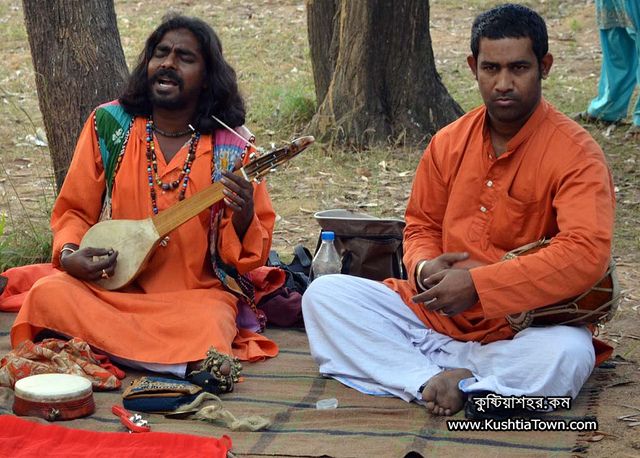
In the Baul tradition the role of the guru is important. The guru does not merely teach songs; they can also show the disciple the meaning of the songs, the discipline of practice, and the path of realisation in life.
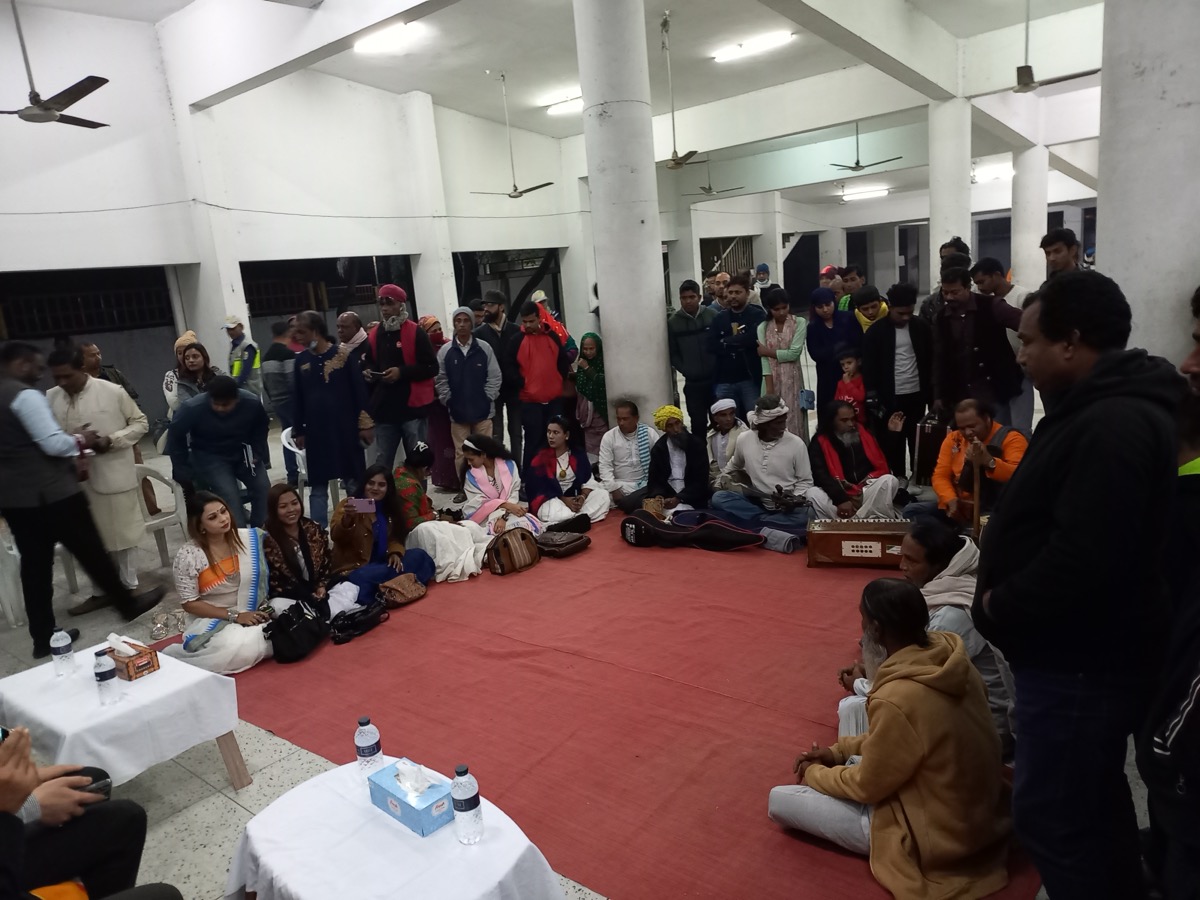
The everyday song gathering at the shrine of Lalon Shah in Cheuriya. Photo: Towhidul Islam / Wikimedia Commons, CC BY-SA 4.0
Historically, Baul songs and their practice have been preserved largely through oral tradition. A practitioner teaches through their songs; the disciple absorbs the songs and the thought they carry and passes them to the next generation. In this process a song is never merely something to memorise; understanding its meaning and the context of its practice becomes essential.
Through the guru-disciple relationship, many songs, melodies, styles of performance and interpretations of coded words have travelled from generation to generation. Yet over time the language, tunes and presentation of the songs have also changed.
In modern times, YouTube, digital audio, social media and recording technology have spread Baul songs rapidly. This creates opportunities for preservation and for new audiences. At the same time there is a risk of losing a song's authentic text, its author's identity and its spiritual context.
Preserving the Baul tradition therefore requires more than recording songs; a song's reliable text, its melodic features, its authorship and the information of its lineage of practice must also be documented.
Nature, Love and Human Feeling in Baul Songs
Confining Baul song to difficult spiritual theory would leave much of its beauty unexamined. Love, separation, longing, tender hurt, waiting and the transience of life are all important subjects of the Baul song.
Many Baul songs voice inward yearning through the language of love. Waiting for the beloved, the ache of meeting, the pain of parting—these sometimes carry the feeling of human relationships, and sometimes become metaphors of spiritual seeking.
Nature's imagery also runs through Baul song. Birds, rivers, boats, home, road or unknown lands—such pictures appear as symbols of human life, journey and existence.
These symbols are what make the language of Baul song at once simple and profound. The general listener can enjoy the melody and feeling, while the attentive listener may seek other meanings of life within the words.
Are Baul Songs the Songs of Any Particular Religion?
The Baul tradition has long historical contacts with Bengal's various religious and spiritual currents. Elements of Vaishnava devotion, Sufi thought, Bengal's folk beliefs and other lineages of practice are reflected in various ways in Baul music and philosophy.
But it would not be right to confine Baul song to the music of any single institutional religion. UNESCO's own description notes that Bauls do not identify themselves with any organised religion or the caste system. Many practitioners of the Baul stream followed their own path of practice beyond conventional religious identity, caste and social restrictions. And the beliefs or ways of life of all Baul practitioners are not the same.
Understanding this diversity matters. Alongside recognising the tradition's spirituality, love of humanity and self-inquiry, respect is due to the distinct beliefs and practices of its various branches.
Here lies the humane appeal of Baul song—it calls people to reflect on their own identity, to understand others, and to face the deeper questions of life.
Baul Songs Today: Stage, Media and Commerce
Today Baul songs are performed not only in village akhras, sadhu-sangha and local assemblies but on television, YouTube, audio-streaming platforms and large stages. As a result, a new generation has the chance to hear Baul songs, and Bengali folk music is becoming known internationally.
This is a positive change. Recording technology is helping preserve old songs, artists are reaching new audiences, and the economic prospects of folk music are growing.
But commercial performance brings challenges. Sometimes lyrics are altered, sometimes the author's name is not properly credited, and sometimes spiritually profound songs are reduced to mere entertainment.
A balance is needed here. Performing Baul songs in modern ways, or setting them to new arrangements, is not in itself wrong. Folk music changes with time. But alongside such change, responsibility is owed to the song's core message, the author's identity, the melodic tradition and the cultural context.
Fair remuneration for artists, transparency in song collection and the publication of reliable information are also part of preserving the Baul tradition.
Why Is Preserving the Baul Heritage Urgent?
Baul song is an important part of Bangladesh's cultural identity. Within it lies a rich store of folklore, music, spiritual practice, oral history and social thought.
Several efforts are important for preserving this heritage.
First, building reliable collections of songs. A song's correct text, authorship, melody, style of performance and authentic recordings need to be gathered.
Second, interviewing elderly practitioners and artists. Their memories, interpretations of songs, guru-disciple lineages and regional performance styles, if documented, would preserve much information now at risk of being lost.
Third, expanding research and education. Universities, cultural institutions, folk-music researchers and local organisations can study Baul songs jointly.
Fourth, attending to artists' living standards. The Baul heritage survives not only through songs and recordings; its future is tied to the lives of the artists and practitioners who carry it.
Fifth, engaging the young generation. Through song-learning workshops, documentaries, digital archives and cultural events, the new generation can be introduced to the history and philosophy of Baul songs.
UNESCO's Baul songs safeguarding project likewise emphasised the transmission of songs and tradition from gurus to young learners, documentation, and awareness-raising through Baul fairs. Notably, that project centred on the Baul community of the Kushtia region—where, as UNESCO's records note, the great Baul guru of Bengal, Lalon Shah, lived and created a tradition of intergenerational transmission of Baul songs. Implemented between 2008 and 2010 with funding from the Japan Funds-in-Trust, the project comprised guru-disciple workshops, a nationwide census and register of Bauls, publication of notations and recordings of songs, and the organisation of Baul fairs.
So, Are Baul Songs Merely Songs?
If Baul songs are judged only by the beauty of melody, rhythm and voice, one important aspect is certainly captured. But entering into their words, one finds that many Baul songs raise questions of human existence, identity, love, self-inquiry, social division and spiritual realisation.
Especially in Lalon Shah's songs, the longing to know the human being and the inquiry into the limits of external identity remain relevant today. When people push others away on grounds of religion, caste, class or social standing, the humane appeal of the Baul song can be felt anew.
Yet confining Baul song to a humanist message alone does not exhaust it either. It holds spiritual practice, deha-totto, the guru-disciple bond, the metaphors of love and the questions of life and death. These several dimensions together have enriched the philosophy of the Baul song.
The Baul song is thus at once music, poetry, the language of sadhana and a medium of reflection on life. To the listener it can be a source of joy; to the practitioner, a path of self-inquiry; and to the researcher, an important key to Bengal's history, literature and folk philosophy.
Conclusion: A Call to Seek the Human Within the Melody
The power of the Baul song lies not only in its melodic sweetness; deep within it lies a call to see humanity anew. It teaches us to question our own mind, reminds us not to rush to judgement about another person's identity, and opens the space to seek life's deeper meaning.
The songs of Fakir Lalon Shah are among the brightest expressions of this tradition. In his thought, the question of knowing humanity, the doubt about divisions of caste, and the search for identity have deeply influenced Bengali culture. To grasp the weight of that thought, one must understand not only the song but its language, metaphors and historical context.
Sustaining the Baul heritage requires honouring the artists, preserving reliable texts of songs, expanding research and carrying its philosophy to the new generation. Then the Baul song will not remain a heritage of the past alone; it will remain meaningful to the people of the present and the future.
Baul songs, then, are not merely songs—they are a distinctive cultural path that questions the human mind, identity, love, sadhana and existence. To grasp their full significance, however, one must know not only the beauty of the melody but the song's message, the practitioner's philosophy of life, and the many-layered history of the Baul tradition.
Sources and Further Reading
1. UNESCO — Baul Songs
ich.unesco.org/en/RL/baul-songs-00107
2. Bangla Academy Folklore Journal — বৃহত্তর ময়মনসিংহ অঞ্চলের বাউল গানে লালন মতাদর্শ (Lalon ideology in the Baul songs of Greater Mymensingh)
journal.banglaacademy.gov.bd/index.php/BAFP/article/view/43
3. University of Dhaka, Sahitya Patrika — লালনের গানের পাঠ-সমীক্ষা (A study of the readings of Lalon's songs)
journal.bangla.du.ac.bd/article/view/405
4. Sahapedia — বাউল/Baul
sahapedia.org/বাউলbaul
5. UNESCO — Action Plan for the Safeguarding of Baul Songs
ich.unesco.org/en/projects/action-plan-for-the-safeguarding-of-baul-songs-00047
6. Cover and article photos — Wikimedia Commons: Debavasya and Towhidul Islam (both CC BY-SA 4.0)