বাংলা
 English
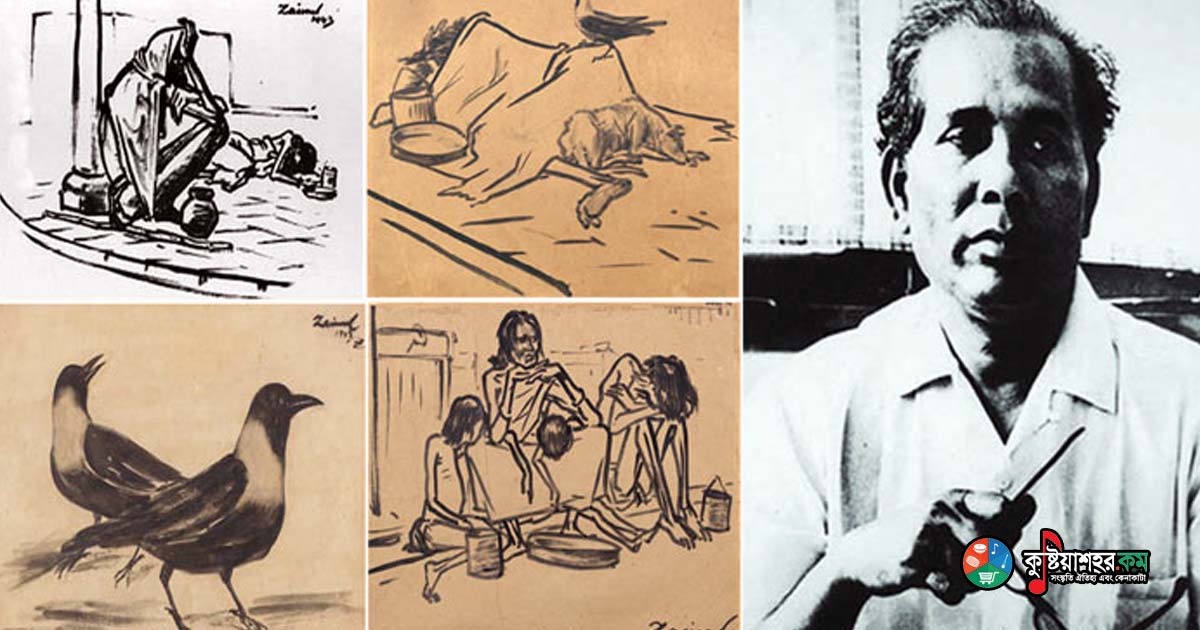
Zainul Abedin (born 29 December 1914 - died 28 May 1976) was a famous Bengali painter of the twentieth century. For his lifelong efforts to spread education in the art of painting in East Bengal, that is Bangladesh, he received the title of Shilpacharya.
His famous works include the Famine Sketches, Sangram (Struggle), a Santal woman, Storm, Crow, The Rebel and others. In 1970 he painted his famous 65-foot-long picture Nobanno on the festivities of rural Bengal.
Zainul Abedin was born on 29 December 1914 in Kendua, Kishoreganj sub-division of the then Mymensingh district. His father Tamizuddin Ahmed was a police daroga (sub-inspector) and his mother Zoyanunnesa was a homemaker. Of nine siblings, Zainul Abedin was the eldest. His schooling began within the family's own environment.
From a very young age he loved to draw. He drew birds' nests, birds, fish, cows and goats, flowers and fruits and showed them to his parents. From childhood he had a deep interest in the arts. At only sixteen, he ran away from home and went with friends to Calcutta just to see the Government School of Arts. After visiting the Calcutta Government School of Arts, Zainul Abedin could not settle into ordinary studies. So in 1933, even before the matriculation examination, he gave up his school studies and went to Calcutta, and with his mother's approval he was admitted to the Government School of Arts. Seeing Zainul Abedin's interest, his mother sold her own necklace to help enrol her son at Calcutta's art school of the time. Zainul Abedin studied at the Calcutta Government Art School from 1933 to 1938. In 1938 he graduated from the Drawing and Painting Department of Calcutta's Government School of Arts, standing first in the first class.
In 1947 British-ruled India was partitioned into two countries, namely India and Pakistan. East Bengal received the new name East Pakistan, which later, in 1971, was established as an independent state under the name Bangladesh. Zainul Abedin was the leading personality of East Bengal's first generation of artists. After the partition of India in 1947, the need was felt for an art education institution in East Pakistan. On Zainul Abedin's initiative, in 1948 the Government Art Institute was set up in a dilapidated room of the National Medical School on Johnson Road in old Dhaka. At the outset it had only 18 students. Zainul Abedin was the institution's first teacher. In 1951 the art institute was moved to a house in Segunbagicha. In 1956 the art institute was moved to Shahbagh. In 1963 it was recognised as a first-class government college and was named the Government College of Arts and Crafts of East Pakistan. After Bangladesh's emergence in 1971, the same institution was renamed the 'Bangladesh College of Arts and Crafts'. From 1948 to 1966 he served as the founding principal of the College of Arts and Crafts.
At Zainul Abedin's interest and planning, the government established the Folk Art Museum at Sonargaon in Narayanganj and the Zainul Sangrahashala (collection) in Mymensingh in 1975.
Zainul Abedin earned special fame for his Famine Sketches of 1943. Besides this, his famous works of art are: Boat (1957), Struggle (1959), Valiant Freedom Fighter (1971) and Madonna, among others, particularly noteworthy. His two long scrolls, Nobanno painted in 1969 and Monpura-70 painted in 1974, are two much-loved works of art. He spent far more time on spreading art education than on painting. It is estimated that his works number more than three thousand.
The number of his works collected by the Bangladesh National Museum is 807. About five hundred more of his paintings are preserved in the Bengal Foundation's collection. More than four hundred of his works are still preserved with his family. The number of works kept in the Mymensingh collection is 62.
Besides, a vast number of his works are preserved in various collections in Pakistan.
In his personal life, Zainul Abedin was bound in marriage to Jahanara Abedin.
For his lifelong efforts to spread education in the art of painting in East Bengal, that is Bangladesh, he received the title of Shilpacharya among the public. Among Bangladesh's painters he is regarded as the guru of the arts. A gallery at the Faculty of Fine Arts bears his name. In 2016 the 35th gallery of the Bangladesh National Museum was arranged as the Shilpacharya Zainul Abedin Art Gallery.
On 9 July 2009, the International Astronomical Union named a crater on the planet Mercury the Abedin Crater, in view of his deepening of humane values and awareness in human civilisation. On the occasion of his birthday, festivities are held on the Dhaka University campus and a children's painting competition is arranged at the Shilpacharya Zainul Abedin Sangrahashala (art gallery).
His sketches have been sold at Bonhams, the world's oldest and largest British auction house. In 1958 he received the then Pakistan government's highest title, Hilal-i-Imtiaz, in 1968 the title 'Shilpacharya' from the students of the Dhaka Art College, and in 1974 the honour of National Professor from the Government of Bangladesh.
On his 105th birthday, Google honoured him with a doodle feature.
In 1958 the Pakistan government awarded him the Pride of Performance prize for his noteworthy contribution to painting.
Zainul Abedin passed away on 28 May 1976. He was buried beside the grave of the national poet Kazi Nazrul Islam at the Charukala Institute on the University of Dhaka campus.