বাংলা
 English

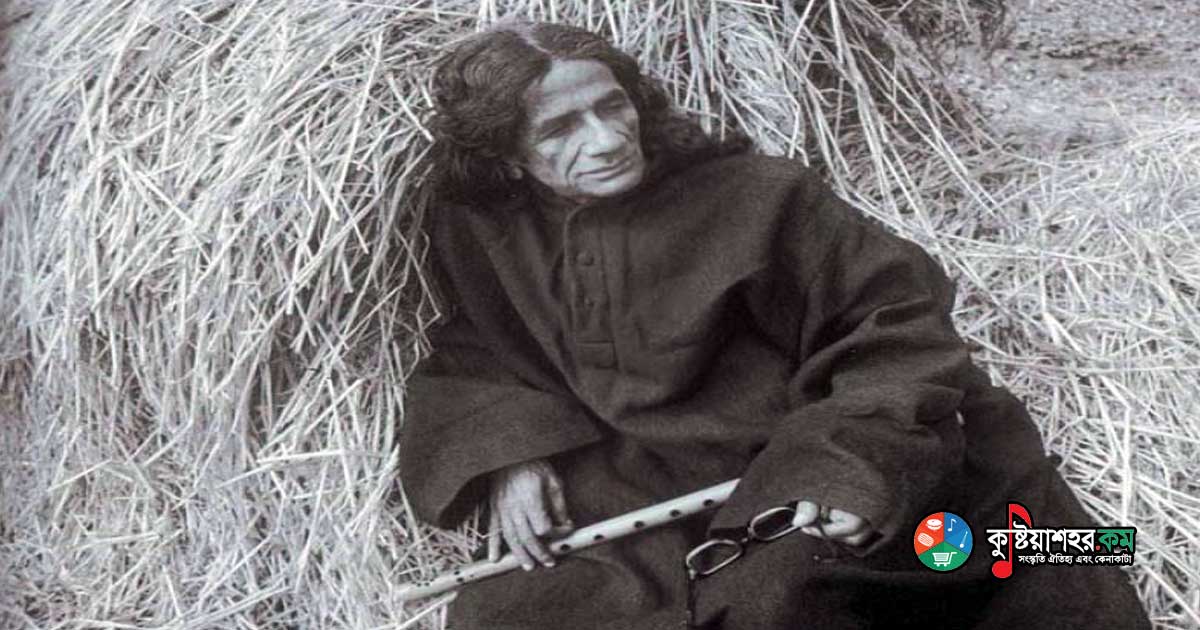
While reviewing Panju Shah's self-revelation, hints have been given about his spiritual thought. The influence of spiritualism in philosophy is undeniable. For this reason, despite judging philosophy, a separate discussion is needed on the nature and distinctiveness of Panju Shah's spiritual thought. Here remains the endeavour to shed a little light on the subject.
Religious feeling and belief are closely related to the essence of spiritualism. The essence of traditional religious faith is "the recognition of a vast consciousness - a being behind the world's countless varieties". This all-pervasive consciousness - being itself bears such names in the scriptures as Allah, Khoda, Bhagaban, God and so on. In philosophy this conscious being bears the name of the Absolute Being (paramasatta), the Absolute. History shows that philosophers have found the hint of spiritualism within the feeling of oneness. This feeling of oneness is described in the scriptures in various ways. Therefore the ancient circle of spiritualism's supporters made the endeavour to prove spiritual doctrine through the interpretation of scriptural sayings. In ancient times the spiritualists began their philosophical analysis with profound religious feeling. As a result, in their philosophy the place of God comes first and the place of the world after. It is from the feeling of God that the descent into the feeling of the temporal world takes place. This is the great characteristic of their philosophical thought.
From the beginning to the end of their religious thought, the Muslim philosophers have tried to discover a reconciliation of religion and philosophy, and at its root lies the conviction of this same truth. Although Platonic, Aristotelian and Neo-Platonic lines of thought were used in forming their own philosophical doctrines, what gained predominance was the explanation of the relation of the trans-knowledge (gyanatit) being - that is, the daya being - with the beings grasped by the senses. As a result, the Mutazilites and the Asharites, despite their inner conflict, influenced by the philosophers mentioned, accepted the doctrine of the virtuous being granted a vision of Allah on the Day of Resurrection, and explained its consistency and possibility according to their own philosophical tenets. In this, recognition was expressed of one 'all-pervasive singular consciousness' which is not inert matter, not a divisible being, not accurately describable.
The exponents of spiritualist philosophy are divided into two camps. One camp of philosophers, placing excessive importance on the all-pervasive singular consciousness, has almost entirely disregarded the theoretical value of everyday life. The other camp has tried to determine doctrine by combining this 'eternal, imperishable, flawless all-pervasive singular consciousness' and 'the world of experience - flowing, mortal, fleeting, flawed'. Yet both camps have accepted this all-pervasive consciousness as the greatest being. In their view, one name of this being is 'Bhuma' and the other 'Brahma'. In philosophical literature the word 'Brahma' is more prevalent. Now, the customary name of the school of those spiritualist philosophers who determine this singular, all-pervasive, eternal, plenary essential being as the ultimate doctrine of the world is Brahmvad or Monism (ekatvabad). Monism is again of two kinds, namely - undifferentiated monism and differentiated monism. According to undifferentiated monism, Brahma alone is the supreme and ultimate being; the world has no true being of its own. And according to the latest monism too, Brahma is the supreme being, and as the inseparable expression of Brahma the being of the world also exists.
Panju Shah's spiritual thought is based on this undifferentiated monism. In his view the being of the world is dependent on human feeling. As long as man does not know Brahma, for so long the feeling of the world remains vast to him. The moment he knows Brahma, the being of the world is at that very moment lost in Brahma-being. Even man himself becomes one with Brahma. In Panju's life this Brahma-feeling awakened very slowly yet profoundly. For this reason, while abiding in family, society and the country-age, he was able to look upon everything with the vision of renunciation. Even while running his household with wife and son, kinsfolk and belongings, it became possible for him to feel 'the all-pervasive singular consciousness'; after the dissolution of this world, that singular Brahma - who in religious language is Allah - will take the account of the jinn and human beings -
He will take the account of the good and the bad.
It is worth noting that the spiritualism of Panju Shah, a believer in the conception of this world and the hereafter, is the successor of all the philosophers of this line, from the undifferentiated Brahmvadi Shankaracharya of the eighth century down to Vivekananda of the nineteenth century. Not only that, one can discover the wonderful consonance of Panju Shah's line of thought with the thought of Plato, philosopher of the pre-Christian era, that is, long before Shankara, of his follower Plotinus, of the mystic philosopher Ibnul Arabi, and of the mystic poet-philosopher Molana Rumi 3.
The world will be destroyed, and with it all creation will vanish. On the path of spiritual practice, Panju Shah wishes, while still alive, to forsake 'I-ness' in the hope of deliverance from the annihilating agony of this destruction. This is called fana in religious language - attainment. In fact, fana is death while living, or the erasure of the ego. In the world of sadhana, 'goribi' (poverty) means being detached from all the objects of the world and completely erasing 'ahom' (the ego) so as to behold that singular plenitude. Through this sadhana the seeker attains the fullness of eternal life. Then his life-dharma, covered over by egotism, merges away, and by the grace of the Seer he becomes fulfilled in an inspired way. Then all his claims and relations come to an end. 'Fana' does not mean the destruction of personality. Fana is simply the name of becoming full in the qualities of true truth and true being, with the mortal-mindedness that stands as an obstruction to sadhana wiped away. The state of the path of fana through love is 'hal', or the 'dasha' of the Bauls and Vaishnavas. For this there is need of inner insight, of the repetition with the breath, and above all of the grace of that object of love. Having reached this state, Panju says -
behold how the difference of being a servant is.
Some interpret this fana as the nirvana of the Buddhist faith. But in fact 'fana' and 'nirvana' are not the same. Moreover, the Sufi mystic seekers are not partisan to nirvana either. This has been discussed before. Here only this much need be said: after fana, 'baqa' is a special stratum of Sufi practice. At the beginning of this state the seeker's self dissolves in Khoda's hand. Then there is no love, there is no lover; the seeker's entire being in this case passes into dissolution; likewise the seeker's entire being dissolves into that One. Just as lovers and beloveds, after long separation, on meeting each other become void of knowledge and gaze upon each other with unwinking eyes, and just as in their mutual union they become silent and motionless, forgetting themselves, so too the seeker's faculty of consciousness, passing into dissolution within that One, falls unconscious like inert matter. At that time there is no knowledge of duality at all. At that time the divine light (nur) does not become visible, or no descent or ascent of the light can be felt. This state is called 'ahadiyat'. Later, owing to the quality of the Beloved's indifference (beniraji), a kind of consciousness is born. By it creation comes to understand creation as itself; coming into the mutual 'tain'-aul, there is a kind of extremely subtle light, without exemplar of the Seer, which encompasses all creation and in which creation remains immersed in that all-pervasive, incomparable ocean of light, at whose ripples the world has assumed ever-new states; the seeker comes to know that light as the nur of the most holy Khoda Tala. This state of the arising of knowledge endowed with consciousness is called 'baqa-billah'. Panju Shah has expressed precisely this practice in his spiritualism. In his words:-
this life becomes naught,
in some birth in some form as baqa
I worship Sai's feet..
Therefore the chapter of Panju's sadhana is not the simplicity of liberation; it is the sadhana of love and devotion. But in the realm of power and glory he (Brahma) is infinite and boundless; there it is impossible to reach him. But where he has come of his own accord and revealed himself under the obligation of the play of love, it is that object of love that we go about searching. Here one more point: to the sadhaks of the primary stratum (the shariat-followers), 'Brahma' or the Seer is a mighty, resplendent 'Lord'. And in the eyes of the mystics (the marifat-followers), 'He' is the object of love, who is to be won by the path of love, by the single-minded devotion of the heart. Therefore the worship of the common path-followers is of glory, but the worship of the mystics is of sweetness. In Panju's spiritualism there is the hint of making the heart's beloved realised through the worship of this sweetness. He says -
wealth is won on the rosary of the mind.
The heart's beloved repeats it with each breath,
seat him on the lotus of the heart.
In fact this 'heart's beloved' is the true vessel of love. Therefore the connoisseurs of doctrine say - 'Love itself is the sadhana; the cultivation of the body is vain; only kaya-yoga is the spiritual discipline; the outer deity, the temple, the worship - all are vain; the outer rites and sects are all fruitless. In essence, kaya-yoga and the primal folk are Bengal's own spiritualism. Discussing Rabindranath's spiritualism in this connection, Ashutosh Bhattacharya says - "Rabindranath's feeling of world-love finds its fulfilment through his spiritual feeling or God-feeling. Rabindranath's sense of humanity is not the sense of humanity of the West; his reliance is entirely upon the Indian ideal, and his feeling of world-love too is dependent upon his conception of God.1 In the mystic mind of Bengal the appeal of this world-love is eternal.
There is no reckoning of lineage here. Panju Shah sang -
and made a spectacle of the feast.
The seeker has found Bengal's true life-treasure, whose essence is the human flavour of feeling. Here there is no difference between Hindu and Muslim. In Muhammad Mansuruddin's words - 'Muslim spiritual practice has been joined with Hindu spiritual practice. Like the Ganga and the Yamuna, the mystic practice of Ram and Rahim flows together.3 Panju Shah is a follower of this practice. As a mystic poet who worships humanity on the basis of the unmanifest thought of undifferentiated monism, the development of his consciousness is of special importance. The poet was born with a mind as generous as a vast ocean. His object of worship is the all-pervasive being, who is 'banza kalpataru, the fallen saviour, the guru of the world.'
To realise this guru of the world, a human guru or murshid is needed. This matter has been touched upon in the discussion of 'philosophy'. Briefly it may be said here that although guruvad is to be avoided in philosophy, in the mystic mind 'guruvad' is the only doctrine. A follower of the mystic poets such as Rumi, Jami, Hafiz and Sadi, and a follower of Siraj, Lalon, Hiruchand and others, Panju Shah has accepted the guru of his spiritual thought as the only helmsman on the path of Brahma. His conscious mind's statement on this has found expression. In his words:-
now the life of yearning goes to the realm of Yama.
Panju Shah's spiritualism is no unreal or fictitious imagination. To realise the Seer a paygambar (prophet) is needed, and to know the paygambar a guru is needed. Through the merit of the learning received from the guru, 'dehatatta', 'manushtatta', 'the doctrine of the heart's beloved' and so on are known in a novel way.

An integral thought-consciousness has created doctrine-sayings and doctrine-songs in Panju's mind. In the end, the poet's spiritual message also found the opportunity to develop in the form of poetry and song. Taking the form of art in the form of spiritualism, it rises enlivened in the flavour of literature; Panju's literature is its proper proof. 'In the simplicity of language, in the gravity of feeling, in the pathos of melody, whose like cannot be matched - in it has mingled the doctrine of knowledge as well as the flavour of devotion.' Panju Shah's spiritualism is a synthesis of religion, philosophy and metaphysics, through which a pure doctrinal thought has developed.
- The life story of Panju Shah
- Modernity in Panju's writings
- Panju Shah's - contribution
- A brief history of Panju Shah's forefathers
- Mystic poet Panju Shah: life and philosophy