বাংলা
 English
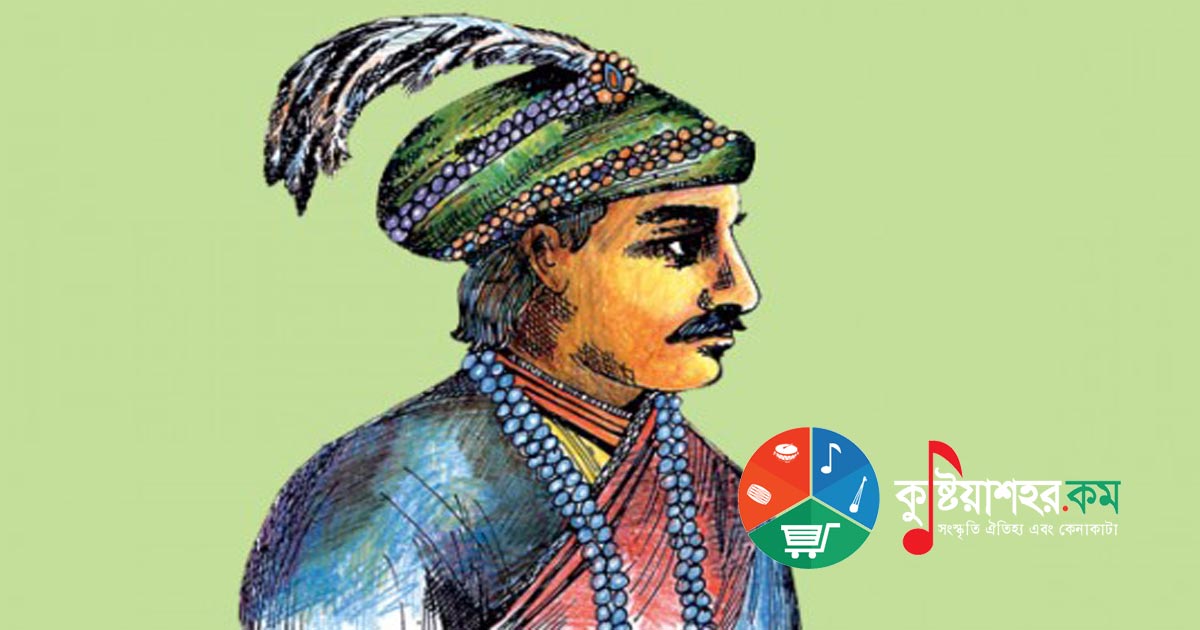
Nawab Siraj-ud-Daulah, or Mirza Muhammad Siraj-ud-Daulah (born: 1732 - died: 3 July 1757) was the last independent Nawab of Bengal-Bihar-Orissa. After his defeat and death in the Battle of Plassey, nearly 200 years of British rule began in India.
The main road of Kushtia town is named Nawab Siraj-ud-Daulah Road (NS Road). Many of his descendants claim that he used to travel along this road, using it to look after the people of this region. At that time Kushtia town stretched from Kushtia's Boro Station to Ghorar Ghat, the present-day Boro Bazar. Ghorar Ghat was the chief hub of trade. The large boats of that era used to moor at this ghat to unload and collect goods. Present-day Cheuria was at that time an island across the Kali Ganga. The boatmen used to rest there.
Siraj-ud-Daulah gained the power of Nawab of Bengal in 1756 at the age of 23 from his maternal grandfather Nawab Alivardi Khan. Due to the treachery of his army chief Mir Jafar, he was defeated in the Battle of Plassey on 23 June 1757. The East India Company, led by Robert Clive, took over the administration of Bengal.
Birth and Ancestry:-
Siraj-ud-Daulah was born in 1733. Nawab Siraj-ud-Daulah was the grandson of the Nawab of Bengal, Alivardi Khan. Alivardi Khan had no son. He had three daughters. He married all three daughters to the three sons of his own elder brother "Haji Ahmad": the eldest daughter Ghaseti Begum to Nowazesh Mohammad, the middle daughter to Saiyed Ahmad, and the youngest daughter Amena Begum to Zainuddin Ahmad. Amena Begum had two sons and one daughter. The sons were Mirza Mohammad (Siraj-ud-Daulah) and Mirza Mehedi. When Alivardi Khan received the governorship of Patna, Mirza Mohammad (Siraj-ud-Daulah) was born to his third daughter Amena Begum. For this reason, considering Siraj's birth an omen of good fortune, he joyfully accepted the newborn as his adopted son. Siraj was very dear to his grandfather, since he had no son of his own. He grew up in the affection and love of his maternal grandfather. There is disagreement over Siraj-ud-Daulah's date or year of birth. However, the more widely accepted view is that Siraj-ud-Daulah was born in 1732. Mir Jafar does not fall among any of his relatives. Kazi Isa was his uncle.
Investiture as Heir Apparent:-
In 1746, when Alivardi Khan went to war against the Marathas, the adolescent Siraj accompanied him. Alivardi appointed Siraj-ud-Daulah governor of Patna while he was still a boy. Because of his young age, Raja Janakiram was appointed his regent. But this did not satisfy Siraj-ud-Daulah. So one day, taking a few trusted attendants under the pretext of travel, and bringing his wife Lutfunnesa along, he set out from Murshidabad. He went straight to Patna and appeared there, ordering Janakiram to hand over his administration to him. But without the Nawab's permission, Janakiram refused to relinquish his charge. Shutting the gates of the fort, he sent an envoy to the old Nawab with a detailed report. On the other hand, greatly enraged at Janakiram's conduct, Siraj-ud-Daulah attacked the fort. Fighting broke out between the two sides, and casualties occurred. Receiving news of the incident, Alivardi Khan hurried to the scene and restored order. That very day, in the durbar inside the fort, Alivardi Khan seated his beloved grandson beside him and declared:-
After me, Siraj-ud-Daulah alone will ascend the throne of Bengal-Bihar-Orissa.
In history this event has been called Siraj-ud-Daulah's investiture as heir apparent. At this time Siraj-ud-Daulah was only seventeen years old. However, many of his relatives could not accept the designation of Siraj-ud-Daulah as heir to the throne. Many began to oppose him. Among them were Alivardi Khan's eldest daughter Ghaseti Begum and her husband Nowazesh Mohammad. Moreover, during Alivardi Khan's lifetime, Siraj-ud-Daulah served as chief of the Dhaka navy. At that time his younger brother Ikram-ud-Daulah was in charge of the armed forces.
Ascending the Throne:-
Sujauddin Muhammad Khan, son-in-law of Murshid Quli Khan, ruled Bengal from Murshidabad as Nawab of Subah Bangla from 1727 to 1739. During his time, his son Sarfaraz Khan served as Naib Nazim of Dhaka from 1734 to 1740, and as Nawab of Murshidabad from 1739 to 1740. At this time (1739-1740) Abul Fattah Khan became Naib Nazim of Dhaka. Incidentally, ever since the capital of Bengal was moved to Murshidabad in 1717, the Nawabs resided in Murshidabad, and from then on a Naib Nazim was appointed for the Bengal dominion. From 1740 to 1744, Alivardi Khan's nephew and son-in-law Nowazish Muhammad Khan was appointed Naib Nazim. However, remaining in Murshidabad, he had his assistant Hossain Kuli Khan, and Hossain Kuli's assistant Hossain Uddin Khan (1744-1754), discharge the duties in Dhaka. From this time a rift appeared between Alivardi's nephew Shawkat Jang and Nowazish Mohammad. As a consequence of this rift, Hossain Uddin Khan was killed in Dhaka and his uncle in Murshidabad. Aga Sadeq and Aga Baker were involved in the killing of Hossain Uddin Khan in Dhaka. Aga Baker was the zamindar of Bakerganj, and Aga Sadeq was his son. While protesting against one of Hossain Uddin Khan's decisions, Aga Sadeq was imprisoned in Murshidabad by Hossain Kuli Khan.
From there he fled to Dhaka and planned the murder of Hossain Kuli Khan. The extremely honest and pious Hossain Kuli Khan was killed at night by entering his palace under cover of darkness. When the incident became known in the morning, the inhabitants of the city gathered together and turned hostile, attacking Aga Baker and his son. When they tried to pass themselves off as appointees to the post of Naib Nazim, the people demanded that they show the charter of appointment to the post of Naib Nazim. Instead of showing it, they drew their swords. In this situation, in the attack by the crowd Aga Baker lost his life, and Aga Sadeq, though seriously wounded, managed to flee. Nowazesh's closest friends were Hossain Kuli Khan and Rajballabh. Hossain Kuli Khan was in charge of Nowazesh's treasury. Frightened to some extent by that killing, Rajballabh then planned another conspiracy. Since Nowazesh was childless, he had adopted Siraj's younger brother Mirza Mehedi as his son. Mirza Mehedi died during Nowazesh's lifetime. But he had a young son. Rajballabh dreamt of seating him on the throne and himself becoming Nawab of Bengal-Bihar-Orissa in Ghaseti Begum's name. In such troubled circumstances, Alivardi Khan passed away on 10 April 1756.
All around began intense anarchy and conspiracy. The English began repairing the fortification in Calcutta without even taking the Nawab's permission. To support Ghaseti Begum, Rajballabh sent his son Krishnaballabh, with the entire treasury of Dhaka, to Calcutta into the shelter of the English. In this situation, on 10 April 1756, Shah Kuli Khan Mirza Mohammad Haibat Jang Bahadur (Siraj-ud-Daulah) ascended the throne of Bengal-Bihar-Orissa.
Initial Activities as Nawab:-
Seizure of Motijheel Palace and the Siege of Kasimbazar Fort
From the moment Siraj-ud-Daulah ascended the throne, the power of the English in Calcutta gradually began to grow. To suppress them, he ordered Watson, the factory chief of Kasimbazar, to demolish the fort walls of Calcutta and not to undertake such work in future without the Nawab's prior permission. But he carried on his work despite the order. Siraj-ud-Daulah then realized that taking advantage of internal feuds, the English were showing an arrogant nature. Therefore he first set about crushing Ghaseti Begum's conspiracy. He seized the Motijheel palace and arranged to bring Ghaseti Begum to Murshidabad. After seizing Motijheel, the Nawab set out for Kasimbazar. On 27 May his army laid siege to Kasimbazar fort. He asked Watson, the factory chief of Kasimbazar fort, to appear at the durbar and write a pledge to comply properly with his instructions. Watson was compelled to write this pledge.
Attack on Calcutta
In the same year, on 18 June, Siraj-ud-Daulah attacked Calcutta. After fierce fighting, the Calcutta fort came into Siraj's possession on 20 June. He entered the fort, sat in the durbar, and ordered Umichand and Krishnaballabh to appear there. Then, entrusting the administration of the fort to commander Manikchand, Siraj-ud-Daulah returned to the capital. He returned to the capital on 12 July.
The Battle of Nawabganj
The Delhi emperor sent a nawabi charter of Bengal-Bihar-Orissa to Shawkat Jang of Purnia. Shawkat prepared to march to war against Nawab Siraj-ud-Daulah. Receiving this news, the English secretly tried to form an alliance with Shawkat Jang. Meanwhile, the English durbar of Madras sent Colonel Robert Clive as commander-in-chief to recapture Calcutta. Siraj-ud-Daulah too set out to resist Shawkat Jang. On the way, the two sides engaged in a face-to-face battle at a place called Nawabganj. Shawkat was killed in the battle. Siraj-ud-Daulah entrusted the administration of Purnia to Mohanlal and returned to the capital.
Clive and Watson, upon reaching Falta, set out toward Calcutta. Almost without a fight they conquered the Calcutta fort. Before this, Clive and Watson had come to Calcutta and sent a proposal of peace to Siraj-ud-Daulah, and Siraj-ud-Daulah had agreed to it. But the English broke the terms and attacked Calcutta. Siraj-ud-Daulah became suspicious of the treachery of his ministers, and for this reason began trying to establish a relationship with the English. So, agreeing to all the English demands, he signed a treaty with the English on 7 February 1757. In history this treaty is known as the 'Treaty of Alinagar'. But the English did not change their attitude. Their real rivalry was with the French. But Siraj-ud-Daulah was giving the French greater preference. Fulfilling the promises of the Treaty of Alinagar (Calcutta) required the Nawab to make considerable sacrifices.
Trial of the treacherous commanders and adverse reaction
After all kinds of disorder had more or less subsided, Siraj-ud-Daulah began the trial of the commanders' misdeeds. Manikchand was imprisoned. Seeing this, Rajballabh, Jagat Seth and Mir Jafar all became frightened. To protect their interests, coming together at Jagat Seth's counsel, they began the conspiracy of deposing the Nawab with the help of the English and seating Mir Jafar on the throne. Yar Latif, secretly joining with Watson, whispered the intrigue that Siraj-ud-Daulah would very soon declare war against the English, and that this was why he had set up camp at Plassey. Clive then, keeping half of his army hidden, arrived in Calcutta with the rest, and wrote a letter to the Nawab:-
We have withdrawn our troops, and you have pitched your tents at Plassey?
Siraj-ud-Daulah, in his simple trust, ordered Mir Jafar to strike camp at Plassey and leave for Murshidabad. As soon as Mir Jafar reached the capital, Scrafton joined him and drafted a secret treaty. On 17 May the draft of this secret treaty was discussed at the English durbar of Calcutta. For Mir Jafar's signature, this secret treaty was sent to him on 10 June. But this secret meeting did not remain secret. Clive began preparing for war. Meanwhile, learning of the secret treaty, Siraj-ud-Daulah arranged to have Mir Jafar arrested. Watson fled from the capital.
The Battle of Plassey:-
On 12 June 1757 the English troops of Calcutta joined the army of Chandernagore. Keeping a few soldiers there to defend the fort, they set out with the remaining troops on 13 June. Despite the Nawab's troops being stationed at Hugli, the fort of Katwa, Agradwip and Plassey on the road from Calcutta to Murshidabad, none of them blocked the English's path. The Nawab realized that his commanders were also party to this conspiracy.
Having a hint of the rebellion, Siraj abandoned the idea of arresting Mir Jafar. He pardoned Mir Jafar and asked him to take an oath. Touching the holy Quran, Mir Jafar vowed that as long as a single drop of blood remained in his body, he would not let the independence of Bengal be harmed. Settling the internal feuds, he entrusted command of troops to Ray Durlabh, Yar Latif, Mir Jafar, Mir Madan, Mohanlal and the French commander Sinfray, and set out with them on the campaign.
From the morning of 23 June the English prepared to engage in a face-to-face battle on the plains of Plassey. The English assembled their troops in the mango grove called 'Lakshabag'. At about eight in the morning, Mir Madan suddenly attacked the English army. Unable to withstand his powerful attack, Clive took shelter with his army in the mango grove. Clive became somewhat perturbed. Mir Madan was advancing steadily. But Mir Jafar, Yar Latif and Ray Durlabh stood impassively at the very places where they had assembled their troops. Had they given even a little support, perhaps Mir Madan could have forced the English to accept defeat. Around midday a sudden downpour came, and Siraj-ud-Daulah's gunpowder got wet. Yet the brave Mir Madan kept up the fight against the English. But suddenly Mir Madan was killed by a cannon shot.
Even after Mir Madan's fall, another of the commanders, Mohanlal, was continuing the battle. He was in favor of attacking the English army against the truce.
But Mir Jafar betrayed once again and ordered his troops back to camp. Taking this opportunity, the English attacked the Nawab. The battle ended at five in the afternoon, and the Nawab's camp came into the English's possession. On the English side, seven Europeans and sixteen native soldiers were killed. Then, seeing no way out, Siraj-ud-Daulah set out for Murshidabad with two thousand soldiers to save the capital. But no one helped him to save the capital either. Siraj-ud-Daulah, with his consort Lutfunnesa and servant Golam Hossain, left the capital, reached Bhagwangola by land, and from there traveled northward by boat through the Padma and the Mahananda. His hope was that if he could reach the western region, with the help of the French soldier Mossie Nas he would go as far as Patna, gather troops from Ramnarayan, and defend Bengal with the help of the French force.
Captivity and Death:-
Reaching the capital, Mir Jafar, not finding the Nawab, sent men in all directions. On 3 July 1757, although Siraj-ud-Daulah crossed the current of the Mahananda river, the water suddenly receded due to the ebb tide, and his boat got stuck at the mouth of Nazimpur. He got off the boat and came to a market near a mosque to get food. There some people recognized him and, lured by money, informed Mir Qasim's army. There is another different opinion on this, that a fakir saw and recognized the Nawab there. That fakir had earlier been punished by the Nawab and lost one of his ears. That fakir reported the Nawab's whereabouts. They came, arrested Siraj-ud-Daulah and sent him to the capital Murshidabad. At the time of his arrest, the Nawab was accompanied by his wife Lutfa Begum and his four-year-old daughter Umme Zohura. The next day, 4 July (or, according to some, 3 July), on Mir Jafar's orders, an assassin named Mohammadi Beg, under the supervision of his son Miran, killed Siraj-ud-Daulah. It is said that after Siraj's death his body was paraded around the whole city on the back of an elephant. He was buried at Khoshbag in Murshidabad, near the grave of Nawab Alivardi Khan.
The Fate of the Family:-
Siraj-ud-Daulah's wife Lutfunnesa and her infant daughter were imprisoned in Dhaka on the orders of Mir Jafar's son Miran. Until Siraj's downfall the conspirators used Ghaseti Begum, but after Siraj's downfall they gave her no opportunity at all. At this time they imprisoned all of them — their mother Sharfunnesa, Siraj's mother Amena, aunt Ghaseti Begum, Siraj's wife Lutfunnesa and her infant daughter — in the Jinjira palace of Dhaka. After living a captive life for quite some time in the Jinjira palace in present-day Keraniganj of Dhaka, on Miran's orders Ghaseti Begum and Amena Begum were taken by boat and drowned in the river. Through Clive's intervention, Sharfunnesa, Siraj's wife Lutfunnesa and her infant daughter were saved, and later they were brought to Murshidabad. They had to live on the meager stipend given by the English Company government. A long 34 years after Siraj's death, Lutfunnesa passed away in 1790.
After Siraj was killed, Mir Jafar and Miran put Amena and the other women of the family on a few wretched boats and sent them to Jahangirnagar in an extremely humiliating and disdainful manner. Golam Hossain Tabatabai, author of Siyar-ul-Mutakherin, wrote that some time after the Siraj family was sent to Jahangirnagar, Miran gave written instructions to Yashorath Khan, the governor of Jahangirnagar and a highly respected person, that he should kill the two unfortunate old women (Ghaseti Begum and Amina). This benevolent governor was indebted to these women and their husbands for his advancement and sustenance. He refused to carry out Miran's vile instruction. Later, after being imprisoned for a long time in the Jinjira palace of Dhaka, Siraj's mother Amena and aunt Ghaseti Begum were killed by drowning in water.