বাংলা
 English
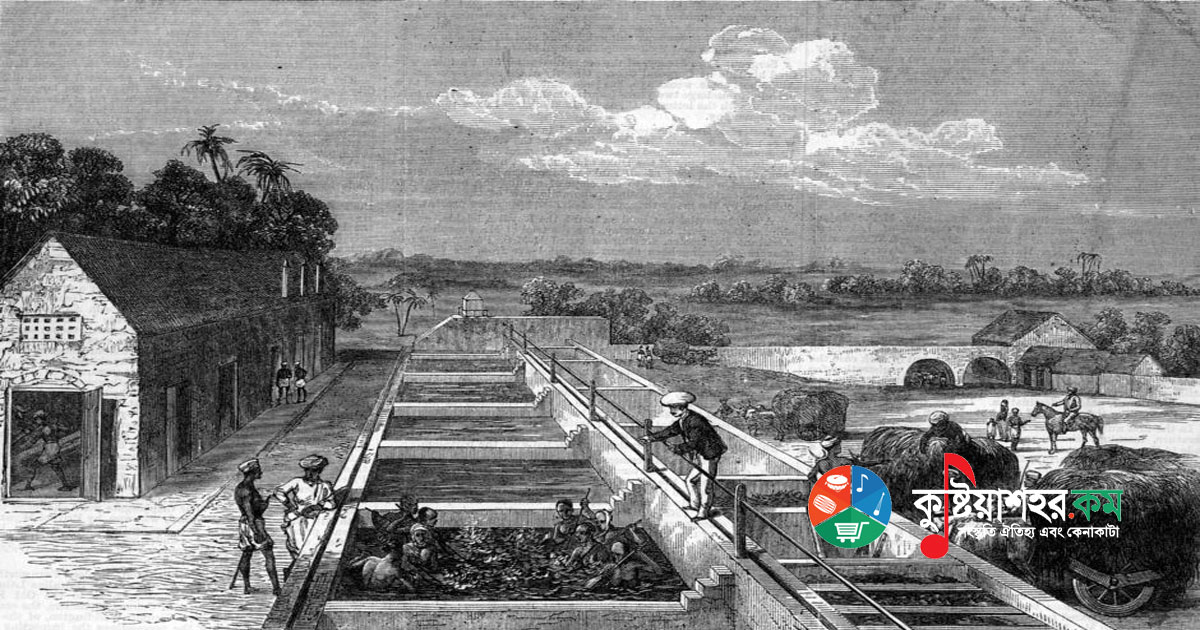
Under British rule, indigo cultivation and the indigo trade in this land, the misery they brought upon the tenants, and the revolt of conscious society and the farming community against indigo form an important chapter of history. Around indigo cultivation one finds a grim picture of the exploitation, oppression and injustice wrought on the tenants by the English sahibs, the kuthiyals and the zamindars, jotdars and moneylenders of this country. Under English rule, indigo was cultivated and traded in this land for nearly a hundred years, from 1795 to 1895. Indigo was grown on a wide scale in various places of West Bengal, including the present districts of Jessore, Khulna, Jhenaidah, Magura, Kushtia, Rajbari, Faridpur, Dhaka and Pabna. It was in this very region that the revolt against indigo cultivation took shape, known as the "Indigo Revolt". Litterateurs, journalists and educated society took up their pens against indigo cultivation.
Dinabandhu Mitra's "Nil Darpan" of Chowbaria in Jessore, the "Hindu Patriot" edited by Harish Chandra Mukhopadhyay of Calcutta, and Mir Mosharraf Hossain of Kushtia-Rajbari's "Zamindar Darpan" and his autobiographical work "Amar Jiboni" (My Life) are authoritative books on indigo cultivation. In the later period these books awakened the people against indigo cultivation. In particular, "Nil Darpan", "Zamindar Darpan" and the "Hindu Patriot" played an important role in building up the Indigo Revolt.
India has been the bearer of a tradition of its own kind through the Aryans, the Guptas, the Palas, the Senas, the Pathans, the Sultans and the Mughals; only English rule (1757-1947) is known as colonial rule in India. From the beginning of the fifteenth century European merchants kept looking for routes to different countries for trade and commerce. The names of Vasco da Gama and Columbus are famous in history. It was thus that the English came to this country for trade at the very beginning of the sixteenth century. Through various channels they went on building trading factories (kuthis). At last, seizing the opportunity, they defeated by treachery the independent Nawab of Bengal, Bihar and Odisha, Siraj-ud-Daulah, on the plains of Plassey in 1757 and turned India into their colony. Throughout the nearly two hundred years of rule by order of the British Crown, exploitation of and trade with India became their guiding creed.
At the very start of English rule they took over the authority over land revenue (1765), giving rise to a new class of zamindars. Under the Permanent Settlement of 1793, while the zamindari became permanent, the tenants' rights over the land were extinguished. The zamindars, pattanidars, dar-pattanidars, tepattanidars and chepattanidars became the real owners of the land. Cash-crop production including jute had hardly begun. Cotton, silk, saffron, sugarcane, rice, oilseeds and pulses were the principal crops. It was in this very period that indigo cultivation and the indigo trade began.
Indigo cultivation can be divided into three phases. From 1779 to 1810 was the initial period of indigo cultivation. From 1810 to 1860 — that is, up to the eve of the Indigo Revolt of 1858 — was the period of the steady rise of indigo farming and trade. The close of the nineteenth century was the period of the end of indigo cultivation.
The Industrial Revolution of the eighteenth century changed the whole pattern of the economy in England and indeed throughout Europe. Suddenly industrial factories began to flourish on a wide scale. In particular, as the textile industry developed in England, a huge demand arose for dyes for printing yarn and cloth. There were not then so many fancy chemical dyes as today; dyes produced from plants were used. The dye obtained from plants was indigo, hence the plant is called the indigo plant. And the planned production of indigo, like the planned cultivation of jute or rice, is called indigo cultivation.
Indigo is not new to this country. From the most ancient times the people of India knew of the indigo dye and also knew the technique of preparing it. The meditating Aryan sages determined the colour of the sustainer Vishnu from the colour of the sky and reflected that blue colour on cloths and emblems. Ancient Roman scholars such as Pliny described it as Indicum. Indigo is "indigo" in English, and its scientific name is Indigofera Tinctoria.
Abul Fazl's Ain-i-Akbari shows that fine indigo dye was prepared at Ahmedabad in Gujarat and at Bayana near Agra, and exported to Constantinople. From Bernier's travel account we learn that Dutch merchants lived at Bayana and other such places to collect indigo. It is not known in what process indigo dye was prepared in India at that time. In the early days of English rule, Louis Bonnaud arrived from America bringing the new method of producing indigo. It is said that it was Louis Bonnaud who introduced indigo cultivation, the building of kuthis and the indigo trade in this country. Born in 1737 at Marseille in France, by chance he went to the West Indian islands and began the indigo business; in 1777, while residing at Chandannagar, he set up two indigo kuthis at the nearby Taldanga and Gondalpara. In 1814 he joined the indigo business at Bakipur, and within a short time became owner of the Nahata concern in Jessore. Finally, in one year he exported 1,400 maunds of indigo from the Kalna indigo kuthi. He died in 1821. Without the East India Company's permission no foreign merchant could undertake any work for an indigo factory. In 1795 Bond Sahib, with the Company's permission, set up the first kuthi of this region at Rupdia in Jessore.
Thereafter, by 1811, indigo cultivation and trade had spread far and wide, with indigo kuthis being established on a massive scale in the then Nadia, Paridapur, Dhaka and Khulna regions. It may be said that from after 1811 indigo cultivation began on a large scale in the present Jessore, Magura, Jhenaidah, Kushtia, Rajbari, Faridpur and Dhaka regions. Almost every union of Rajbari district had an indigo kuthi, and in some unions as many as two or three kuthis can be traced. The largest quantity of indigo, however, was cultivated in the Pangsha and Baliakandi upazilas adjoining the Gorai and Chandana. Ruins of indigo kuthis could be seen even in the sixties at Pangsha, Joshai, Jalilpara, Babupara, Bagdul, Machpara, Kashbamazhail, Kuthimaliat, Kordi, Mrigi, Saurail, Bakshadangi, Madhupur, Ghikmala, Garakola, Baliakandi, Sonapur, Baharpur, Jangal, Sangrampur, Belgachhi, Padamdi, Kalukhali, Joshai, Durgapur, Dalagila, Kuthirhat, Barbakpur, Basantpur, Ramdia and Sekara.
On the way to school I used to see, in the village of Madhupur in Nadua union, a ruined kuthi covered with bushes. The people of the area could say nothing about that ruined kuthi. Now I realize that it was an indigo kuthi set up in the 1820s. A village of Madapur union is named Sangrampur. It is said that the ordinary farmers of that village threw themselves into the struggle against indigo cultivation, and that is why the village came to be called Sangrampur. In Jangal union there is still a homestead site which people call "Thatha Parar Bhita". It is said that to crush the revolt against indigo cultivation, English sepoys used to come along that path on horseback. The farmers cut trenches along the path and raised earthen mounds, and the rebels sat in ambush nearby with their lathis. The English sepoys, riding fast, fell into the trenches, and the rebels took the chance to beat them with sticks and bury them in the pit. That is why people have called the place "Thatha Parar Bhita" ever since. Indigo plants can still be seen in various places. There is an indigo plant in front of the Science Building of Rajbari Government College. Indigo is still grown in the Jessore-Jhenaidah region, but for firewood and green manure for crops, not for making dye; ordinary people call it the mal gaach (indigo tree). The indigo plant is short. Its leaves are much like coriander leaves, only longer in spread. With its branches the indigo plant grows at most 11 or 12 feet, and its trunk is one to one and a half feet thick. Indigo is generally produced from the saplings. Indigo seed was sown in fields of aus paddy in the months of Ashwin and Kartik; on high ground it was sown in Magh and Falgun, while indigo was cultivated on low land in the month of Chaitra. When the plants grew one and a half to two feet tall, they were cut and brought to the factory (the indigo kuthi) for fermentation. Then they were boiled in the factory's great vats, and with a mixture of certain chemicals the indigo was made. The powdered indigo sold in packets today is not like the indigo then obtained from the indigo plant; that indigo came in lumps and dissolved easily in water.
First, the sahibs, taking small plots of land under the zamindars, had indigo cultivated with the help of the local tenants. By the Eighth Act of 1819 (Regulation VIII of 1819) the zamindars were given the right to grant pattani taluk settlements, and countless taluks came into being within every pargana. The newly risen zamindars, taking hefty salamis from the indigo planters, began granting large pattanis for indigo cultivation. Those who possessed vast property in the country also had indigo cultivated, taking pattanis separately on their own or on other people's land. When the fame of the indigo of Jessore, Nadia and Faridpur reached England, many sons of the rich there began coming to this country in the hope of growing richer still. Some came on their own estates, others pooling money with a few partners to set up a joint company and run an extensive concern or business. Thirteen such concerns grew up in Jessore district alone. Within a single concern there were fifteen to twenty kuthis (indigo production factories), and the management and running of all the kuthis remained under one authority. The manager of a concern was called the bara sahib (big sahib) and his assistant the chhoto sahib (little sahib). The chief kuthi of a concern was called the sadar kuthi. Several concerns or business centres for indigo cultivation were set up taking in the then Kumarakhali, Khoksa, Pangsha, Baliakandi, Rajbari and Goalanda. Among these, Kumarakhali-Shalghar-Madhua was a large concern, and under it were the indigo kuthis of Pangsha, Machpara, Joshai, Jalilpara, Khoksa, Kashbamazhail, Babupara, Bagdul, Mrigi, Ghi-Kamla, Narua, Madhupur, Garakola, Shikjan, Padamdi, Kutirhat, Sekara, Sonapur, Sangrampur, Belgachhi and Baharpur of this district.
Its sadar kuthi was the Shalghar Madhua kuthi of Kumarakhali, and the bara sahib was T. I. Canning. Another large concern or business centre was at Kumarakhali. Under this business centre were Jangal, Baliakandi, Samadhinagar, Sadhukhali, Kordakdi, Jamalpur, Nalia, Arkandi, Kuthirhat, Kuthipanchuria and Madhukhali, along with the indigo kuthis adjoining Kamarakhali in the present Faridpur district. The sadar kuthis were at Kamarakhali.
From Mir Mosharraf Hossain's autobiography Amar Jiboni light can be thrown on the indigo cultivation, the indigo trade and the unjust oppression of the indigo planters in this region: "To the south, earlier, the Chandana river and open fields stretching far; to the west, the village of Padamdi; the Nawab's indigo kuthi. At some time before, for the indigo work, a native white-faced sahib had been appointed chief executive of the indigo kuthi, with his family." (Mosharraf Rachanasambar, page 239). By the Nawab's indigo kuthi he meant that of Nawab Mir Muhammad Ali of Padamdi. On page 211 it is written on this subject: "I began to get a great deal of money in the business. Handing over the burden of the indigo work and of the whole zamindari to your father, he went to Calcutta. Here your father earned so much from the indigo work that he once sent 125 maunds of indigo to Calcutta. In all the years Mir Khairati (Nawab Muhammad Ali's pet name) supervised the indigo work himself, he never made more than twenty or twenty-five maunds of indigo a year, and only once did the produce come to 50 maunds. Your father toiled and sent 80 or 90 maunds of indigo to Calcutta year after year. The indigo of the Mrigi kuthi sold at the same price as the indigo of the English indigo sahibs. I have heard that by selling indigo Mir Khairati got twenty thousand taka in one year and twenty-five thousand in another — and once he received fifty thousand taka." From this one learns how profitable indigo cultivation then was. It may further be surmised that although indigo cultivation was concern-based at the start, it later broke up into small jots and taluks, and the owners of the indigo business became the English sahibs and the big local zamindars. On page 114 of Mir's autobiography: "The kuthi of Shalghar Madhua was Thomas Kenny's sadar kuthi. Several more kuthis belonged to it. An English kuthiyal was appointed in every kuthi. There was a kuthi named Mirpur; in that kuthi an English kuthiyal worked on Kenny's behalf, and probably he had some share in that kuthi. Whether a kuthi was a chief one or a small one, every kuthi had that zamindari of the indigo planters."
The method of indigo cultivation was of two kinds — nij and raiyati. The cultivation a person or company carried out on its own land under its own supervision with hired labourers was its own cultivation; and with advance money, or dadan, the company had indigo cultivated by the tenants on the tenants' own land. That was called the raiyati or dadan system. The raiyati or dadan system was of two kinds — elaka and be-elaka. The raiyats, taking dadan, contracted to sow indigo; cultivating on their own land was called elaka, and cultivating on another's land was called be-elaka. The indigo plants, once cut, were stacked in a part of the kuthi called the nilkhola. The cost of indigo cultivation per bigha was: tillage 1 taka, rent 10 annas, seed 4 annas, weeding 8 annas, cutting the plants 4 annas, and a 2-anna stamp for each signing of the dadan — a total cost of 3 taka.
On an ordinary bigha 8 to 12 bundles of indigo plants grew. Counting each 4 bundles at 1 taka, the income from the indigo of an average 8 bundles was 2 taka. One maund of seed, worth 4 taka, grew per bigha, making 6 taka in all. Deducting the cost of 3 taka, the profit was 3 taka, and after deducting the 2 taka of dadan cost the farmer was left with 1 taka per bigha. And if the indigo came to 12 bundles, the income stood at 2 taka (Indigo Company Report, page 23). If the indigo did not grow well because of natural calamities, however, the dadan money was not recovered. It may be noted that Gastrell Sahib put the tenant's income from indigo at only four annas.
At first the farmers, believing indigo cultivation profitable, became interested in growing it. They began cultivating indigo not only on high ground but also in low paddy fields. As a result the farmer's paddy production fell and a food shortage set in. Their profit from indigo cultivation was nominal. Even then, at measuring time, 6 bundles were entered as 4, or 4 as 2. Besides, day after day they were caught in the debt of the dadan advances and were ruined. With fraudulent contracts the planters kept them bound in dadan year after year. When measuring the land, the planters' dalals cheated the farmers: measuring one and a half bighas, they entered one. In 1854 Danvers, District Magistrate of Jessore, wrote: "The planters had indigo cultivated on the finest land but paid less than the wages actually due. The price fixed for indigo in 1795 they forced the farmers to cultivate at even half a century later."
The prices of daily necessities had risen, but the planters would not accept it. Ashley Eden wrote: "Murder, riot, robbery, plunder, abduction of women, arson — there is no wrong they did not do. The compulsion of indigo cultivation and the spread of indigo farming grew so fast that at one time it seemed no rice would be grown in this country at all. In 1842 the police chief of Bengal reported that the zamindars of the western part of Faridpur (the present Rajbari region) were oppressing the farmers in every way and did not hesitate to loot their property." One Abdul Motaleb wrote in a newspaper 150 years ago: "O Allah, why do You smite us like this? You can do everything. Why not, in one day, kill all the raiyats and settle the raiyats' debts? I make this petition to You, imploring Allah — kill us all in one day." (Prothom Alo newspaper, report by Muntasir Mamun). In 1848 the District Magistrate of Faridpur was Jelatur Sahib. He observed that not a single box of indigo reached England that was not dyed with the blood of Bengal's farmers.
The oppression of the planters and zamindars was so terrifying that words cannot describe it. Ordinary people understood the Company itself by the word "English". This Company was their all in all. There is no end to the ways in which this Company ruined ordinary people; backed by the Company's power, the object seems to have been to wear out the ordinary tenants altogether. "Without getting hold, by every means possible, of all the villages on every side of the kuthi, they would not grant a kuthi pattani, to say nothing of petty zamindars and talukdars. By the weight of the lathi, with the help of the storehouse, with the help of native lathiyals, with the cry that the foreigner will overpower and the thief break in, and by the force of the shields and swords of the Rajputs of Singh-Simir, how many deeds they committed in this country — it is not an easy matter to publish a detailed account of all those events." (Mir Mosharraf Rachanasambar, page 114).
The wrongful, unlawful doings of the kuthiyals were not confined to seizure, molestation, oppression and exploitation. From the tenants' water pots and blankets they lifted their eyes to the brides and young women of people's houses. Once such a girl of a household caught their eye, she had no protection left. "By guile and by force the kuthiyal would get hold of her; if need be he would kidnap her. There are plenty of moneyed men, but openly there is no power to obstruct any act of the kuthiyals. No one has the strength to stand against the sahib of the Mirpur (Kushtia) kuthi. At the very name of the kuthi people tremble; to speak of the sahib is far off — the kuthi's naib, gomasta, amin, tagadakari, khalasi, paik and peyada themselves keep people restless with their harassment. With glaring eyes one rebuke from them fixes every eye. And after that, even if the Singhs come with shields and swords fastened at their waists, even then the neighbours of the neighbourhood will shut their own houses in broad daylight and hide their heads in the jungle." (same page 115).