বাংলা
 English
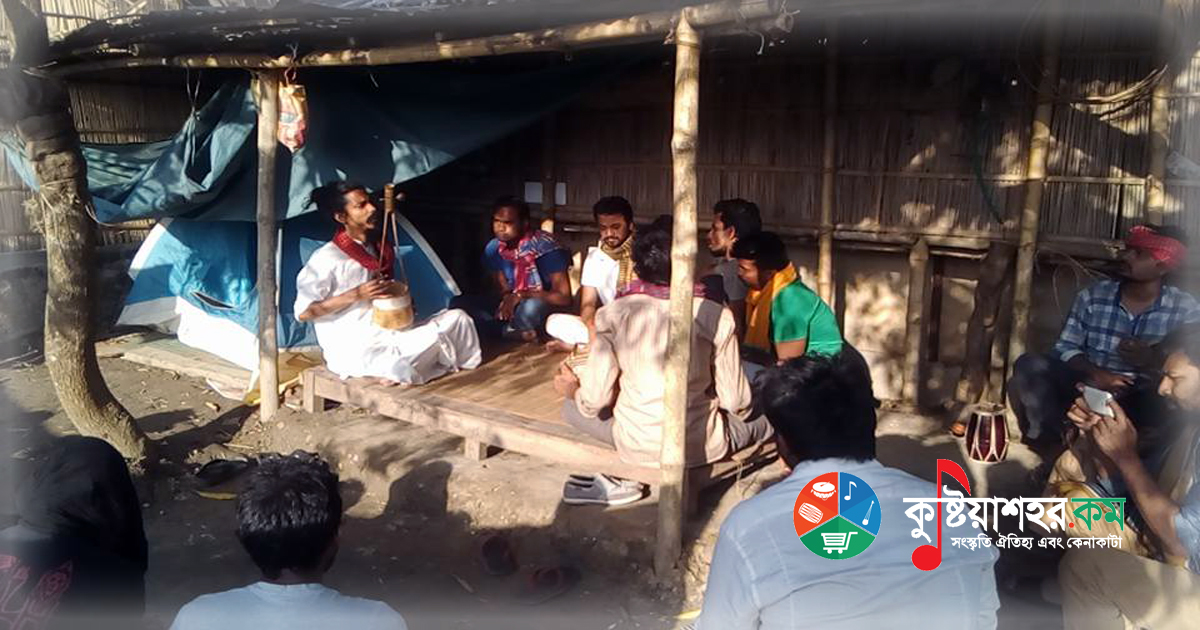
Fakir Lalon Sai, throughout his life, held a festival of reunion with devotee-sadhus every year on the night of Dol Purnima. The sadhu-sangha went on through the whole night. Taking that as its theme, the three- or five-day Lalon Smaran Utsab is observed every year at Cheuria in Kushtia. That he is no longer among us is as true as the fact that even after his tirodhan his thought and philosophy keep stirring the world of our reflections - this too is the utmost truth; and that this wave will keep flowing age after age is truer still. That philosophy therefore keeps coming back before our young generation in many ways, and will return again and again. For those of us who are young, in building a society, a state and a world free from hatred, malice and division, Lalon's philosophy must count as a unique guiding light.
Lalon fakir's whole identity lies in his songs. We have given Lalon fakir a place in the inner chamber of our hearts for the extraordinary mystic music he created. For these remarkable, philosophically charged songs he composed and set to music send great waves through our world of thought. Sprung spontaneously from the depths of his mind, these songs are today each a philosophy in itself. What is not in them? There is the theory of the body, of the self, of the guru, of devotion. There are his carefully considered views, questions and answers on the Prophet, Krishna, Jesus, the Vedas, the Quran, the Creator and other subjects.
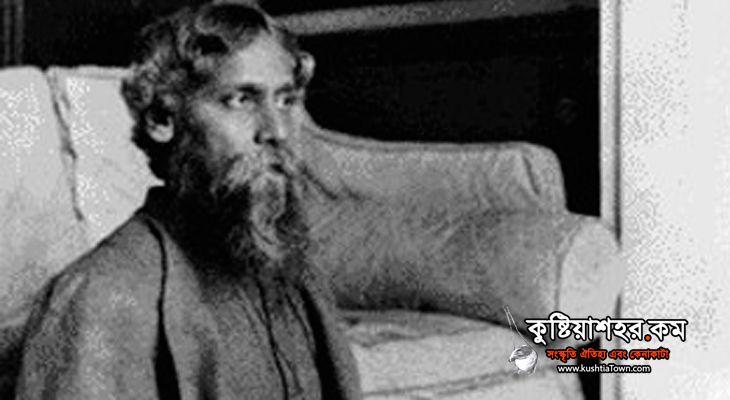
As the first collector of Lalon Saiji's songs we come to know the name of Kobiguru Rabindranath Tagore. Kobiguru himself was the collector of nearly a hundred and a half of this mystic sage's songs. In the 'Haramoni' section of the Prabasi magazine Rabindranath himself published twenty of Lalon's songs. But the question is, why did Kobiguru spend his priceless time collecting and publishing Saiji's songs? Why did he grow so eager to spread Lalon's philosophy? Why, being himself a renowned lyricist, composer and singer, did Kobiguru surrender his mind to Lalon's music? What hidden philosophy of life did he find there? Drawn by what irresistible attraction did he vow to enter deep into the Baul life? Nor did he merely try to taste that essence himself; scattering that essence across the sand-palaces of a divided earth, he set about lessening its heat. Anyway - if life is for life's sake, and if there is a home for man for man's sake, then Rabindranath Tagore's immersion in Lalon's philosophy is, it goes without saying, deeply resonant, engaging and captivating. So, in that frame, perhaps we can find some answer to the questions above from the following discussion.
It goes without saying that hearing Saiji's songs Kobiguru was utterly spellbound. Diving into the Bhabsagar he suddenly knew and understood that Lalon's philosophy is never to be exhausted. That source flows unceasingly. What blossoms at its very root with profound strength has unfolded, song after song, like a hundred-petalled lotus. And perhaps for that reason it was Kobiguru who first strove to hold Lalon's songs up before the world. Translating the song 'How does the unknown bird fly in and out of the cage' into English, he held this great sage and philosopher up before the world. As a result, beyond the domestic sphere, the thought and life-philosophy of this humanist singer, sage and philosopher began to become visible to the outer world like a flower blossoming out of its stifling shell. Thus, slowly, Saiji came to be the focal point of the whole world's interest. Today, research on Lalon's philosophy has well and truly begun across the globe.
In his unclaimed leisure Kobiguru spent much time with the Bauls. He saw their very ordinary lives. But in even greater wonder he heard, and was startled by, the profound philosophy of life hidden in the plain word-choice of these Baul fakirs. Astonished, Kobiguru therefore says: 'A Baul sage named Lalon fakir tried to say something by synthesising the Hindu, Muslim, Buddhist and Jain faiths - we should all pay attention to that.' Its plain meaning is that Kobiguru could feel the importance of Fakir Lalon Sai's philosophy in the deepest place of his heart. It is perhaps through the remark above that he sought to express that tray of feeling properly, and to try to draw the attention of all other scholars and the learned.
Lalon's settled thought on caste is known to all today. Caste and creed, high and low, lowborn and gentle, Hindu, Muslim, Buddhist, Christian and such distinctions astonished him, wounded him. So, rising above all these divisions, he imagined a united human society. He did not care the least for caste and creed. That is why he sings: 'Saying caste is lost, caste is lost / what a strange factory this is / none is ready for true work / all I see are tinsel shows.' In another song he says: 'Some wear the mala, some the tasbi at the throat / that is why they call their castes different / in going or in coming / whose mark of caste remains?'
Perhaps because he saw man simply as man, without getting caught in the snare of divisions, he asked man to be worshipped as the guru. For hidden in that is the eternal stream of love's nectar, whose fruit is the liberation of humanity. In the Kali Yuga he saw man as an avatar. He said none can know it without being divya-jnani (one of divine knowledge). That knowledge lies hidden in the worship of man and the service of humanity. For the formless Creator takes form and reveals Himself in man - Saiji held this up thus: 'All sadhana bears fruit for him / whose devotion is fixed on the human guru / river or marsh, beel or canal / in every place there is that same One.... / the divya-jnani comes to know at last / in the Kali Yuga man is the avatar.'
One distinct significance of Lalon fakir's songs is that towards their end Lalon usually composed the verse in his own name. The result was that his songs could no longer be passed off by anyone else as their own. Thus, in the well-known song on caste, Lalon says at the end: 'Who in secret eats the whore's bread / what harm does that do to religion / Lalon says, whose caste do you speak of / that delusion has not gone.'
It is hard to understand, without knowing Lalon, how simply a philosophical question can be asked. Every song of his sets us face to face with many fundamental questions. Though we know the answers, with some unknown dread we still stand facing truth and yet take our stand against conscience. Because Lalon could keep his conscience ever awake, standing face to face with truth he was not perturbed. Knowing and understanding all the prevailing religious doctrines, he at last expressed his realisation of truth without restraint in the 'Lalonian' manner. That realisation of his found outward expression in all his mystic songs, where, standing against violence and malice, hypocrisy, religious bigotry and communalism, he held up humanity alone, and with an unquestioning mind sang its song of triumph.
His songs are like a treasury of boundless strength whose centre is man alone, with the feeling of humanity as its only theme. But how many of us have been able to rouse ourselves with the feeling of humanity? Or are we constantly grinding humanity down with schemes and tricks? Have we been able to create any environment in our social surroundings where the feeling of humanity is nurtured? The answer is no. And because we could not, in Saiji's language it remains a 'hut-bazaar at the roadside'. So, in this roadside market, Lalon's counsel sets waves moving in the world of thought. Lalon therefore says: 'Serve the simple man, look, O mind, with divine knowledge / you will find the priceless treasure in the present.' Even so, slowly, Lalon has now become a matter of interest to the elite as well. People from abroad too now want to know Lalon, the Bauls' greatest treasure; they want to taste the essence of Lalon's philosophy.
In the present time, therefore, Lalon's philosophy appears deeply relevant and important in the heart of every humanist who believes in the existence of one and the same human essence. Not divisions but the philosophy of non-division alone can, forgetting violence and malice, build a peaceful world - that is what shines through Lalon fakir's songs. So the hope remains that, through the spread and expansion of Lalon's philosophy, we of the young generation may strive to build such a world.
Information gathered by - Palash Basu - Blog bdnews24.com