বাংলা
 English
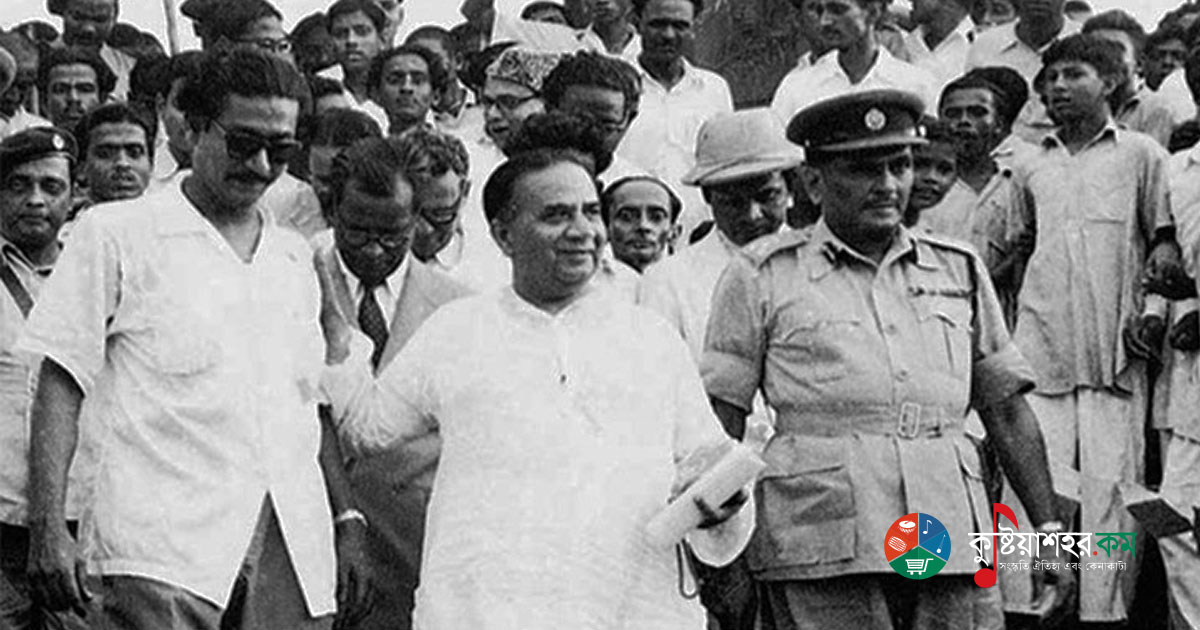
Hussain Shaheed Sohrawardy (born September 8, 1892 - died December 5, 1963) was an East Pakistani Bengali politician and lawyer, one of the main leaders in forming the United Front. He was respectful of democratic norms and public opinion, and was therefore hailed by the enlightened society as the 'son of democracy'.
He was born into a noble family of Medinipur in present-day West Bengal. He was the youngest child of Justice Sir Zahid Sohrawardy. Zahid Sohrawardy was a renowned judge of the Calcutta High Court. His mother was the famed Urdu writer Khujasta Akhtar Banu, and Sir Hassan Sohrawardy was his maternal uncle. The members of his family, in keeping with the custom of the noble Muslim families of India at that time, used the Urdu language. But Sohrawardy learned Bengali on his own initiative and practiced Bengali. After beginning his education at the Calcutta Aliah Madrasah, he joined St. Xavier's College. From there he obtained a bachelor's degree in science. Then, at his mother's request, he earned a master's degree in Arabic language and literature from the University of Calcutta. In 1913 he sailed for the United Kingdom. At Oxford University in the United Kingdom he obtained an honours bachelor's degree in science. There he also studied law and earned the degree of 'Bachelor of Civil Law' (B.C.L.). In 1918 he earned the Bar-at-Law degree from Gray's Inn. Then, returning to Calcutta in 1921, he took up the legal profession.
In 1920 he married Begum Niaz Fatima. Begum Niaz Fatima was the daughter of Sir Abdur Rahim, home minister of British India at that time. She died in 1922. His second wife was Begum Vera Sohrawardy, a Russian actress of Polish descent.
1924-1947 - He first joined Chittaranjan Das's Swaraj Party. At the time it was mainly a group within the Indian National Congress party. He had a considerable role in the signing of the Bengal Pact of 1923.
In 1924 he was elected deputy mayor of the Calcutta municipality. The mayor was Chittaranjan Das. In 1927 Sohrawardy resigned. In 1928 he played a leading role in the All-India Khilafat Conference and the All-India Muslim Conference. Although he had great political influence among Muslims, he was not involved with the Muslim League until 1936. In early 1936 he formed a party called the Independent Muslim Party. Toward the end of 1936 this party merged with the Bengal Provincial Muslim League. On that account he was elected general secretary of the Bengal Provincial Muslim League, the BPML, and held the post until late 1943. After the resignation of the Shyama-Haq cabinet in 1943, he was an influential member of the cabinet formed under Khwaja Nazimuddin. In Khwaja Nazimuddin's cabinet he served as labour minister, minister of municipal supply and so on. In the 1946 elections, he and Abul Hashim were the chief claimants to the credit for the sweeping victory of the Bengal Provincial Muslim League. In 1946, as chief minister of Bengal, he gave extensive support to the Pakistan movement. As chief minister of united Bengal, in 1946 he gave his support and cooperation to the Pakistan movement. Regarding an independent India, Jinnah called for Direct Action Day on 16 August 1946 against the Cabinet Mission Plan. In Bengal, at Sohrawardy's urging, a government holiday was declared on that day. When Muslims protested on that day demanding Pakistan, a separate homeland for Muslims, large-scale Hindu-Muslim riots broke out in Calcutta. In Noakhali of East Bengal immense destruction took place on that day. Sohrawardy was severely criticized by the Hindus at the time for his silent role. On his initiative, at the 1946 Delhi Conference a controversial amendment to the Lahore Resolution was placed before the Muslim League's legislators. The amendment contained the proposal for an undivided independent Bengal. But because of his controversial role in the Hindu-Muslim riots in Calcutta his acceptability among the Hindus diminished. As a result, apart from Sarat Chandra Bose, no other Congress leader agreed with his idea of an undivided Bengal. In 1947 he stepped down from the post of chief minister of Bengal. However, after resigning he did not go to Pakistan immediately but stayed on in Calcutta. At that time, given the possibility of renewed conflict between the Muslims and Hindus of Calcutta, he sought Mahatma Gandhi's help. Mahatma Gandhi then responded to Sohrawardy's call to calm the Hindu-Muslim riots on the condition of a joint role. It may be noted that Sohrawardy did not go to Pakistan with the partition of the country in '47. In 1949, when the then Government of India imposed a growing burden of taxes on him, he was forced to leave India and move to Pakistan.
1947-1962 - After Pakistan's independence in August 1947, the conservative leaders of the Muslim League grew strong under Khwaja Nazimuddin's leadership. Even before that, on 5 August 1947 Khwaja Nazimuddin, with Jinnah's indirect support, was elected leader of the Muslim League's parliamentary party. From then on the progressive leaders of East Bengal's provincial Muslim League became cornered. After Khwaja Nazimuddin became chief minister of East Bengal he called Sohrawardy an "Indian agent" and an "enemy of Pakistan" several times. Sohrawardy was removed from his seat as a member of Pakistan's legislature. Many of his followers were involved in forming the East Pakistan Chhatra League in early 1948 and the East Pakistan Awami Muslim League in June 1949. Through the conference of a section of the then Bengal Provincial Muslim League led by Hussain Shaheed Sohrawardy and Abul Hashem, the 'East Pakistan Awami Muslim League' was founded on 23 June 1949 at Rose Garden on KM Das Lane in Tikatuli, Dhaka. Later, however, with the aim of practicing secularism and establishing a non-communal spirit, the word 'Muslim' was dropped from the organization's name.
At its founding, Abdul Hamid Khan Bhasani became president of the East Pakistan Awami Muslim League, with Ataur Rahman Khan, Shawkat Hossain and Ali Ahmad as vice presidents. Shamsul Haq of Tangail became general secretary, and Sheikh Mujibur Rahman, Khondaker Mostaq Ahmad and A. K. Rafiqul Hossain were given the responsibility of joint general secretaries. Yar Mohammad Khan became treasurer. Mujib took on the responsibility of joint general secretary while still in prison. On the other hand, for the whole of Pakistan the organization was named the All-Pakistan Awami League. Hussain Shaheed Sohrawardy became its president. During the 24 years of Pakistani rule the Awami League was in power in the province for two years under Ataur Rahman Khan's leadership, and under Hussain Shaheed Sohrawardy's leadership it was a partner in a coalition government at the centre for 13 months. In 1953 he formed the United Front together with A. K. Fazlul Huq and Maulana Bhasani. This United Front was formed at the initiative of the Awami Muslim League to defeat the ruling Muslim League on the occasion of the election to the East Bengal Legislative Assembly to be held in 1954. On 4 December 1953 the Awami Muslim League, together with the Krishak Sramik Party, the Pakistan Ganatantri Dal and the Pakistan Khilafat Party, formed the United Front. The leaders of this United Front were: 1) Maulana Bhasani, 2) A. K. Fazlul Huq and 3) Hussain Shaheed Sohrawardy. This United Front issued a 21-point election manifesto. The chief demands of that manifesto were: granting full autonomy to East Bengal on the basis of the Lahore Resolution, making Bengali the state language, declaring 21 February Shaheed Day and a general holiday, building a Shahid Minar to preserve the memory of the language martyrs, and so on.
In the election to the East Pakistan Legislative Assembly held from 8 to 12 March 1954, the United Front won 223 of the 237 Muslim seats. Of these, the Awami Muslim League won 143.
In the 1954 election the United Front formed by Maulana Bhasani, Abul Kasem Fazlul Huq and Hussain Shaheed Sohrawardy won an unprecedented victory. The ruling Muslim League was completely routed. It won only 9 seats. In 1955 the Awami Muslim League dropped the word 'Muslim' and became a non-communal political organization. Then Sohrawardy became law minister in Mohammad Ali Bogra's cabinet. He held that post from 20 December 1954 to August 1955. From 11 August 1955 to 1 September 1956 he was leader of the opposition in the Pakistan legislature. His role in framing Pakistan's first constitution in 1956 was notable. He was also prime minister of Pakistan from 12 September 1956 to 11 October 1957. In 1956, after Chaudhry Mohammad Ali's resignation, he was appointed prime minister of Pakistan. He was described as a pioneer of Pakistan's pro-United States stance in foreign affairs. In 1956 a constitution was adopted on the basis of parity of numbers. Bengali was recognized as a state language alongside Urdu. Despite the Awami League having only 13 MNAs at the centre, Hussain Shaheed Sohrawardy became prime minister with the cooperation of the Republican Party.
While prime minister, he took steps to remove the economic disparity between East and West Pakistan.
But this step of his gave rise to widespread political opposition. His attempt to introduce the One Unit idea in West Pakistan as in East Pakistan was thwarted by the West Pakistani politicians. Then in 1958 Iskander Mirza imposed martial law in Pakistan. From August 1959, under the Elective Bodies Disqualification Order, he was declared barred from Pakistan's politics. Citing the offence of anti-state activities under the Pakistan Security Act, he was arrested on 30 January 1962 and detained in Karachi Central Jail. On 19 August 1962 he was released. In October 1962 he formed the National Democratic Front (N.D.F.) for the anti-Ayub movement.
For health reasons he went abroad in 1963, and while staying in Beirut, the capital of Lebanon, he died on 5 December 1963. He was later brought to Dhaka, and on 8 December his janaza was held on the Racecourse Maidan (now Suhrawardy Udyan). After the janaza he was buried in the premises of the Dhaka High Court beside the grave of Sher-e-Bangla A. K. Fazlul Huq.
Source - Wikipedia