বাংলা
 English
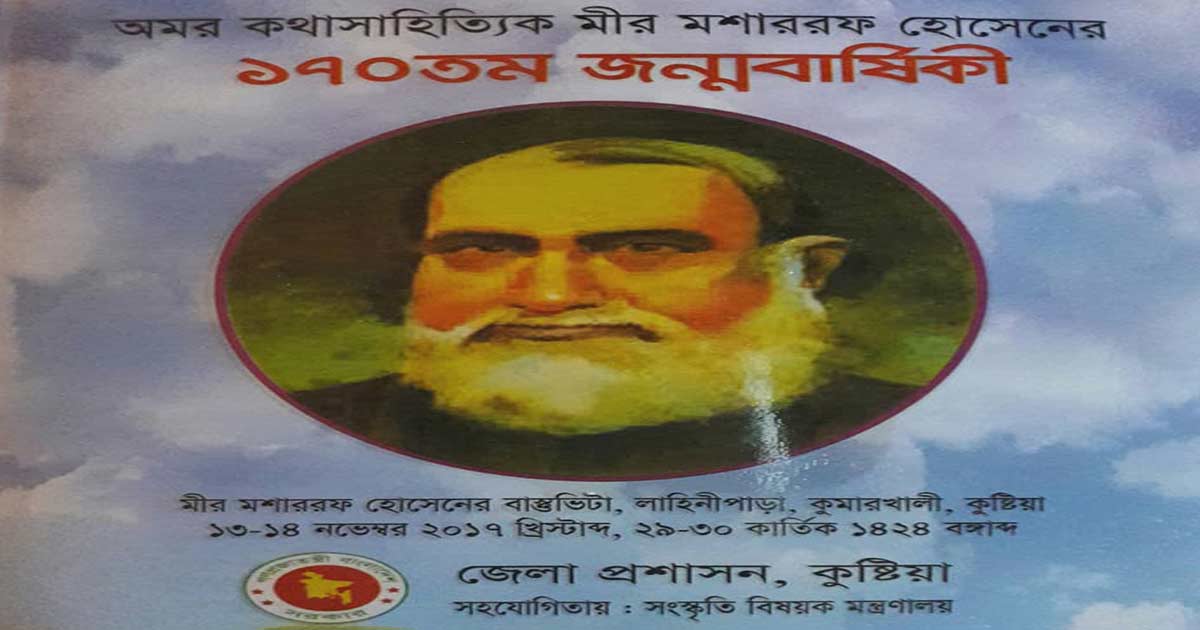
Mir Mosharraf Hossain (1847-1911), the 'pioneer of the Muslim renaissance in Bengali literature', was born on 13 November 1847 in Lahinipara village — then under Kushtia subdivision of Nadia district, the hallowed ground of literature and culture, now Kushtia district. Although his father Mir Moazzem Hossain was financially well-off, because of a slackness of character Mir Mosharraf Hossain could not go far in formal education.
Yet by personal industry he read widely the works of the literary figures then current, such as Bankim and Madhusudan, and the tales and legends of puthi literature. In contrast to the Arabic-Persian-Urdu preference of the aristocratic Muslim urbanite, it was the rustic, rural Bengali that fed the making of his mind. As a result, the first initiation of literary creation in a religion-oriented stream of generous, non-communal synthesis took place at his hands; and he was the first successful Muslim literary artist. 'The most important thing is that, unlike the Bengali Muslims of his time, he was neither indifferent nor hesitant about his homeland and mother tongue.' [Abul Ahsan Chowdhury]. 'Intending the improvement of knowledge and taste among illiterate and literate Muslims, he purified into modernity and propagated the form, flavor and language of the puthi literature on which the Muslim mind of the time was accustomed to feed.' [Mohammad Harun-or-Rashid]. From the world of the dobhashi puthi, spoken in a mixture of five languages — Bengali, Arabic, Persian, Hindi and Urdu — he stirred the Muslim mind toward a modern consciousness of life. Using unadulterated Bengali in literature, he established himself as a powerful prose writer.
In the medieval age, especially the sixteenth-seventeenth-eighteenth centuries, the Bengali language and Bengali literature were nourished by the joint contribution of Hindus and Muslims.
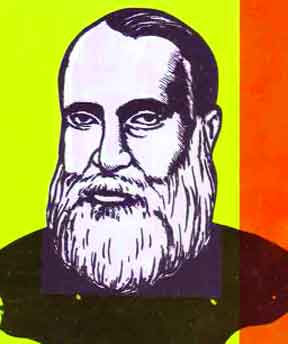
But after the English conquest from 1757 the distance between Hindus and Muslims steadily grew. On one hand the urban aristocratic Muslim class made the pursuit of Arabic-Persian-Urdu its only duty, while on the other the Muslim society, thinking the avoidance of English contact and English education the only path to liberation, fell behind. In this situation Mir Mosharraf Hossain, a village boy, raised waves of new hope. He is the pathfinder of the renaissance of Bengali Muslim consciousness in Bengali literature. His Ratnavati (1869) is the first novel composed by a modern Muslim writer; his play Basanta Kumari (1873) is the first Bengali play composed by a Muslim writer; Bishad Sindhu (1885, 1887, 1891) is the greatest prose epic of the Bengali language; and 'Ajijan Nehar', the periodical he edited (1874), is the first literary periodical edited by a Bengali Muslim.'
--- Bhudev Chowdhury
Unbiased rationalism and universal humanity are the greatest wealth of the renaissance, that is, of modernity. 'That unbiased mentality first touched the hands of Bengali Muslims and was transmitted into modern Bengali literature through the writings of Mosharraf Hossain. The artistic statue of the sadhu form of Bengali prose is Vidyasagar's handiwork; that language was built on the structure of the conversational prose current in the Sanskrit-pandit society. In Bankim's writings too the excess of Sanskritic tatsama words took a polished form. But the shape Mosharraf's Bengali prose took was built on the structure of the speech of the ordinary Bengali — Hindu and Muslim alike — of rural Bengal, and is its refined written form.' This language is much closer to the soil.'
--- Bhudev Chowdhury
After Ratnavati, two more novels of his were published under the names 'Udasin Pathiker Moner Katha' (1891) and 'Gazi Miyar Bastani' (1899). 'Both works are autobiographical; in truth all of Mosharraf's original writings of both novel and play are expressions of the flavor of his personal experience. The artist has drawn an exact blueprint of the poverty of rural Muslim society in Bengal, their helpless simplicity, and the heart-rending exploitation by self-interested inhuman creatures taking advantage of it — in financial, social and even religious life. He has composed compassionate artistic images of what he saw with his own eyes. The Udasin traveler and Gazi Mia were in fact he himself. In these stories we see as it were the motion picture of a new life, and at the same time we must immerse ourselves in the unfeigned earthy taste and scent of rural life.
--- Bhudev Chowdhury
In sentiment and language 'Bishad Sindhu' carries the greatest signature of his genius. Its three parts were published respectively — the Muharram part in 1885, the Uddhar part in 1887 and the Yazid-slaying part in 1891. Though the heart-rending killing of Imam Hasan and Imam Hussain at the hands of Yazid, lord of Damascus, is the main substance of the book, it has been realized in the vessel of the humanly passionate emotion of Yazid's enchantment with Jaina's beauty. In the critic's words it must be said that it is a hybrid creation rich in romantic passion, made of a mingling of history, novel, drama and other branches of literature. Though not an original work, Bishad Sindhu is rich in universal literary flavor. 'Bishad Sindhu is not merely an ocean of sorrow; in its expression of eternal truth in universal feeling and in its majestic and glorious substance with the taste and scent of more ancient wealth, it remains as vivid in Bengali literature as a classical edifice, and it is precisely in the surging waves of its language's brimming undulations that Mir Saheb's literary genius has blossomed to the full.
--- Mu. Abdul Hai
In his comprehensive history of Bengali literature Dr. Asit Kumar Bandopadhyay comments: 'Mir Mosharraf is the first Muslim writer who acquired classical Bengali prose with astonishing skill and, by writing many excellent books, earned special glory not only in Muslim society but in Hindu society too. His Bishad Sindhu is a tragic and epic-like prose novel composed on the lamentable events of Karbala..... It is this book that has given him immortality. Character creation, the patroness of romance, and such a heart-rending manifestation of epic grandeur and tragic grief — I think such will be found in the work of no other Bengali novelist except Bankim Chandra. Whatever the critics of today's Bangladesh may say, Mir Saheb is the true connecting link between the eternal Hindu and Muslim societies.'
In respect of diversity of subject too, Mir Mosharraf Hossain's literary achievements are noteworthy. Novels, tales, sketches, plays, farces, verse, poetry, music, essays, biography, autobiography, news reports, student textbooks and the like — altogether nearly forty books he wrote within a span of forty-five years. From this angle he is a many-sided writer.
In his own time Mir Mosharraf Hossain was both admired and condemned. Yet the Hindu writers applauded his mastery of the Bengali language, saying that if many a Hindu writer could learn Bengali as he had, they would consider themselves blessed. The life of this illustrious, many-sided writer Mir Mosharraf Hossain ended on 19 December 1911.