বাংলা
 English
Bishad Shindhu
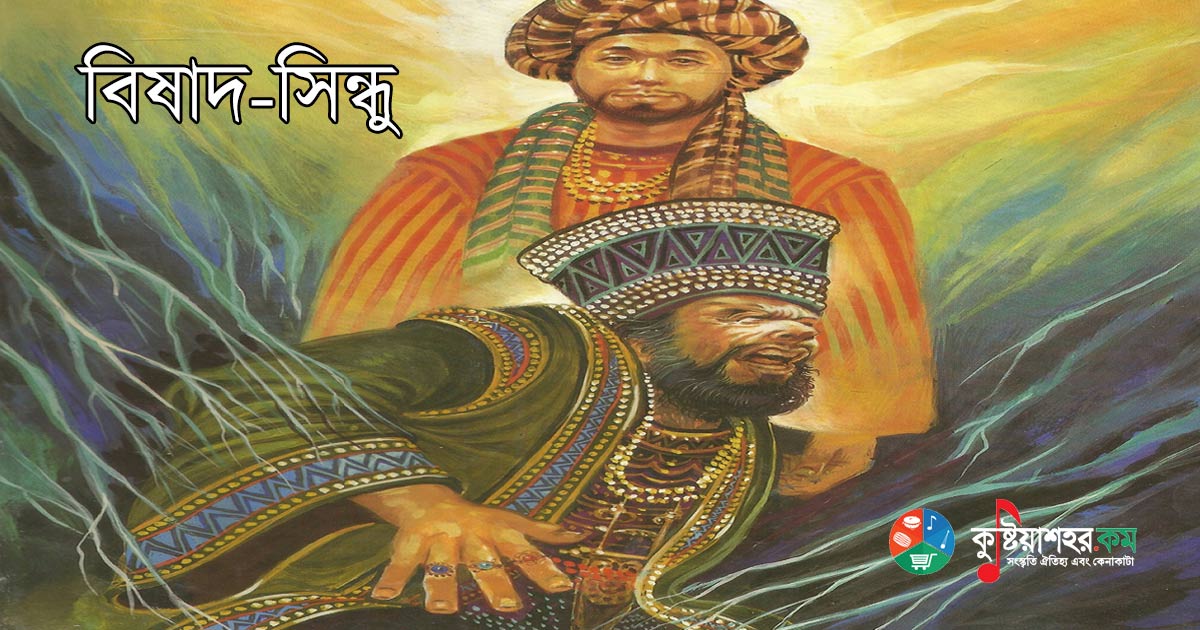
Bishad Sindhu is the historical novel by Mir Mosharraf Hossain composed taking the battlefield of Karbala as its material. It was published in three parts in 1885, 1887 and 1891 respectively; later these were printed in one volume.
The principal characters of Bishad Sindhu are historical in name, but fictional in the narration of events and in character creation. The book contains some sub-stories which are not properly historical. In the book's preface the author Mir Mosharraf Hossain wrote — 'Bishad Sindhu was composed taking the summary of the main events from Persian and Arabic books.' A notable point is that Mir Mosharraf Hossain did not name which Arabic and Persian books he collected the events described in Bishad Sindhu from. For this reason 'the critics' are 'hesitant to endorse the author's claim'. Munier Chowdhury harbored rational skepticism about the author's claim. Discovering considerable similarity between the dobhashi puthi and Bishad Sindhu, he felt reassured that Mosharraf's basis was indeed the popular Bengali puthi on Karbala. Golam Saklayen's opinion is identical. Anisuzzaman and Mustafa Nurul Islam also believe the dobhashi puthi to be the chief inspiration and main source of Mosharraf's story. Kazi Abdul Mannan surmises, 'In order to create the reverence and attraction of the devout Muslim society toward the book, Mosharraf raised the question of the story's source in Arabic-Persian books as well.'
The main substance of Mir Mosharraf Hossain's Bishad Sindhu is the events responsible for the death of Imam Hussain, the beloved grandson of Hazrat Muhammad (PBUH). True, the book also describes the events that followed Imam Hussain's death. The principal characters of the novel Bishad Sindhu are found in history, but the mention or trace of some minor characters cannot be found in any historical book. Yet the researcher's conclusion is — 'since this book has been composed on the basis of history, it can be called a historical novel.' In it, at once, the portrayal of the characters and of human life's sorrow and pain, envy and malice are depicted, and likewise against the backdrop of history are described conflict over the throne, struggle, bloodshed, killing and so forth. In sum, having directly observed the characters and features of the history narrated in Bishad Sindhu, researchers did not hesitate to accord it the rank of a historical novel. However, it mentions certain events that cannot be judged in the light of history. Indeed, even in real life one may harbor doubt about their existence — such as certain supernatural events, some of which originate in religious belief and some in occult power and trust.
Bishad Sindhu opens with a prophecy of Hazrat Muhammad (PBUH), and the book's conclusion will come as the prophecy comes true. Besides this prophecy it mentions some supernatural events — such as Hussain's severed head vanishing before Yazid's eyes, blood flowing from the trees of the Karbala plain, the arrival of Hussain's parents from heaven at the time of the funeral rites of his body, and Hanifa's captivity in the space between two mountains. If only the events of real life are marked in a novel, it is generally not counted as a novel. But though real events and supernatural matters are introduced in Bishad Sindhu, they do not arouse the readers' disbelief. The place and time of Bishad Sindhu's events is the Arabia of the seventh century. In judging this novel, some researchers have opined that one should remember the beliefs of that particular age and its people — if the descendants of Hazrat Muhammad (PBUH) believed in divine power, there is nothing to marvel at; for they believed that no one could deviate from the path appointed by the Creator. While reading Bishad Sindhu one sometimes feels as if Imam Hasan and Imam Hussain are not humans of flesh and blood, for they depend entirely on heaven and none of them considers himself accountable for the fruits of his own deeds. On the other hand, Yazid, Zaida, Maymuna and Marwan — though hypocrites — seem much more humans of flesh and blood, for they believe the events of the future will be influenced by the fruits of their present actions. Engaged in clash with the descendants of Hazrat Muhammad (PBUH), Yazid struggled on unceasingly, yet at all times Yazid relied on his own might and artifice. But Imam Hasan and Imam Hussain welcomed death without protest, without resistance; for they believed it was the Creator's wish, and so death had to be welcomed.
Mir Mosharraf Hossain was born in the middle of the nineteenth century, and the environment in which he grew up was nurtured by the customs and beliefs of the times before his own age. Most researchers, comparing Bishad Sindhu with the epic, have said — 'It has the vast backdrop of an epic. It is not the story of the clash of one person with another — it is the clash between two monarchs over lordship. Entangled in this clash were the lives of many people, the fates of many people.' It has nearly a hundred characters; within it are many stories spread in branches and twigs. The craving, desire and cruelty of lordship of people riven by envy and malice, and bloody struggle — and all this happened centering on one woman. Just such events occurred in the Iliad, the epic of Greek literature.
Most of the events of Bishad Sindhu revolve around Jaina. Jaina is the root cause of the clash between Yazid and Imam Hasan-Hussain. Jaina is a chaste and devoted wife; abandoned by her first husband, she was married a second time to Imam Hasan. By the irony of fate, after Imam Hasan's death she became a prisoner in Yazid's jail. While imprisoned she felt that she was somehow responsible for the bloodshed of Karbala — had she accepted Yazid as husband, none of these events would have happened. From the angle of literary creation, Jaina can be compared with the character of Sita in Michael's Meghnadvadh Kavya.
Bishad Sindhu first gained popularity as a textbook and began to be read from village to village. Later, following the thread of Bishad Sindhu's popularity, it was first assimilated into the question-answer rounds of the competitive sessions of Bangladesh's jarigan, and subsequently, transformed into verse-songs of Bishad Sindhu, it came to be performed in the song-dance presentations of jarigan. The whole text of Mir Mosharraf Hossain's written literature Bishad Sindhu, composed in the prose style of modern Bengali, has been assimilated in the mold of the jarigan prevalent in the Netrokona region of Bangladesh.
Through a comparative reading of Bishad Sindhu and jarigan, readers and researchers will clearly be able to observe how the written literature of modern Bengali, Bishad Sindhu, assimilated by the scantily educated 'boyati', 'jarial' or 'khelowar' of the village in the sessions of jarigan, is performed in the rural session with so much vividness. Through the presented text one can mainly observe the assimilated text of the dance-song-based jaripala. But it must be remembered that, from the history of the assimilation of the written literature Bishad Sindhu in the sessions of jarigan, it is known that Bishad Sindhu's narrative has come to be performed in the rural session generally in two ways of assimilation. According to the depositions of the boyatis of jarigan in field studies, Bishad Sindhu was assimilated into the jarigan session first of all chiefly as an interesting, information-based element of the question-answer in competitive sessions; secondly, from the competitive jarigan session itself Bishad Sindhu gradually entered the song-dance-based jaripala, transformed in the framework of rhythms created from the mouths of the boyatis. In the second phase, when the prose style of Bishad Sindhu was transformed into rhythmic song by jarigan's creative boyatis, mainly 'khudro poyar' or 'dirgho poyar' rhythm-songs were applied, though variety was given to it by the disa-dohar or dhuya and the dak sung before and amid the pala's poyar. Varied rhythms can be observed in the disa-dohar or dhuya. It is mainly in the dohar-disa that varied rhythms are applied; over the customary structure of the pala's poyar, variety in jarigan is generally created by the covering of tripodi, chopodi and such rhythms. Another element uttered by the dohar-kholowar, creating variety amid the dance-song of the jarigan session, is the 'dak'.
In the dance-song-based jarigan session centered on Bishad Sindhu, the written literature of this novel — at times presenting the main text, at times presenting a cut-and-trimmed version of the main text's words — is presented by the jaripala performers in rhythmic-song form before and after it, from the prescribed flow of the novel. In the Bengali literature of the medieval age, poet Hayat Mamud, Fakir Garibullah and Syed Hamza showed the greatest credit in composing verse on Karbala. In Mir Mosharraf Hossain's story, similarity can be observed with the stories of poet Hayat Mamud and Fakir Garibullah. Though he took materials from the writings of his predecessor Fakir Garibullah, the story selection, construction and character creation of the book Bishad Sindhu are entirely Mir Mosharraf's own.
Researcher: Saymon Zakaria