বাংলা
 English
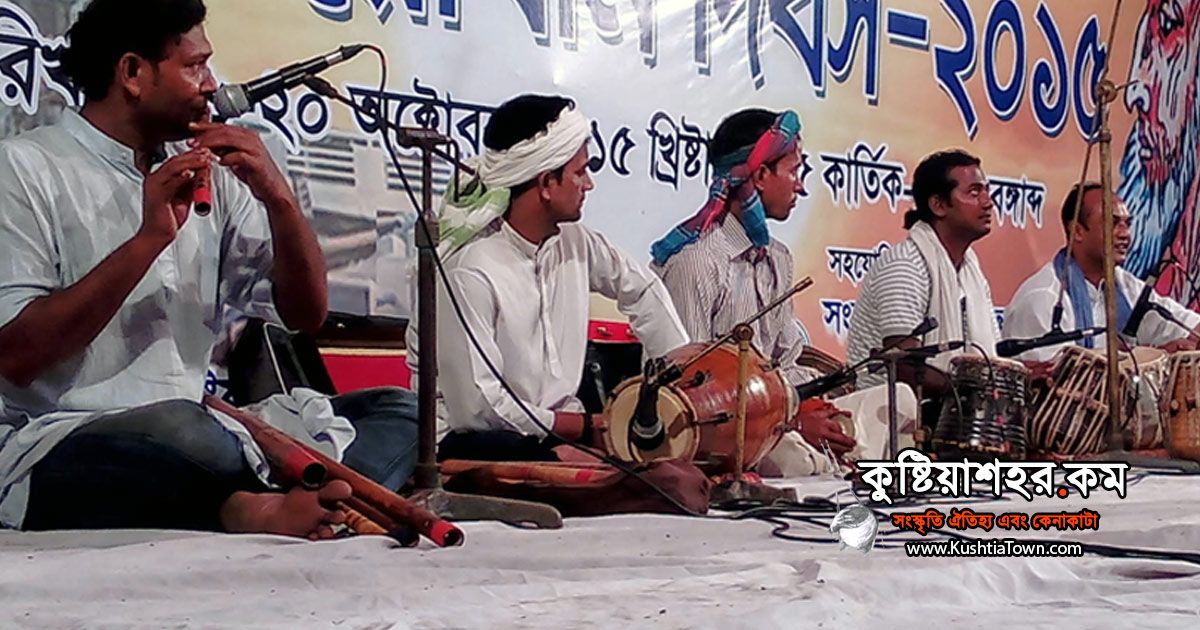
I could not rely entirely on the collections of Lalon's songs that have been published, because they are poorly edited and full of errors. In many cases the text carries no meaning and these texts are clearly corrupt. In other cases I found that errors are not easily noticeable. I also realised that even the songs I recorded on a tape recorder from live performances cannot be relied upon completely. Indeed, the artists themselves cautioned me about this, because when they forget a part of the song while singing, they fill the gap however they can.
For these reasons it seems to me that, until an authentic and reliable edition of Lalon's songs is published, the best way to determine correct texts is to ascertain, through discussion with the older fakirs devoted to Lalon in Jashore and Kushtia — the primal source-region of Lalon's songs — as pure a text of each song as possible. It is not easy to follow this method at all times, because the Baul-fakirs do not generally stay long at a stretch at their own den. They wander from village to village of Bangladesh singing songs. That is why it becomes difficult to pin them down in one place and, at leisure and at ease, hold talk and discussion with them to draw out material for research.
I must call it my good fortune that in 1986 I got Khoda Box Biswas, one of the principal artists and theorists of Lalon's songs in Bangladesh, for three months at the Dhaka Shilpakala Academy. At the time he was working as an instructor at that academy. During those three months I had the opportunity to work with him almost every day. The sorrowful matter is that this distinguished sage of Lalon's songs is no longer alive. Khoda Box spent twenty years with his guru Shukchand Shah. Shukchand Shah's guru was another Khoda Box Shah of Hariarghat in greater Jashore district. That Khoda Box Shah's guru was Moniruddin Shah.
Moniruddin Shah was a disciple initiated by Lalon's own hand. According to Khoda Box's reckoning, he knew five hundred of Lalon's songs, and in his storehouse of memory held one thousand seven hundred songs by seventy-six folk poets. He drew my attention to the differences between the published texts of the songs and the texts he had learnt from his guru. This difference in the songs' texts has had its effect on the meaning too. In most cases Khoda Box's texts correspond with the texts of the notebooks Tagore collected. From this it is proven that the songs have been handed down correctly. In particular, for the songs not present in Tagore's collected notebooks, I tried to determine the texts by discussing them with at least one other fakir. In this I have at present had the help of the Jashore-resident elderly fakir Abdul Karim Shah. While considering the texts of the songs Khoda Box sang, I followed a method such that alternative readings were not neglected. Moreover, before accepting Khoda Box's text, I had to see whether it was tenable in terms of Baul religion and philosophy.
Comparing the published texts of Lalon's songs with Khoda Box's oral texts, I present two examples. In the song beginning 'Kuler bou hoye aro koto din thakbi ghore', one line of this memorised Lalon song is given in Lalan Geetikay (Motilal Das and Piyushkanti Mahapatra, 1958: song no. 14) like this: 'dis ne aro arai kori'. In the context of this song I could not grasp the significance of 'arai kori'. Looking at the different collections of Lalon's songs only increases my doubt. This song is not in Tagore's aforementioned notebook of songs. Instead of 'arai kori', Lalan Shah and Lalan Geetikay (Muhammad Abu Talib, 1375: second volume, song no. 255) give 'achar kori'. Though the literal meaning can be recovered, the theoretical meaning cannot be discovered. What ritual is being spoken of here is not clear. The text of Bhab Sangeet (Khondkar Rafiuddin, 1374: song no. 204) has 'atir kori'.
This reading seems unrelated to the context. According to Khoda Box's text, the word before 'kori' should be 'anchir'. I first heard this text from Khondkar Riazul Haq. He got the text of this song from Khoda Box, and I later obtained Khoda Box's endorsement on the matter. 'Anchi' means 'janonashouch' (post-partum impurity) (Jnendramohan Das, 134, first part), and 'anchir kori' means 'the money given to the midwife'. This reading carries meaning in the context of the Baul religion. The Bauls follow a method of retaining semen in their sexual discipline. Those who succeed in this discipline have no offspring; hence the midwife's money need not be given any more. In judging the meaning of the entire song, the word 'anchi' is the most significant:
As the bride of lineage, O mind, how many more
days will you stay at home?
Lift your veil, let us go
to the sadha-bazar.
Fearing for lineage you will lose your work;
will you take lineage along with you?
You will repent the day at the cremation ground
they cast you out.
Give no more the midwife's kori —
become the vein of the heart's core.
O you, you will be well;
lineage will go far away for all time.
Everyone who inflates the price of lineage,
the guru is not gracious to him.
Lalon roams the Fatarra;
roaming, he covers up lineage.
'Anchir kori' is the reading I consider the most tenable and acceptable. My second example concerns the bhanita of Lalon's song beginning 'Adi Makka ei manabdehe'. Of the collections of Lalon's songs I have examined and reviewed, the readings of most of this song's bhanitas are nearly identical. This song is not in Tagore's collected notebooks. That the text of this song has been corrupted, even the famous Baul specialist Upendranath Bhattacharya did not suspect. But the oral text is the most meaningful in the context of Baul religion and philosophy, and corroborated by Lalon's other songs. If the oral text is substituted for the texts published by researchers, the song's meaning changes and its true sense is obtained. In the aforesaid collections (Motilal Das and Piyushkanti Mahapatra, 1958: song no. 295; Muhammad Abu Talib, 1375: second volume, song no. 161; Upendranath Bhattacharya, 1378: song no. 43) the bhanita of this song is given more or less like this:
Fakir Lalon says, that very
hidden Makka,
the Primal Imam is that Miyan.
According to Mr Bhattacharya (1378: 325), 'Miyan' is a synonym for 'Khoda' (God). Again, in his 'translation' of Lalon's songs, Songs of Lalon (1987: 78-79), Brother James considered the word 'Miyan' probably a synonym for 'Sai' and translated it as 'Lord'. But 'Miyan', that is, 'Miya', is in Bangla an honorific word for Muslims. Even if, straining the ancient English language, 'Miyan' can be translated as 'Lord', still the use of this word in the sense of 'God' is not at all proper unless it is joined to some particular Bangla word (as in 'Allah Miya').
According to the text of Bangladesh's renowned Baul singer, the late Khoda Box, the word 'Miyan' used in this song is really 'meye' (girl). In the regional language of Kushtia, 'meye' is pronounced 'minnye', even as 'miya'. Because of the phonetic resemblance between 'Miyan' (an honorific title) and 'minnye' (that is, 'meye'), many have taken 'minnye' for 'Miyan'. In correct language the bhanita of the song would in fact be:
Fakir Lalon says, that very
hidden Makka,
the Primal Imam is that Girl.
From the throat of the Baul singer Abdul Karim Shah the very same word of this reading is pronounced. Out of curiosity I asked quite a few fakirs at Cheuria, Lalon Fakir's Akhra in Kushtia, about the actual use of the words of this bhanita's text. They were all agreed on the matter. The line of the song is 'Adi Imam shei meye'. Incidentally, I wish to note that in two collections — Bhab Sangeet (Khondkar Rafiuddin, 1374: songs no. 15, 40) and Baul Kabi Lalan Shah (Anowarul Karim, 1373: songs no. 316, 192) — the word 'meye' is clearly present, not 'Miyan'. Moreover, when I got the opportunity to see the notebook preserved at Khoda Box's ashram, I saw that there too 'meye' is written.
It then appears that, astonishingly, in Lalon's philosophy the Primal Imam is identified as a venerable woman. To everyone else the Primal Imam being a woman may seem incongruous, but to the Baul community it is the expression of their unfeigned reverence for 'Shakti'. This Shakti is the outward manifestation of the power of the supremely merciful Allah. Yet in the Arabic language 'Imam' means a religious leader, and that leader is a man.
Among the Muslim Bauls there is the belief that the 'Primal Shakti' is Bibi Fatema, the consort of Hazrat Ali. It is for this that Lalon Fakir says in his song 'Bhoj re jeneshune', 'Taking Fatema's remembrance, the deed succeeds'. That is, remembering Bibi Fatema with single-minded attention, spiritual attainment is certain. Only through 'Shakti' is it possible to appear at the court of the supremely merciful Sai.
Carroll Solomon: former professor, Washington University, USA; killed in a road accident in March 2009.