বাংলা
 English
The life of Lalon Fakir stretched over more than a century. Within this span he composed and sang some ten thousand songs. Their literature has grown into such a wealth that there is no parallel to it anywhere in the history of the world's folk and mystic literature.
Lalon Fakir's ancestors' address, lineage, religion, caste, date of birth — even his own name — remain veiled in mystery. Professor Mohammad Mansuruddin devoted his whole life to collecting Lalon Fakir's songs, and by piecing together hearsay and argument he tried to establish a biography of Lalon.
Lalon was born in 1774 into a Hindu family in Chapra village of Nadia district of the Bengal of that time. Lalon died on 17 October 1890. Once, on the way to Murshidabad on pilgrimage, he fell gravely ill and lost consciousness. His fellow travellers took him for dead and threw him into the river. Drifting with the current, Lalon came to rest at a bathing ghat. Regaining consciousness, he cried out for help, and a Muslim family rescued him. To be cured of his illness he had to stay with that family a long time. There, at the inspiration of the family's spiritual guru, Siraj Sai of Jessore, he took initiation as a darwesh. After a long interval he returned to his own family and told them of his long stay with that Muslim family — and as a result he was ostracised. Lalon then became a Baul and devoted the rest of his life to the search for the Supreme Soul.
Even in his lifetime Lalon had become exceedingly famous. Two weeks after his death the local Hitokari newspaper published an editorial under the title "Mahatma Lalon Fakir". That editorial gave an account of Lalon's fame. In it was written:
He himself knew no letters, yet hearing the countless songs he had composed one took him for a supreme scholar. He read no scripture, yet in matters of religion he seemed an extraordinary master of the scriptures.
The same editorial said that at the time of his death Lalon had ten thousand disciples. The disciples addressed him as 'Sai', and for that reason the title 'Shah', used at the end of the darweshes' names, also became attached to his name.
Lalon was the greatest of the Bauls. In the second half of the seventeenth century the Baul ideology gained wide currency in Bengal, and by the strength of Lalon's creative sadhana it came to full maturity in the nineteenth century. The Baul ideology is not a separate religion, but only a way of perceiving Allah.
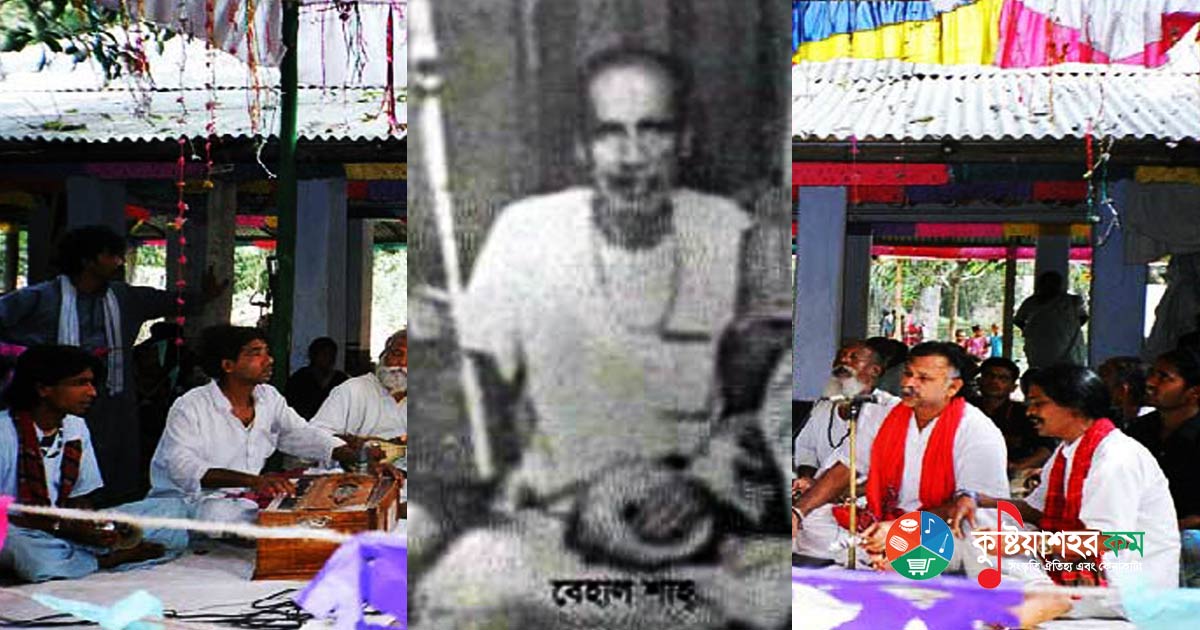
Among the Bauls are people of both the Hindu and the Muslim communities. A person engaged in household life too may follow Baul sadhana; yet the greater part of the Bauls are those who have renounced the world and own no means or wealth. By day they beg with an ektara in hand, composing songs and singing them among ordinary people. When night falls they return to their akhra, where collective debate on doctrine and bhajana-sadhana take place. The Bauls go neither to the mosque nor to the temple; they honour neither the shariat nor the scriptures. Though they believe in the guru, they seek no pir or swami. With their women they spend the night in the akhra itself, as the Sufis do not. In the Baul way, women are an inseparable part of sadhana; yet though they live together with their women, bearing children is forbidden to them.
The Bauls do not believe in writing their songs down. Wandering here and there they shape their songs and gain unearthly experience.
The word 'Baul' is a Bengali corruption of 'baura' or 'baula'. In North India 'baula' is used for people of the mad sort; in the Bhojpuri regional language the verb form of the word for madness is 'baurana'. Measured against the standards of their own tradition, the Bauls were dissenters — and for that very reason they came to be known as Baul, the unbalanced ones.
For ten years Lalon went on composing his songs without a break, and he never looked back to polish them. Nor did anyone record them. Nothing of his was ever printed in his lifetime. The work of collecting his songs began only after Lalon's death. To this day many of his songs remain unpublished, and many, many more have probably been lost forever. No reliable manuscript of Lalon's songs has ever been found; what is found are copies, or copies of copies. The celebrated Bengali writer Annadashankar Ray, tracing the source-streams of Baul sadhana, has shown that Islamic Sufism, Hindu Vaishnavism and the Buddhist Sahajiya practice — these three currents came together and merged in the Baul stream. The mention of the Rasul (pbuh), the Prophet, Allah and the formless Supreme in Lalon's songs is a reflection of the Sufi influence.
Or else
She has no hands, no feet, no shoulders, no head
The influence of the Vaishnav stream in Lalon's songs is seen in the mention of Gora — that is, Chaitanya Mahaprabhu — and of Krishna. 'Kala', the Bengali counterpart of the word 'Krishna', recurs again and again in his songs. The song below is one of Lalon's most graceful and most moving songs:
I cry, Mother, holding your feet
I shall steal butter no more
Of these three streams of religious thought that bore upon Lalon, the strongest is the Sahajiya path — the way of seeing and perceiving the Supreme within man himself. Sometimes Lalon called that Supreme the "Man of the Heart", sometimes 'the unknown bird', sometimes "the unacquainted man", sometimes the unattainable moon. According to the Sahajiya ideology, through searching within himself man can come to know God; and on the whole, it is through loving human beings that God is found. No one but Chandidas has proclaimed this belief in so beautiful a way:
above all stands man, and above him there is none
This relation of man and God is scattered through the verses of Lalon's immortal songs:
the Man of my heart?
Or,
finds fulfilment in every endeavour
Or,
Or in this song –
yogis and sages, for four ages,
have wandered the world in search of him
The Bauls played a great role in the reform of society as well. Annadashankar Ray wrote:
Their sadhana is not religious but human. The sages seek a close bond with the Supreme Soul, yet are indifferent to the world beyond. They feel no burning desire to enter heaven, nor are they afraid of hell. This body, this life and this earth are the whole world of their songs.
He wrote further that just when a renaissance was arising among India's educated classes, another movement had at that very moment begun within the hearts of the village people. History has paid no attention to the relation between these two streams of the Indian renaissance. The day this unwritten part of history is recorded, there will be room to see Lalon in his true context.
Annadashankar Ray said further that the influence of this renaissance of Lalon's within the heart of the Bengali people is no less than the influence of Raja Rammohan Roy.
Lalon and the other Bauls condemned religious bigotry and exploitation in the name of religion. They sang against racism and religious distinction and made the building of a bridge between Hindu and Muslim their own object of worship. Few people have contributed so greatly to the pursuit of unity in Indian society as Lalon and the other Bauls. Below are some unforgettable verses of Lalon's songs:
Lalon says — in these eyes I have seen no shape or form of caste
Or,
Lalon says — I know not my own self, I seek it still
Or,
what a strange factory is this!
Along with being a sage and a true devotee, Lalon was a poet of the very first magnitude. No one but Rabindranath could utter such splendid praise of him:
In the simplicity of his language, the depth of his feeling and the ache of his melody, he has no equal; in him are mingled the theory of song, the making of poetry and the essence of devotion alike. Such an unmatched message of folk literature, he believed, would be found nowhere else.
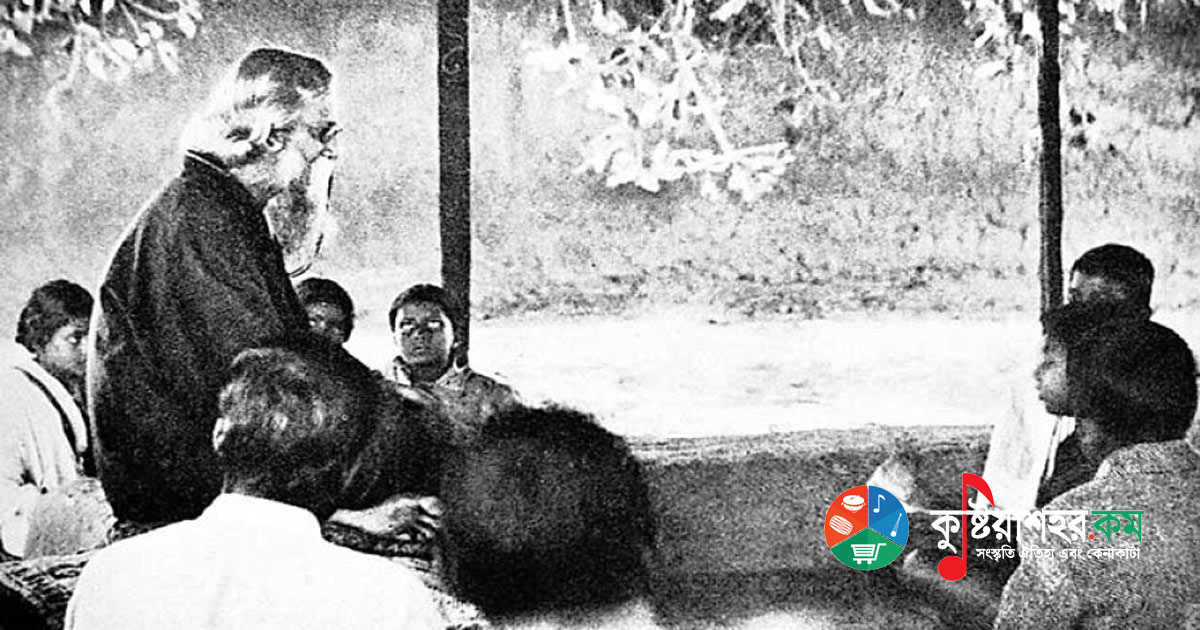
Even without naming Lalon specifically, the Bauls appear in Rabindranath's many writings. Yet when quoting Baul songs, Rabindranath cited Lalon's songs again and again. In his Oxford lectures — later published as "The Religion of Man" — Rabindranath quoted Lalon's song 'The unknown bird within the cage'.
It was Rabindranath who first drew the attention of educated Bengalis to the literary value of Baul song. He also undertook an effort to collect Baul songs, and it was he who first edited and printed twenty of Lalon's songs in the Prabasi magazine.
Among the acknowledgments Rabindranath gave to Baul song, the greatest was his discovery in them of a reflection of the Upanishadic philosophy. In one place in "The Religion of Man" Rabindranath wrote:
Those Upanishadic rishis who said that in trying to grasp the unknown being our mind returns bewildered — the utterance of this village poet matches theirs clearly; yet without exhausting himself chasing his own infinite as the ancient rishi did, this poet makes it understood that the path of perceiving the infinite lies open.
In the introduction to the first volume of Muhammad Mansuruddin's 'Haramoni', Rabindranath wrote:
I remember, I was then young, when a Baul of the Shilaidaha region sang in Calcutta to the ektara:
the Man of my heart?
Having lost that Man, for him alone
I roam through land and foreign shores.
The words were utterly simple, but through the melody their meaning was lit by a matchless radiance. In those words one hears the very language of the Upanishads: "Know the Person within, else there is the pain of death." From the lips of the unlettered I heard that very saying; its sung melody said in simple language that he whom one must know above all men is the very one whose not-knowing brings the deepest pain — the tune of the crying of the child who cannot see its mother in the dark rang from his throat.
Annadashankar Ray reached the conclusion that although Rabindranath's poetry and Baul song share something of the same nature, it was Rabindranath's poetry that influenced the Bauls, and thereby Lalon's influence was limited. The Baul songs are by nature based on hidden meanings; their true import is not easily intelligible to ordinary people, and only those initiated into the Baul faith can grasp their sense. Rabindranath's poetry is exactly the opposite.
Like the Bauls, Rabindranath too believed that God dwells within man. In 'The Religion of Man' he spoke of the divinity of man and the humanity of God. In Gitanjali he said:
hoping for the formless gem.
Although mysticism remains a common element in Rabindranath's poetry and in Baul song, in this the Bauls did not influence Rabindranath. Rather, both gathered the mystic element of their poetry and songs from the common inheritance of Islam, the Hindu and the Buddhist faiths.
Not in his poetry but in his songs Rabindranath was deeply influenced by the Bauls. In the preface to Haramoni he wrote:
In many of my songs I have taken Baul melodies; and in many songs the Baul melody has mingled, knowingly or unknowingly, with other ragas and raginis. From this one may understand that at some time the Baul's melody and message merged simply within my mind.
Among the folk music of Bengal, the songs of Lalon are graceful. These songs are in truth soul-possessing; they carry their listeners toward the Supreme Lord. The songs are simple, plain, unadorned and risen from the soil. Because of their deep and rich philosophical content, many researchers, Annadashankar Ray among them, were unwilling to count them wholly as folk songs and placed them in the category of sadhana songs. Yet whatever the philosophy, it is beyond argument that these songs employ folk similes, words, scenes and style. Their folk source and their popularised nature are the very life of these songs, and for that reason Rabindranath called them folk songs. But classifying the songs at once as 'folk songs' and 'sadhana songs' involves no contradiction, for it is the folk simile that makes these songs a fitting vehicle of sadhana.
Unlike Rabindra Sangit or Nazrul Giti, Baul song has no pure, original form. The Bauls themselves were opposed to writing their songs down; of musical notation there is no question at all. The songs are sung after being heard, and they flow by mouth from Lalon's disciple to the next disciple. In this process many changes have already come upon the songs. Singers of later times have worked their own ornaments into them; to please the modern ear their melodies have been altered in various ways — indeed it is said that even in Lalon's lifetime his songs were sung to many different tunes: those who lived in the akhra sang them in one melody, and those who kept the ways of the world in another.
The Baul movement of Bengal was no isolated social or spiritual movement. It was part of similar movements that took place in several other places of India. The influence of Sufism and of the Vaishnav and Sahajiya doctrines on the Baul movement has already been mentioned. The Bauls were also close to the sage-poets of North India such as Kabir, Namdev and Dadu. In simile, style and underlying feeling, Baul song and the poetry of the sage-poets of North India share a great deal, though at the same time there are some amusing differences. In this line, Lalon and the poets may be set side by side.
The births and religions of both Lalon and Kabir are veiled in mystery. According to folk belief, both were born in Hindu families and brought up in Muslim ones. The poetry of both was an instrument for seeking the Supreme and for the reform of society. Both spoke strongly of the unity of mankind and of the inseparability of man and God. Quotations from several of Lalon's songs have been given above; now let there be an example from Kabir:
The dye that shows me I too am dyed in that red
(The beloved's essence — whenever I gaze at that radiance,
in beholding its glow I too have become radiant.)
In condemning religious bigotry, superstition and social injustice, Kabir and Lalon both used a language of biting sarcasm. To condemn Hindu superstition Kabir said:
Better still the grinding stone — it feeds the household
(If God could be found by worshipping stone, I would worship the mountain
Better yet is the millstone, for it provides the family's grain)
Against Muslim ritualism Kabir said:
and up on its crest the mullah cries aloud — can the Creator be deaf?
(With stone and mortar they have built the mosque,
and climbing to its top the mullah shouts — is God deaf?)
Lalon too attacked the ritualism of Muslim and Hindu alike, saying:
then what is the rule for the woman?
The sacred thread marks the Brahmin man —
how do we know the Brahmin woman?
Between the poetry of Lalon and that of Kabir there are differences of great significance. Kabir's couplets are restrained, concentrated, carefully wrought — and therefore instantly effective. Lalon, by contrast, not believing in writing his songs down, sang as he walked along his way, following his own mind; for that reason his songs are repetitive. Lalon sang before his listeners, so his songs are largely conversational in nature and at times highly dramatic. Sometimes he spoke, addressing himself. Many of his songs begin with a question:
Or,
Another element of Lalon's songs is 'bhakti', devotion — an element not found on the stage of mystic poets like Kabir. Like Tulsidas or Surdas and many a poet of India, Lalon too repented of his misdeeds and, surrendering himself wholly to God, begged forgiveness. As one of his songs has it:
wandering forever down the wrong path
Forgive my sins, O Lord, in this prison-house of the world.
Like many other celebrated bhakti poets and philosophers, Lalon too felt the hollowness of the path of devotion, and for that reason he chose instead the way of surrendering himself entirely to God.
The history of Lalon's life proves this: that despite the humblest and most obscure birth, with the strength of courage and faith a human being can deny a decayed, immoral and exploitative social politics. In this process the voice of such a person does not only sound within his own generation but continues to be carried into the generations to come. Again and again on the soil of India such human beings have appeared. Crowds of followers have gathered around them, and in their lifetime they have earned a reverence like that of gods. In our own generation such a person was Gandhiji, and in nineteenth-century Bengal that person was Fakir Lalon Shah.
Lalon's poetry and song are a priceless inheritance — not merely the wealth of India but the common treasure of all three countries of the subcontinent. The message carried in Lalon's songs has an immense relevance today. And when the resurgence of communalism and racism has cracked the foundations of India's unity and democracy, Lalon's pure message of human love and brotherhood will remind anyone of a long tradition.
Translation: Shibabrata Barman.