বাংলা
 English
In condemning religious bigotry, superstition and social injustice, Kabir and Lalon both used a language of biting sarcasm. To condemn Hindu superstition Kabir said:
Better still the grinding stone — it feeds the household
(If God could be found by worshipping stone, I would worship the mountain
Better yet is the millstone, for it provides the family's grain)
Against Muslim ritualism Kabir said:
and up on its crest the mullah cries aloud — can the Creator be deaf?
(With stone and mortar they have built the mosque,
and climbing to its top the mullah shouts — is God deaf?)
Lalon too attacked the ritualism of Muslim and Hindu alike, saying:
then what is the rule for the woman?
The sacred thread marks the Brahmin man —
how do we know the Brahmin woman?
Between the poetry of Lalon and that of Kabir there are differences of great significance. Kabir's couplets are restrained, concentrated, carefully wrought — and therefore instantly effective. Lalon, by contrast, not believing in writing his songs down, sang as he walked along his way, following his own mind; for that reason his songs are repetitive. Lalon sang before his listeners, so his songs are largely conversational in nature and at times highly dramatic. Sometimes he spoke, addressing himself. Many of his songs begin with a question:
Or,
Another element of Lalon's songs is 'bhakti', devotion — an element not found on the stage of mystic poets like Kabir. Like Tulsidas or Surdas and many a poet of India, Lalon too repented of his misdeeds and, surrendering himself wholly to God, begged forgiveness. As one of his songs has it:
wandering forever down the wrong path
Forgive my sins, O Lord, in this prison-house of the world.
Like many other celebrated bhakti poets and philosophers, Lalon too felt the hollowness of the path of devotion, and for that reason he chose instead the way of surrendering himself entirely to God.
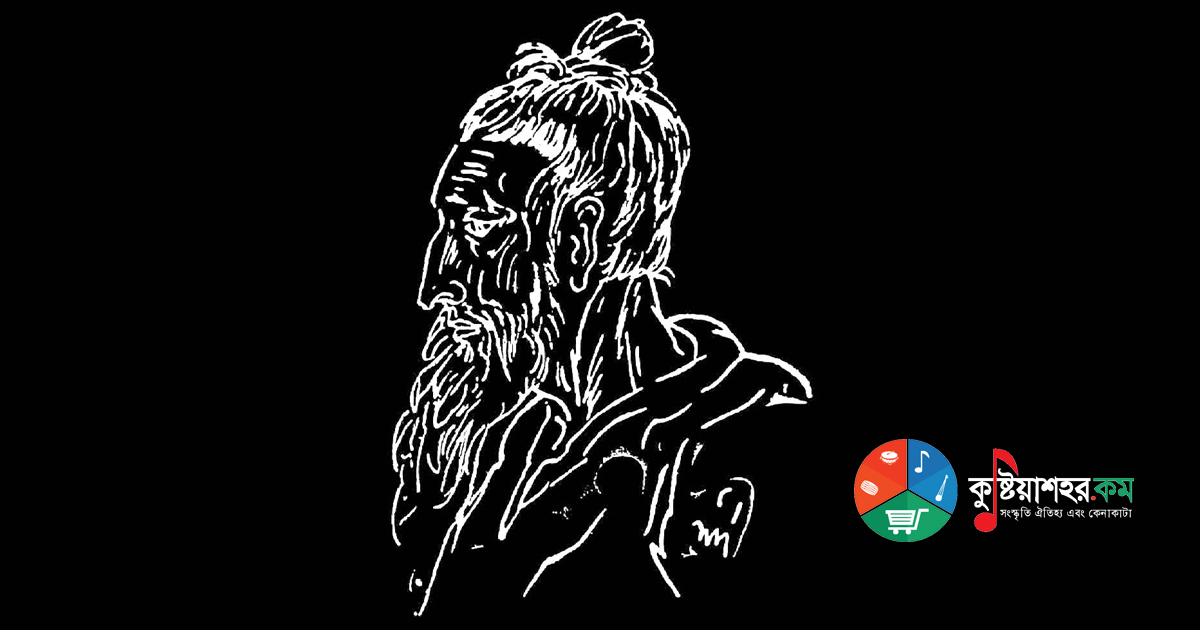
The history of Lalon's life proves this: that despite the humblest and most obscure birth, with the strength of courage and faith a human being can deny a decayed, immoral and exploitative social politics. In this process the voice of such a person does not only sound within his own generation but continues to be carried into the generations to come. Again and again on the soil of India such human beings have appeared. Crowds of followers have gathered around them, and in their lifetime they have earned a reverence like that of gods. In our own generation such a person was Gandhiji, and in nineteenth-century Bengal that person was Fakir Lalon Shah.
Lalon's poetry and song are a priceless inheritance — not merely the wealth of India but the common treasure of all three countries of the subcontinent. The message carried in Lalon's songs has an immense relevance today. And when the resurgence of communalism and racism has cracked the foundations of India's unity and democracy, Lalon's pure message of human love and brotherhood will remind anyone of a long tradition.
Translation: Shibabrata Barman.