বাংলা
 English
The 1971 struggle for independence is a golden chapter in the history of the Bengali nation. Winning independence by defeating the barbaric Pakistani forces in a war of just nine months is a very rare precedent in world history. In this struggle for freedom the Bengalis lost thirty lakh fresh lives, the honour of countless mothers and sisters, and immense wealth. Even so, in exchange for a chest full of blood, the Bengalis won a crimson independence. That is why the Liberation War of Bengal remains a source of inspiration for the tormented people of the world, seared by the disgrace of subjugation and longing for freedom.
Through a bloody nine-month war, the Pakistani invaders were driven out and our beloved Bangladesh emerged. The conspiracy that began with the assassination of the Father of the Nation along with his family on 15 August 1975 to make Bangladesh dependent again continues even now! The Razakars and Al-Badrs, who opposed the Great Liberation War, continue that same mischief at every step. However, with the Awami League, which led the Liberation War, in state power, the people are now hopeful. In the last election, the people of the country gave a massive verdict of trust in the grand alliance government led by Prime Minister Sheikh Hasina. During the previous four-party alliance government, the freedom fighters of the country were neglected the most. For that reason, since Sheikh Hasina's government came to power, the neglected freedom fighters who took part in the war of independence and the local people who remained in the background have begun to dream that they will be recognized. It is a certain truth that although forty years of independence have passed, as a nation we have not yet reached the desired goal. One of the main reasons is the failure to give the freedom fighters their true recognition and the black shadow of corruption. Even now there are many nameless freedom fighters and localities whose contribution to the war of independence was outstanding. This effort concerns one such locality left behind the news.
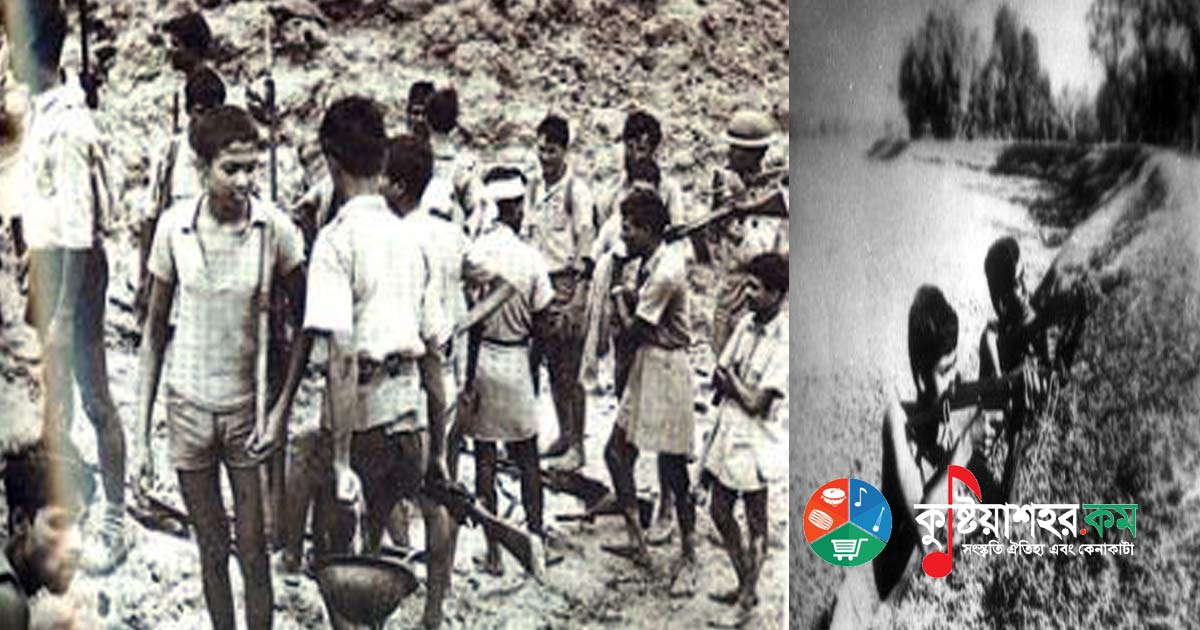
The greater Kushtia district of the time has a glorious contribution to Bangladesh's war of independence. The formation of Bangladesh's first provisional government in the mango grove of Meherpur is its finest testament. In 1971, even the people of Kushtia's remotest villages threw themselves into the war. Durbachara was one such storied locality. The young men of this traditional village of Kushtia Sadar upazila staked their lives to take part in the war for the motherland. But sadly, even after four decades, this area bearing the unforgettable memories of the Liberation War still remains out of the limelight! By visiting the area and talking to its freedom fighters, freedom fighters' families and the elderly, many unknown facts were learned. During the 1971 war of independence, the Banshtala battle of Kushtia was one of the most notable. Being a battlefield, Banshtala was always talked about the most. But behind it lay the unforgettable feats of the young men of the Durbachara area. In fact, the Banshtala battle was organized mainly with the majority of the fighters of that area. At that time, all operations of the Banshtala battle were directed from Durbachara. On the day of the battle, 5 September, when the Pakistani troops took position at the Banshtala crossing, the freedom fighters launched a counter-attack from Durbachara. Overall leadership of the freedom fighters in that battle was with Abul Kashem. However, on 5 September the battle there was organized under the leadership of Shamsuddin Ahmed. Eleven were martyred and 20/25 wounded. Five of the dead were buried in front of the Durbachara government primary school and the rest were buried in various places. One of them was buried beside the Kamalapur football field. Although eleven were martyred in that battle of 5 September, six were buried side by side in Durbachara. They were Tajul Islam, Didar Ali (Bir Pratik), Yakub Ali, Saban Ali, Abdul Mannan and Shahidul Islam. The rest were buried separately in various places. And Shahidul Islam was martyred on 6 December in the battle of Karimpur. After the Banshtala battle, another battle was fought at Karimpur in December, the month of victory. In that battle too, the freedom fighters began their mission from Durbachara. In that face-to-face battle, Shahidul Islam, a meritorious student of the then Rajshahi Engineering College, was martyred. He too was later buried beside the five martyrs of Durbachara. Despite such contributions to the Liberation War, the related localities still suffer neglect.
The residents of the related localities say with emotion that although we were closely involved in the great Liberation War, hardly anything has happened here. Somehow six graves in Durbachara have been bricked up. Two plaques have been put up at Banshtala and Karimpur. Especially after the people of all strata of Durbachara, the freedom fighters and the members of the freedom fighters' families have endured so much, no one seems to be looking. Shahidul Islam, martyred in the Karimpur battle, was the most meritorious student of this area. At the time he was a third-year electrical student at Rajshahi Engineering College, now known as Rajshahi University of Engineering and Technology (RUET).
Shahidul, son of the late Solim Uddin Bishwas, a former chairman of Ujangram union, was an exceptionally meritorious student. At that time he passed both the SSC and HSC examinations in the first division. He then set off for Rajshahi with the dream of becoming an engineer. But at the call of the motherland he abandoned the pen and took up arms as the weapon of patriotism. On 6 December this fearless brave son fell victim to the brutality of the Pakistani invaders. Speaking about this, Shahidul Islam's younger brother, fellow fighter and former chairman of Ujangram union, Sabu-bin-Islam, said in a voice choked with tears, 'This pain cannot be forgotten. The Pakistani soldiers shot and killed my brother in front of me. And they detained me and took me to the Bittipara camp. My father had many dreams about my martyred brother. His wish was that he would become a renowned engineer and work for the country. Everyone knew of my brother's talent. He was the most meritorious in his batch at Rajshahi. That is why after his martyrdom a hall at Rajshahi University of Engineering and Technology was named after him — that is, Shahidul Islam Hall on the present RUET campus.' Freedom fighter Sabu-bin-Islam continued in a tone of frustration and anger, 'We fought for the country unconditionally. But now there is no security in our lives! Like others, the true freedom fighters are today deprived and humiliated. There is much pain and anguish in my heart. I did not fight to see such a state. Amid the crowd of fake certificate-holding freedom fighters, the true freedom fighters are so helpless that I no longer attend freedom fighters' events, because I feel ashamed of myself, I feel disgusted.' This valiant freedom fighter asks nothing for himself. Yet he is still waiting with eager hope that a memorial will be built at the site of the graves of the six martyrs of Durbachara. He firmly hopes that the present pro-Liberation-War government will implement it.
Tajul Islam, another talented son of Durbachara, was also martyred in the Banshtala battle. At the time, this honours student, his newly married wife's wedding turmeric barely worn off, went to India for training. He returned from there and plunged into battle. Martyr Tajul's father Karim Sheikh said, 'Tajul was charitable. Doing good to others was almost like his obsession. The daring Taju single-handedly subdued a Pakistani soldier in the Banshtala battle. Defeated by his strength, the enemy shot him from behind and killed him like a coward.' Taju's father, aged 80, wiping his eyes, said, 'It makes me proud to think that my son gave his life for the country. But what did we get? Even my son's grave has not been properly bricked. So many governments have come and gone since the country became independent, but none pays attention to this. I request the honourable Prime Minister to arrange for the graves to be properly walled and a memorial built there.' Tajul's elder sister-in-law Jahanara Begum and sister Meherunnesa, sobbing and weeping, said, 'He always thought of others. He doted on the little ones. He joked with us. They killed such a lively boy like a coward. We still cannot believe Taju is gone.' When Taju's uncle Tobbar Mollah, who carried Taju's body back from the battlefield on his shoulder, was asked to describe the events, he burst into tears like a child.
That many true freedom fighters have remained in the background, passing their days in dire hardship without food or half-fed, has a living example in freedom fighter Bajr Mollah. The local elders claim that this 78-year-old patriot contributed more to the war than many of today's well-known freedom fighters. He took part in the war with conviction, and now in old age he is locked in a battle for life. For two handfuls of food he has opened a tiny shop right beside the martyrs' graves. His two sons struggle to run their own households, so he rarely gets to see them. Forced by circumstances, the old father has now become a grocer. The innocent students of Durbachara government primary school are his customers. Asked about his war memories, this old man, arrived at the last stage of his life, said, 'What more can I say, grandson. Journalists come and go. Nothing happens. Meanwhile many who never fought manage certificates through influence and are enjoying allowances and other privileges at full tilt.' Though this old freedom fighter carried the regret of never receiving anything despite knocking on door after door at various times, as his last wish he too expressed the longing to see a memorial built at the site of the martyrs' graves in Durbachara.
Though not on the official list, Asadur Rahman took part in the war with conviction in 1971. His contribution was far greater than that of many titled freedom fighters, and it continues to this day. It is largely through the efforts of this venerable man, now serving as headmaster of Durbachara Multipurpose High School, that the history of Durbachara's freedom struggle somehow survives. He is working tirelessly with devotion to preserve the burial site of the six freedom fighters and to keep Durbachara's war history alive. As the fruit of his efforts, a 'Liberation War Museum' has already been set up on the western side of the freedom fighters' burial ground. But for lack of funds nothing much of historical value could be preserved there. He has taken up another great initiative. He is writing a book to immortalize Durbachara's valour in the Liberation War, containing all the events with data and information. The elderly headmaster says hopefully, 'Within Kushtia, the place of greatest glory in the Liberation War is Durbachara. It is the only place in Kushtia district with a combined grave of freedom fighters. Yet even after all this, nothing much has happened here because of the local administration's indifference. It is very painful. Even so, I remain hopeful that perhaps in the future a glorious monument for the freedom fighters will be built officially in Durbachara.'
Even after the country was freed of its enemies and became independent, for a long time the burial site of the six martyrs of Durbachara remained neglected. Work on building the graves came several times, but the work was not done properly because the people concerned embezzled the money. Finally, a few years ago, through the efforts of the present Kushtia district freedom fighter commander Nasim Uddin Ahmad and the then Ujangram union freedom fighter commander, the late Shams-er Ali Mollah, the development work of the graves was done, under a project named 'Roktron' (Debt of Blood). Under that project the graves were walled with bricks on all sides and name plaques placed before each grave. No development work has taken place since. Every year, before 16 December, the duty is fulfilled merely by whitewashing! The local residents demand that a memorial be built here. Many experts have said that if a government monument is built at this place (Durbachara), which carries the great memory of the freedom fighters, the place could become a historic site.
Information source: - Zahidul Alam Joy, Daily Janakantha