বাংলা
 English
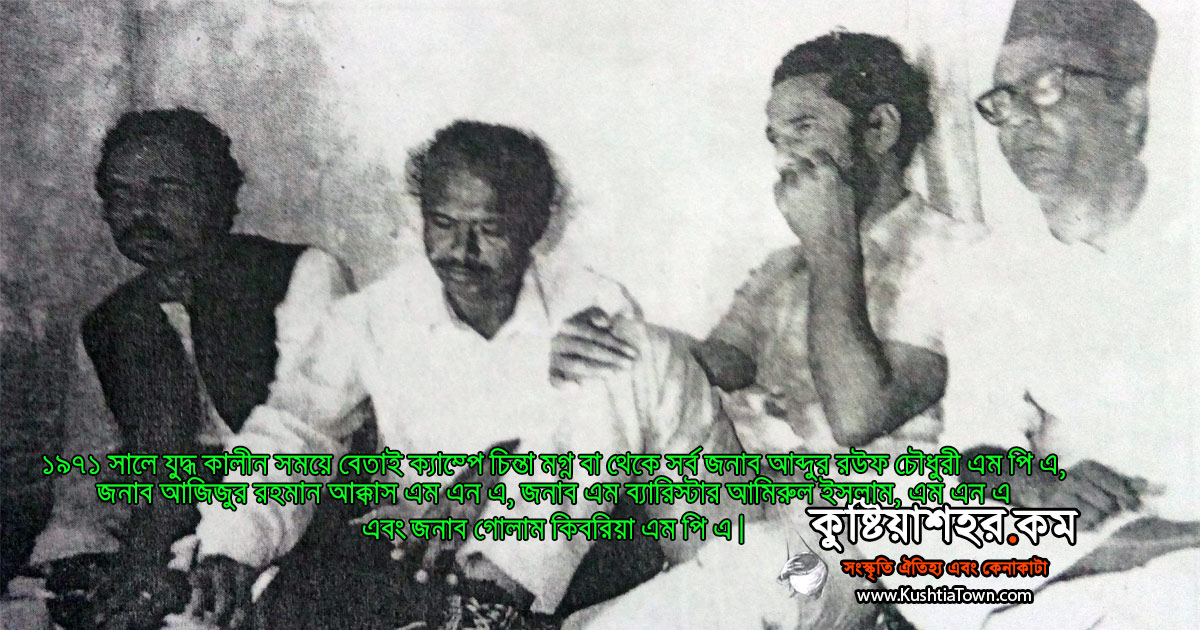
Raushan Ali began discussing this war and the plans ahead within his own party. He advised everyone to move to a safe place, but he himself stayed on in the town. After fifteen days free of the enemy, on 14 April the Pakistani troops reoccupied the town amid wanton destruction and killing. In the meantime Raushan Ali crossed the border into West Bengal, where he held long discussions with his political friends of many years. Coming to Krishnanagar in Nadia district, he brought together the young men arriving from Bangladesh and arranged armed training so that they could join the War of Liberation.
Two recruiting camps were run under the leadership of the National Awami Party. The first was at Krishnanagar, run by Comrade Raushan Ali, and the other camp was at Anandapalli, run by the youth leader Syed Zahed Rumi. Important meetings of the NAP central committee were held at Park Circus in Calcutta, and in all of these meetings Raushan Ali offered sound, practical decisions.
The nation will remember forever, with respect, his active role in the War of Liberation. During the war he travelled day and night from camp to camp, inspiring the freedom fighters. He would say firmly: a nation that has once taken up arms and begun a war of independence cannot be silenced; the guns will keep firing until independence is won. That is the rule, that is history. He would sit with the young fighters, talking with them and encouraging them by recounting episodes from his own long years of struggle. Comrade Raushan Ali travelled through the various industrial belts of India, trying to rally support for the Liberation War, and held lengthy discussions with the communist leaders of West Bengal. In particular he met several times with the leaders of the CPI, the CPI(M) and other progressive democratic parties, and pressed them to bring pressure on the Congress government.
In the end, the independence of Bengal came at the cost of the blood of three million martyrs. He returned to Kushtia and threw himself, together with the party workers, into rebuilding the war-ravaged town. At the same time, when the long-outlawed Communist Party was formally re-established, he took over the responsibility of secretary of the district branch. While supporting the way Bangabandhu's government ran the country, he kept speaking out against the unruly conduct of his own party's leaders and activists. When BAKSAL was formed, he was elected one of the leaders of the BAKSAL district committee.
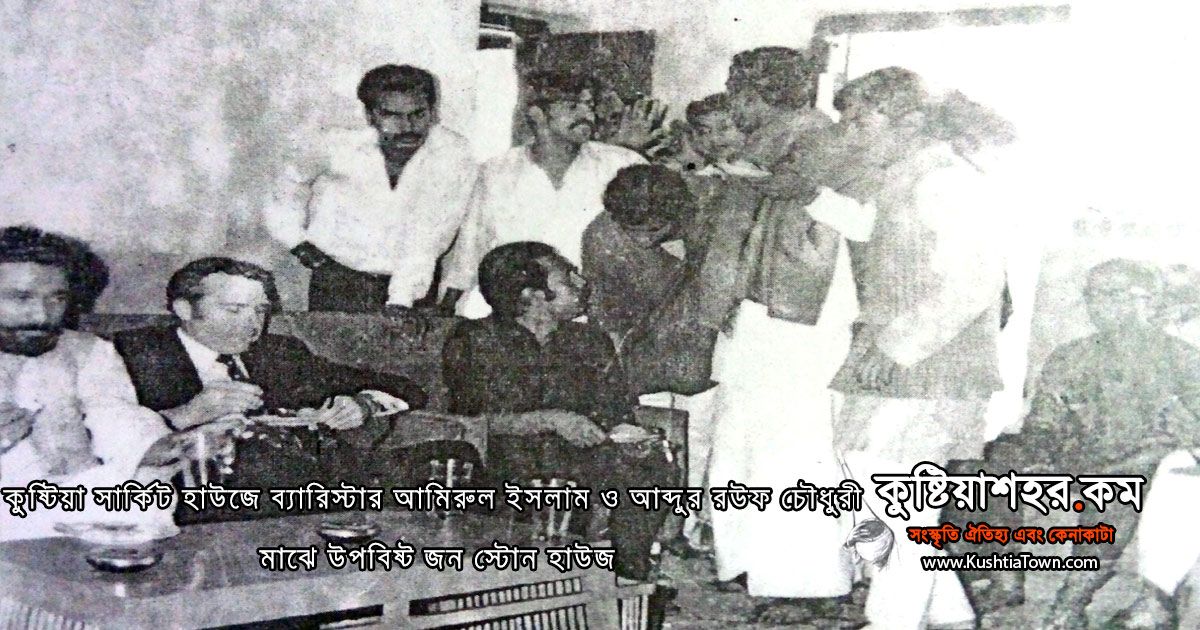
In 1974 Bangabandhu came to Kushtia on an official visit and expressed a wish to meet Comrade Raushan Ali. Bangabandhu Sheikh Mujibur Rahman, the apple of the Bengali people's eye and Father of the Nation, came to the Circuit House to talk with Comrade Raushan Ali, himself the apple of the eye of workers, peasants and all the oppressed toiling people. Breaking all protocol, Bangabandhu rushed over and embraced him. Then the two leaders sat down to talk. With gratitude Bangabandhu said to the Comrade: "Raushan Bhai, I have heard your name many times, but we have never met in person. The nation will remember forever your sacrifices, your forbearance and your devotion." He went on: "You have gained nothing in your whole life — tell me, what do you want?" The Comrade smiled faintly, and then said humbly to Bangabandhu: "Do something for the workers, the peasants and the toiling people. That will be my everything." The two leaders then discussed the formation of BAKSAL at length.
On 23 February 1972, at the invitation of the Soviet trade unions, Comrade Raushan Ali went to the Soviet Union. The delegation had six members in all. Travelling by Soviet aircraft via Bombay and Tehran, they reached Moscow at night. At the Moscow airport the labour leaders of that country received the delegation, and he was then taken to the Sputnik Hotel. In Moscow the Bangladeshi delegates discussed various matters with the leaders at the office of the All-Union Central Council of Trade Unions. They visited a watch factory and the world's largest oil refinery at Baku, and in Prague they held talks with the officials of the World Federation of Trade Unions. In Leningrad they visited the Aurora warship [from which the revolutionaries fired the first shot in 1917], the martyrs' graves, the seaport, museums and several factories. From 7 to 10 March they took part in the seventh congress of the trade unions.
After Bangabandhu was killed along with his family on 15 August 1975, Khondaker Mostaq came to power. Then on 7 November the army chief, General Ziaur Rahman, imposed martial law and seized power by force, and all political parties were banned. Once again the signs of the Pakistani era reappeared on the political stage. By this time Raushan Ali had grown quite ill. He had been stricken with an incurable skin disease: police repression at various times, exhausting toil, poverty and hardship, and long years in prison had brought on the disease, and even after extensive treatment he could not be cured. In 1979 the Ziaur Rahman government began scheming to shut down the Mohini Mill, and against this conspiracy the ageing Raushan Ali took to the field with the workers. In the end the BNP government made its decision to close the mill final. Thinking of the plight of thousands of workers, Raushan Ali again took to the field despite his failing health. In 1980 he became bedridden, yet whenever he felt a little better he would rush off to be among the mill workers.
Soon after Ziaur Rahman came to power, Comrade Raushan Ali was arrested. After the independence of Bangladesh, this leader of the oppressed people was imprisoned for the first time — under the dictatorship of Zia.
After a long period of imprisonment he was released. Finally, on 5 February 1982, the historic Mohini Mill was shut down on the pretext of running at a loss. Under the leadership of Comrade Raushan Ali, the 'Mohini Mill Struggle Council' was formed, bringing together professionals from every level of society.
On 24 March 1982 another military dictator, General Ershad, took power, following exactly the path of General Ziaur Rahman. In the early years of the 1980s the workers' and employees' unity council (Sramik Karmachari Oikya Parishad) was formed, and so was the 15-party alliance, a combination of fifteen political parties. Raushan Ali held a leading position in both bodies. With the responsibility of the Communist Party on one side and the leadership of the movement against military rule on the other, he kept carrying on despite his failing health.
In September 1984 Raushan Ali fell gravely ill and was admitted to the Sadar Hospital. But he could not be saved. A legendary hero of the toiling people, Comrade Sheikh Raushan Ali breathed his last on 17 September 1984. From the days of British rule right up to the anti-Ershad movement, there was hardly a democratic or progressive struggle in which Comrade Sheikh Raushan Ali did not take part directly. His sacrifice, his devotion and his combative life will remain unforgettable to the people of the area. Not only in this country — in India and throughout the world of that time his name was on everyone's lips. To Marxist theorists he remains an ideal.
It must be said that Comrade Raushan Ali's principal struggle was centred on Kushtia district and, more broadly, on Bangladesh and India. Yet even today no memorial worthy of keeping his memory alive has been built. Only the Kushtia pourashava (municipality) has named one of its markets after him. This meagre recognition is not enough for a leader as dearly loved as he was. The very party whose ideals he struggled for all his life — the Communist Party of Bangladesh — does not remember him even by mistake; it is as if today's comrades have forgotten even to observe his birth or death anniversary. Along with Moni Singh, Raushan Ali is one of the handful of leaders who gave their lives, their youth, everything, to the party and brought the CPB to where it stands today.
When the pages of memory are turned, that great, compassionate human being rises again and again, radiant, upon the screen of remembrance — can this nation forget him so easily? What the people of Kushtia could have done to preserve his memory, what the party ought to have done — has any of it really been done? That failure is not his; it must be called ours, and the failure of his beloved party.