বাংলা
 English
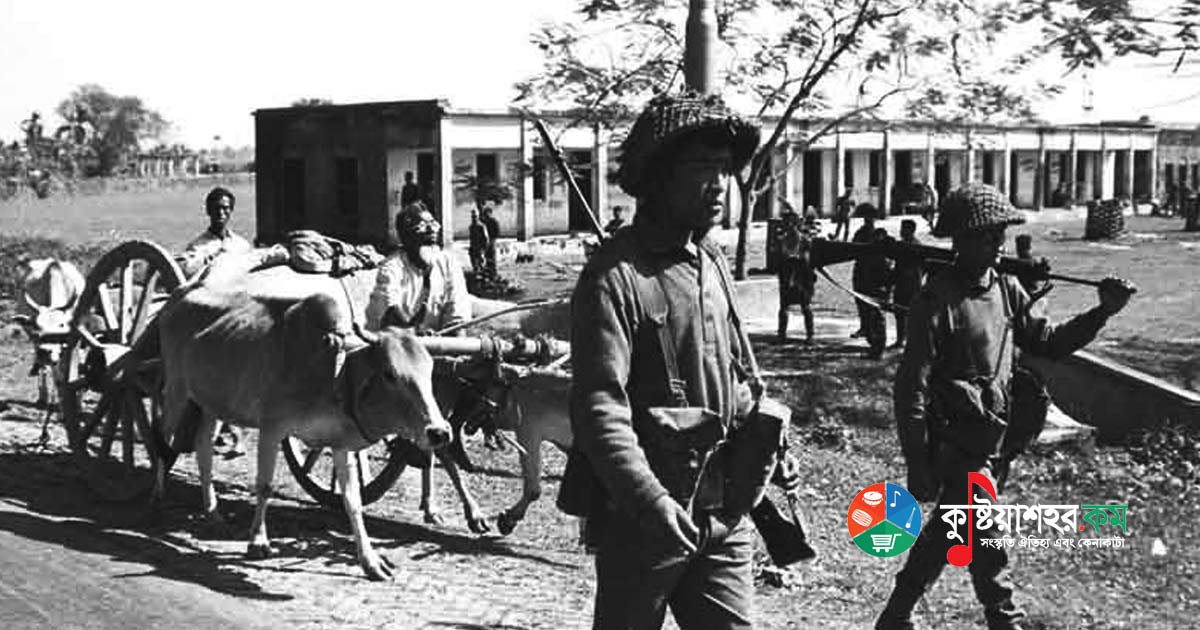
On this day, 11 December 1971, the freedom fighters of Kushtia district fought bloody battles — 22 of them, big and small — and liberated Kushtia from the hands of the Pakistani forces. Against the marauding Pakistani troops armed with state-of-the-art weapons, the brave young Bengali freedom fighters fought with boundless valour and boundless courage, and succeeded in driving the Pakistani occupiers out of the sacred soil of Kushtia and freeing it. That day the sky over Kushtia rang with the soul-stirring slogan of "Joy Bangla" from thousands upon thousands of people yearning for freedom.
Barricades were thrown up along the roads and across the countryside. Carrying staves and weapons, shields and swords, people rushed to Kushtia town from villages including Haripur-Barkhada, Jugia, Alampur, Dahkola, Jiarukhi, Koya, Sultanpur, Poradah and Baradi.
During Bangabandhu Sheikh Mujibur Rahman's historic speech at the Racecourse Maidan on that historic 7 March, the longing for freedom shone in the eyes of all those people, and in their hearts rang his final proclamation — "This struggle is the struggle for independence." Embracing that proclamation of the charter of freedom, the people of Kushtia who longed for liberation, like the rest of the country, prepared to seek the path to freedom. Immediately after this speech, to crush the Bengalis, one company of troops from the 27th Baluch Regiment of the Pakistan Army arrived from the Jessore cantonment on the night of 25 March under the "Operation Searchlight" battle plan and took up positions in Kushtia. They declared a curfew for 30 hours at a stretch and patrolled armed and ready. After Bangabandhu's speech, Major Abu Osman took a stand against the Pakistan Army. At that time the Pakistan Army, under Lieutenant Colonel Rezaul Karim of the 1st Bengal Regiment, was stationed at Jhikargacha in Jessore for its regular winter exercise. Around this time, after talks between the political leadership of Kushtia and Abu Osman, Captain Azam Chowdhury was sent to Jhikargacha in Jessore to persuade them to take a stand in favour of Bangladesh's independence. But seeing no result, Captain Azam Chowdhury returned from there and, taking along the Mujahid and Ansar forces, the student community of the Independent Bengal Student Struggle Council and people of every walk of life, plunged into the war of independence.
As per the programme of the central committee of the Independent Bengal Student Struggle Council, on 23 March A. Jalil, convener of the Kushtia district branch of the council, hoisted the flag on the field of Kushtia Islamia College in the presence of a spontaneous crowd. Present there at the time were Sheikh Dalil Uddin, Marfat Ali, Lokman Hossain, Jamal Uddin Khaled, Saifuddin Tarek (Bir Protik) — who was later killed in the war — and people of all walks of life. The freedom-loving people of Kushtia could not accept such army activity that day. Breaking the curfew, they poured out onto the streets and built barricades. Near Majampur, Thanapara, Amlapara and the big bazaar gate, members of the public piled bricks and rubble, felled tree trunks and even house roofs onto the roads to obstruct the army's movement. When the army cleared them away, it became all the more ferocious. Fierce fighting began.
At 11 pm on 25 March, 147 soldiers of the Baluch Regiment took up positions at the police lines, the district school, the thana, and the wireless office and telegraph office at Aruapara. Meanwhile, civilians and the political leaders of the time, having received Bangabandhu's final directive, prepared for the liberation war, and fighting spread on every side. On 27 March, in front of the present Civil Surgeon's office, a young student named Ronnie Rehman lost his life under gunfire while throwing a hand grenade at a Pakistani army vehicle from a one-storeyed building. Ronnie Rehman was Kushtia's first martyr of the liberation war. That very day the Pakistani forces began firing indiscriminately on ordinary people in various parts of the town; seven were killed on the spot. Among them, Gyana Sen of the Court Station and Hasem of Courtpara are known by name. Amid the atrocities and genocide of the Pakistani forces, the people of Kushtia rose in rebellion. Major M. A. Osman Chowdhury, wing commander of the Jessore sector of the EPR, was in charge, with Captain Sadek as deputy commander. The No. 4 Wing consisted of 5 companies and 1 support platoon. Under this wing, Subedar Mozaffar Ahmed was commander of the 'A' company in the Pragpur area, Subedar Khairul Bashar Khan of the 'B' company in the Dhopakhali area, Subedar Mukid of the 'C' company in Baidyanathtala (Mujibnagar after 15 April), Subedar Majid Molla of the 'D' company in the Jadabpur area, and Subedar Rajjak of the 'E' company at the wing headquarters. In addition, the signal platoon under Havildar Muslem Uddin was stationed at the wing headquarters. Each company was equipped with the necessary weapons. One company had 5 light tank-destroyer cannons, 7 light machine guns, 1 machine gun and the remaining 303 rifles. At the wing headquarters, besides one company of troops, there were 6 three-inch mortars and 200 Chinese automatic rifles. Moreover, the ammunition and vehicles needed for a battalion to join the battle were at No. 4 Wing. On the other side, the commander of the Pakistan Army was Major Shoaib. Captain Shakil, Captain Samad and Lieutenant Ataullah Shah were stationed in Kushtia as officers under him.
The Pakistani forces also had 106 mm jeep-mounted recoilless rifles, heavy and light Chinese machine guns, automatic rifles, powerful wireless sets and abundant ammunition. On the night of 25 March, Major Osman Chowdhury, together with his family, was staying at the Kushtia circuit house. From the morning of 26 March, as the military authorities in Dhaka kept issuing new military directives over the radio, he hurried to Jhenaidah and, upon reaching Chuadanga, called an emergency meeting. Captain A. R. Azam Chowdhury, Dr Asabul Haque, local political leaders and police officers met in a secret meeting. Meanwhile, on the morning of 27 March the Punjabi Captain Sadek came to the Jadabpur company headquarters and ordered the soldiers to disarm; when a Bengali guard resisted Captain Sadek, a clash broke out, in which Captain Sadek and his Punjabi accomplices were killed. After this sudden clash, Major Osman formed an advisory council to deal with administrative matters, military and civilian coordination, international communications and political support. MP Dr Asabul Haque, Advocate Yunus Ali and Barrister Badal Rashid were among the members of this advisory council. Through consultations with the advisory council, a plan was adopted to free Kushtia district of the enemy. Major Osman ordered all the EPR soldiers stationed at the border to assemble at the Chuadanga headquarters, and ordered Pragpur's company commander, Subedar Mozaffar, to begin the campaign along the road towards Kushtia.
The Pakistani forces had taken up positions at the police lines of Kushtia town, the district school and the Aruapara wireless station. Under the plan for a simultaneous surprise attack from three directions, Captain Azam Chowdhury was ordered to attack the army camp at the district school. Of these three places the district school was the largest and strongest. Subedar Mozaffar was ordered to attack the camp at the police lines, and Naik Subedar Moniruzzaman (later martyred) to attack the wireless station. At that time there was no field wireless or field telephone at all for communications. So, with the help of the telephone department, a field exchange was set up in a field in Ailchara village of Poradah. Under the leadership of Dr Asahabul Haque, a field medical centre was arranged with doctors and medicines. By noon on 28 March all the companies at the border had assembled at Chuadanga as ordered. In line with the earlier plan, one company of troops was sent to Jhenaidah, where they blockaded the Jessore–Jhenaidah road so that no troops or weapons could be supplied to Kushtia from the Jessore cantonment.
Another company of troops, under Captain Azam Chowdhury, was sent to Poradah along the unpaved Chuadanga–Poradah road. Captain Azam's instruction was that, on reaching his destination, he should contact Subedar Mozaffar and send a report to Chuadanga headquarters. The plan was for Captain Azam's company to attack the south-western corner of the town, that is, the circuit house, while Subedar Mozaffar's company, a platoon of troops and some volunteers under Naib Subedar Moniruzzaman would attack the wireless station adjoining Mohini Mill from the east. The joint attack would come simultaneously from three directions. The date of the attack was set for 4 am on 29 March. All arrangements were complete. But owing to communication difficulties and an accident involving one of the vehicles, Subedar Mozaffar's troops could not reach the designated spot, so the attack was rescheduled for 4 am the next day, 30 March. At 4 am on 30 March the attack on Kushtia began, unexpectedly, from three directions. As planned, the moment the attack began, thousands of local people filled the sky over Kushtia with the soul-stirring cry of "Joy Bangla". This shattered the enemy's morale completely. After barely an hour of fierce fighting, the freedom fighters and troops broke into the police lines and the wireless centre and began wiping out the enemy. Seeing no way out, a small number of Pakistani soldiers, terrified, threw down their weapons and fled towards the district school headquarters; many Pakistani soldiers were killed as they fled.
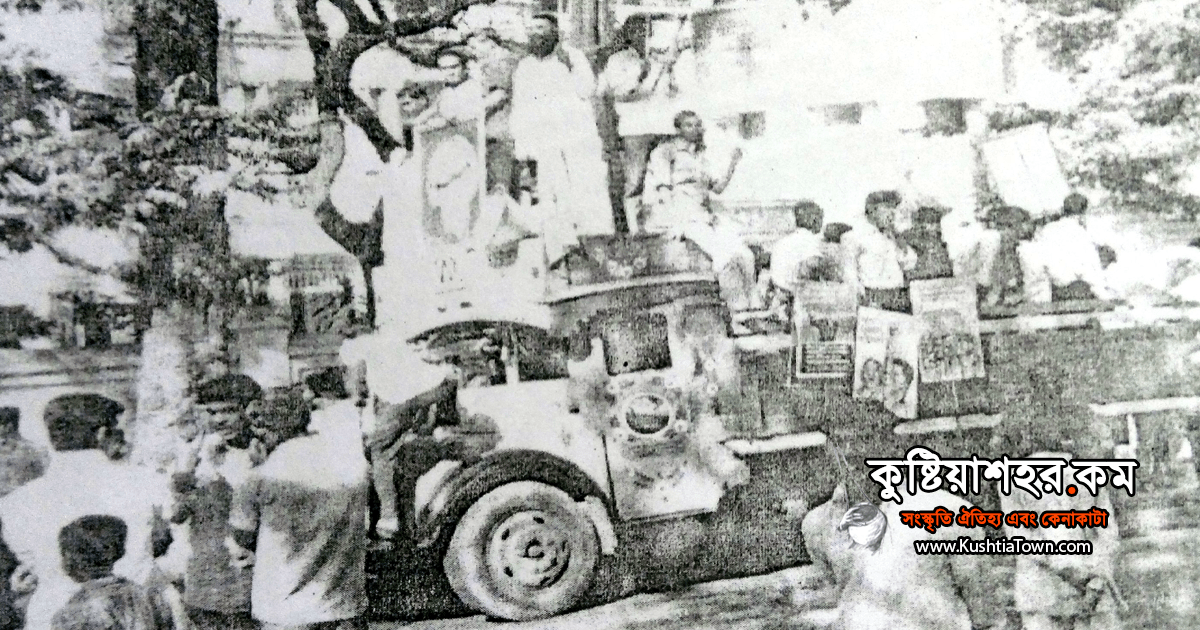
After a full day of fighting, the entire town except the district school had fallen to the liberation forces. In victorious jubilation, the freedom fighters took up strong positions around the district school and kept the battle going. Thousands of freedom-hungry people meanwhile kept supplying the freedom fighters with food. At this point an appeal from the enemy side came through on the wireless set; from the Jessore cantonment the reply to every message was: "We cannot help you. Defend yourselves by your own efforts." The next day, 31 March, fierce fighting continued. After a whole day's battle, 40/50 of the enemy were still alive, most of them officers. Finding no way forward, under the cover of night they tried to flee towards Jhenaidah in two jeeps and a Dodge truck. The freedom fighters caught on and followed their route. Near the Garaganj bridge the freedom fighters had dug a pit and covered it over; the Pakistani soldiers knew nothing of it. Their two vehicles plunged into the pit, and Major Shoaib and the enemy soldiers were killed. The rest, wounded, scattered into the neighbouring villages, where the alert freedom fighters, volunteers and ordinary people beat them to death with staves. On 1 April Kushtia became completely free of the enemy and passed into the hands of the freedom fighters. Four freedom fighters were martyred in this battle and many were wounded. In line with earlier orders, Captain Azam Chowdhury sent all the weapons, ammunition and vehicles captured in Kushtia to Chuadanga in the early hours of 3 April.
That very day a mobile crew of the French Television Corporation arrived in Chuadanga and expressed the wish to interview Major Osman Chowdhury. At that time, apart from the BBC and Akashvani, nowhere else was accurate information about our liberation war being broadcast. The interview with Osman Chowdhury lasted a full 15 minutes. At exactly that moment an air strike by the Pakistan Air Force began over Chuadanga, and for quite a while the battle raged between the aircraft and the freedom fighters on the ground. The French TV crew seized the opportunity and captured the scene on film. The first napalm bomb was dropped on the soil of Bengal. That day the sacred soil of Bengal was lacerated by this bomb in Kushtia town and other areas; bomb and helicopter machine-gun attacks rained down all over Kushtia town. With their meagre weapons the freedom fighters fired back at the Pakistani air pirates. After their ignominious defeat, the Pakistani forces strove to reoccupy Kushtia completely. Large numbers of troops and weapons were brought to the Jessore cantonment by air and by water. Around this time a detachment of the Pakistani forces came to Kushtia by water from Aricha on 11 April. With only a small number of weapons, a group of freedom fighters under Naib Subedar Shamsul Haque built a resistance at Goaland. Their instruction was that the Pakistani soldiers must not be allowed to land on this side of the Padma at any cost.
On 13 April there was a fierce clash between the freedom fighters and the leading troops on the banks of the Padma. One of the Pakistani army's vessels sank and they were forced to flee northwards. Landing at Nagarbari, the Pakistani soldiers advanced rapidly towards Pabna. After an intense exchange of gunfire with the freedom fighters stationed at Bheramara, the Pakistani soldiers landed in the Bheramara area. Subedar Major Mozaffar was in charge of that command, and he was forced to withdraw with his troops. At this point they went down at Jhenaidah. After being free for 17 long days, Kushtia fell back into the hands of the enemy. After this, as soon as the Pakistani soldiers entered the town, they carried on with arson, genocide and a reign of terror. At that time the town's population was very small, and those who were there were killed at the hands of the Pakistani soldiers. The Pakistani soldiers set fire to Bengali homes one by one. Later, during the liberation war, chairmen of the zonal councils — formed through the votes of MNAs and MCAs — were elected in Dhaka in order to free the whole country of the enemy.
Young men were selected one by one, given guerrilla training at various places in India, and dispatched to different sectors of Bangladesh. After the defeat of the resistance forces on various battlefields of Kushtia, thousands of people from the district who stood for its independence — political leaders, student leaders, members of the army, EPR, police, Ansar, Mujahid, students, young men and freedom-loving people — left the country and fled. On the afternoon of 17 April, at the mango grove of Baidyanathtala in Meherpur of the then greater Kushtia district (later Mujibnagar), the oath-taking and introduction ceremony of the provisional government of Bangladesh, formed on 10 April, was held.
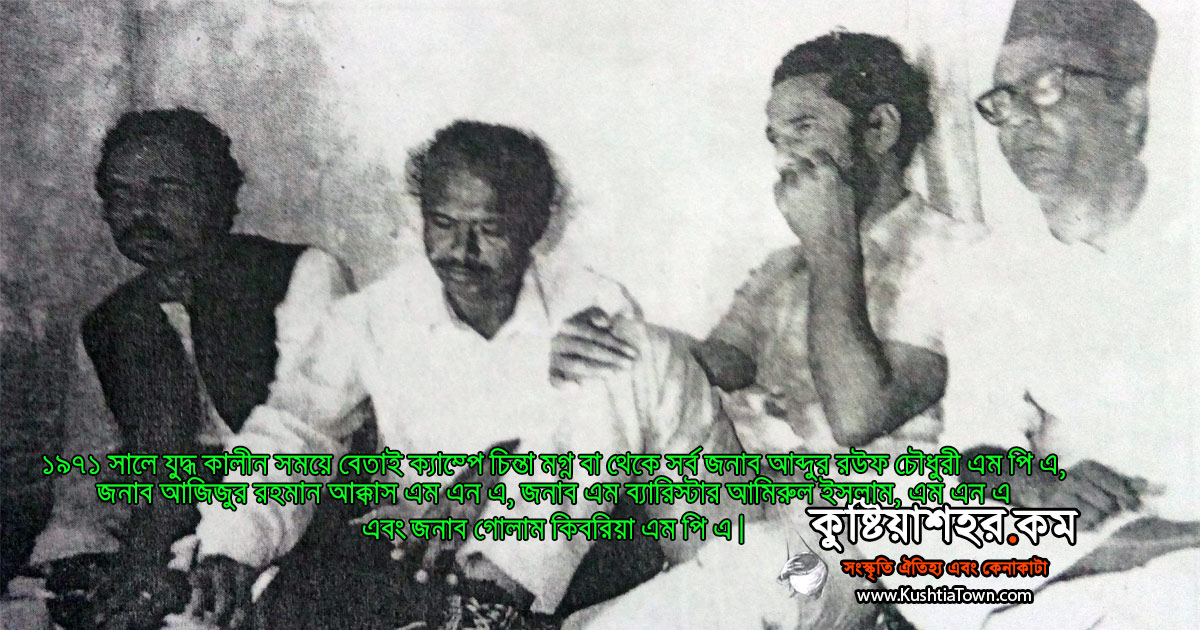
The battlefields of the liberation war were divided into 11 sectors, and greater Kushtia district came under Sector No. 8. Major Abu Osman Chowdhury served as commander of Sector No. 8. On the morning of 10 December, south of Kushtia town near the Chowrhas BTC tobacco purchase centre, on the north side of the GK canal bridge, the liberation forces and the allied forces together fought a bloody battle against the Pakistani troops on the main road. Here too 70 members of the allied forces were martyred. By the evening of 10 December all areas of Kushtia district were independent and free of the enemy. On 11 December Kushtia town and the Poradah, Mirpur and Bheramara areas became independent and enemy-free. The destruction of that day still lives in the memory of Kushtia town. After a total of 22 battles, big and small, from April to December, Kushtia was freed of the enemy on 11 December. In enemy-free Kushtia, Abdur Rauf Chowdhury, zonal chairman of the then provincial council, hoisted the official national flag in the Kushtia collectorate square and handed over charge of the district administration to M Shamsul Haque, secretary of the zonal council. The role of Kushtia's poets, students, writers, artists and authors in the liberation war was remarkable.
(Information sources: Abdul Hannan's "Kushtia in the Liberation War" and the history of Bangladesh's liberation war, compiled by journalist Noor Alam Dulal)