বাংলা
 English
His forefathers came from Bethua Dahari in Nadia. They were the owners of the Mohammad Shahi pargana; Gaus Bila was its old name, Ghosh Bila its present name. There were two accomplished brothers, one of whom was Baghu Dewan. His mazar (shrine) is at Alampur; the other brother's mazar is at Ghosh Bila, and his name was Faiz Uddin.
Faiz Uddin Ahmed was his son. Jamir Uddin Ahmed's son was Ekin Ali. Ekin Ali's sons were Khandaker Isahak, Khandaker Shahadat, Khandaker Kausar and Khandaker Naosed. Khandaker Mahabub was the son of Isahak Ali. Khandaker Abdul Wahed was the son of Khandaker Shahadat Ali. Khandaker Manowar Hossain was the son of Khandaker Naosed Ali (he does business in Saudi Arabia).
Khandaker Abdul Wahed was born on 1 January 1912 at his maternal uncles' house in Jhaudia. His maternal grandfather was Kafil Uddin Ahmed. He received his primary education at the village school, passed his matriculation in 1937 from the Goswami Durgapur High School and passed his IA in 1940 from Bangabani College in Calcutta. His studies were cut short by his father's death.
At that time Bangabandhu Sheikh Mujib was a student of Islamia College; he became involved in the student movement and joined the Student Federation of India (SFI). His father had a business at Shyamligandha in Cooch Behar. Every Sunday there would be a gathering at their house in Cooch Behar — Hindus, Muslims and Christians all came. One of the people there was a member of the Communist Party, and from him came his first lessons in politics. He first took a job as a wireless operator; the world war had just begun. While he was working as a wireless operator aboard a ship, an accusation was made that Khandaker Abdul Wahed was in contact with Japan.
An Irish mechanic on the ship complained that he was in contact with the enemy side abroad, and he was tried at Fort William. The case ended in his acquittal, but he was let go from his job. He then took training in the station master's course on the East Indian Railway and was posted to the Lucknow division, with a mutual transfer to Halsa station. In 1945 he was elected a member of the Railway Workers' Trade Union and a member of its zonal committee; at that time he was in Assam. In the 1946 provincial assembly election of undivided Bengal, Jyoti Basu was the candidate, Jamir Uddin Prodhan stood for the Muslim League and Humayun Kabir for the Congress. Jyoti Basu was elected.
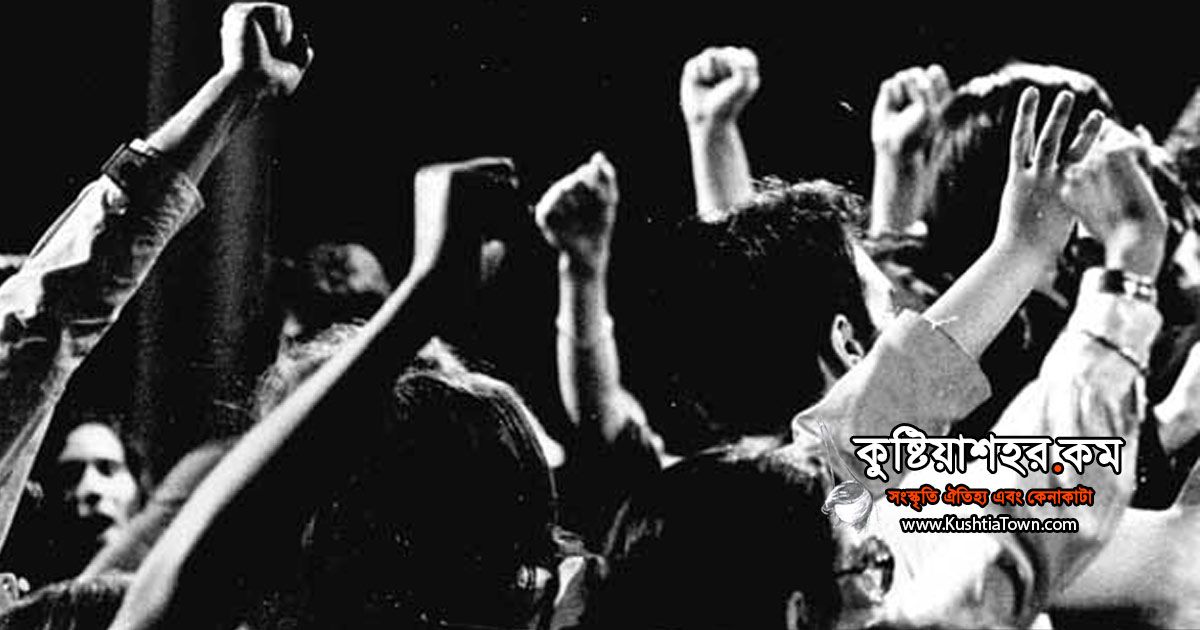
The country was partitioned in 1947. Khandaker Abdul Wahed chose to continue his service in Pakistan and was posted as station master at Lalmonirhat. S. A. Sohrawardy was then the general manager of the Chittagong zone. Many joined the service with false declarations. In those days one had to work more than sixteen hours, and as a trade union leader he came out in protest; a movement spread across the whole country. When the railway authorities refused to listen, he stayed away for a day, and all the trains from Shantahar to Lalmonirhat came to a halt. He was summoned, and when he put forward his position, pleading illness in defence of his absence, he was sent off to the medical officer, and then transferred from place to place.
While he was living at Bone Para he was dismissed from his job. The welfare officer R. N. Bagchi asked that he be reinstated, but when the D.T.S. traffic superintendent Salahuddin Ahmed refused to take him back, he gave up the service. Although he left the job in protest against discriminatory treatment, he carried on the movement together with Jasim Mandal and Mukhlesur Rahman of Faridpur. Later he came to Kushtia, took a job at the Mohini Mill and became secretary of the trade union in 1951, becoming deeply involved in the Mohini Mill movement.
He carried on the movement alongside Nanda Sanyal (also known as Sudhir Sanyal), Sheikh Raushan Ali and Garisullah Sardar. In the United Front election of 1953, Syed Altaf Hossain received the nomination and he began working on his behalf. In early 1953 Maulana Bhasani came to Kushtia, and the demand arose for forming a United Front; before that there had been no United Front.
Because of his election work he was detained in November 1953. Dewan Ahmed and Abdul Kaiyum were also detained, and they were sent to Pabna jail. He was freed in June 1954, after the election. In November 1954 he was arrested again, and was then sent to Rajshahi jail. In 1955 he became involved in the Khapra Ward movement: prisoners were made to work the grinding wheel, and after that movement the grinding was stopped. The authorities fired on the movement.
Hanif, Delwar and Sukhen became martyrs. From there Khandaker Abdul Wahed was sent to Dhaka Central Jail, and he was released in March 1956. He served as secretary of the Suta Kal (textile) Workers' Union until 1967 and held that post until the East Pakistan Workers' Federation was formed. In August 1964 he was arrested again and was released in 1966; he had been in Jessore Central Jail. He passed the mukhtari (pleader) examination in 1951.
He was enrolled at the Kushtia bar. After the Workers' Federation, the T.U.C. was formed in 1971, and he built up the T.U.C. in Kushtia, with Raushan Ali as president and himself as secretary. He remained in the T.U.C. until 1975. He was president of the Kushtia unit of the federation affiliated with the socialist party and senior vice-president at the centre, president of the Bangladesh Krishak Sabha, and a member of the central committee of SCOP, and he played a special role in settling disputes between the government and the workers.
He was elected a member of the Kushtia District Lawyers' Association twice — in 1987, and once before, when Masud Rumi was elected president. Khandaker Abdul Wahed had three sons and one daughter. His son Mazedur Rahman, a BUET engineer, works in America. His other son, Sajedur Rahman, was the district commander of the Muktijoddha Sangsad for Kushtia.
Khandaker Abdul Wahed went to jail in 1968 and was released in 1969; later that same year he was arrested in the Mohini Mill gherao movement. In all he served nine years in jail. In 1982 he served one day in jail in the anti-Ershad movement, obtaining bail through the efforts of all the lawyers of the Kushtia bar. He passed away on 6 November 2007.