বাংলা
 English
Aga Yusuf (born: 23 April 1924 – died: 30 April 2003):- From about the mid-1960s, within nearly two decades, he stunned everyone by building at least twenty industrial and commercial establishments — from tobacco and tobacco products to agriculture, banking, healthcare, the pharmaceutical industry, engineering, cold storage, jute, textiles, timber and publishing.
Yet the astonishing fact is that within a few years of his death — just as the Mughal empire met its fate after Aurangzeb's death — the industrial empire of Aga Yusuf Sahib, known as the 'Erba Group', collapsed as well. Incompetent successors, mismanagement, plundering by a class of self-serving officials, internal feuds, and failure to repay the loans and dues owed to banks and financial institutions caused the establishments to shut down one after another, and those that have not yet closed are on their way to doing so.
Now let us look back to the past. Aga Yusuf Sahib was born on 23 April 1924 in the village of Barkhada, not far from Kushtia town. This is where his paternal and maternal families originally lived. His father Sheikh Yusuf Ali was a sub-registrar under British rule and later retired as district registrar. His mother Salema Khatun was a homemaker. Aga Yusuf was the second of his parents' five children. His full name was Abu Muhammad Aga Yusuf. ('Aga' is an honorific title or form of address given to aristocratic families in the era of the Turkish sultans.) His other siblings were his elder sister Saleha Khatun (who was long engaged in the teaching profession), Asiya Khatun (a homemaker), and two younger brothers, Abu Muhammad Hasan Yusuf and Abu Muhammad Anwar Yusuf. These two were mainly associated with Aga Yusuf's business and commercial establishments.
Aga Yusuf was a student of Presidency College, Calcutta, and obtained an MA degree in economics from the University of Calcutta in 1945. He also studied law there for some time. Meanwhile, when the country was partitioned in 1947, he returned to Kushtia and decided to join the army.
He joined the Kakul Military Academy at Abbottabad in Pakistan and received his commission there. He distinguished himself in the army and was promoted at one stage to the rank of major. During his long tenure in that same rank, the discrimination against East Pakistanis — that is, Bengalis — in all fields, including the army and the administration, loomed large to him. He observed that despite all his qualifications he was not being promoted, while his Punjabi and Pathan juniors were leapfrogging over him. At one stage he decided to retire voluntarily from the army. At that time the retired Lieutenant General Habibullah Khan of the Pakistan Army was serving as chairman of the Pakistan Industrial Development Corporation (PIDC).
Learning that Aga Yusuf was retiring voluntarily, Habibullah Khan advised him not to sit at home but to join PIDC. (It may be noted that Habibullah Khan — President Ayub Khan's brother-in-law and Gohar Ayub's father-in-law — later became one of Pakistan's top industrialists.) Around 1960 or early 1961, on his advice, Aga Yusuf joined the East Pakistan Industrial Development Corporation, or EPIDC, in Dhaka, first as a special officer and later as secretary (PIDC had by then been split up). During this period, largely through his efforts, the Kushtia Sugar Mill was established. Later, at one stage, following the path of his 'guru' or mentor Habibullah Khan, he left his job with the intention of becoming an industrial entrepreneur himself and founded the Alpha Tobacco Company at Singia in Jessore (1966). It was Alpha that was the first rung of his success. Along that path one establishment after another grew up. From the very beginning, Aga Yusuf Sahib's two brothers Hasan Yusuf and Anwar Yusuf were his chief associates. Later, Hasan Yusuf somewhat withdrew because of illness, while Anwar Yusuf, involved in his elder brother's business from his student days, played the role of his chief aide. But in some mysterious circumstances, no one knows how, Anwar Yusuf fell to his death from the fourteenth floor of their office building in Dhaka. The date was 16 March 1997. It is said that Mr Anwar jumped down through the ventilator of the washroom adjoining his office room and committed suicide. But those who visited the scene after the incident claimed their position to be that for an adult like Anwar Yusuf to jump through that tiny gap of the ventilator was utterly impossible. Moreover, no event had occurred in Anwar Sahib's life that would drive him to call death upon himself, nor was there any such situation. Yet the police investigation found no edge to the mystery; the matter ended with mere embellishment of rumour. Those who opined that this suicide was the culmination of internal feuds and family disputes did not get far either. Still, many believe to this day that it was through Anwar Yusuf's unfortunate death that the first step in the fall of Aga Yusuf's industrial empire was built.
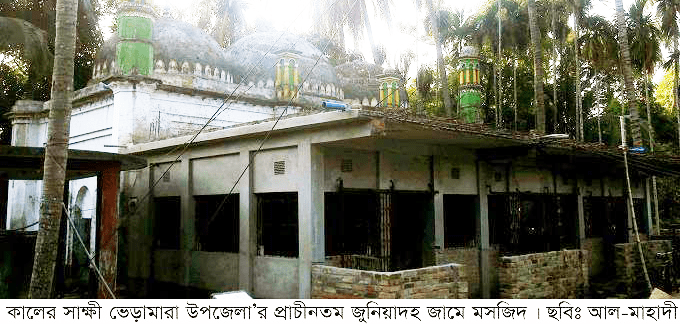
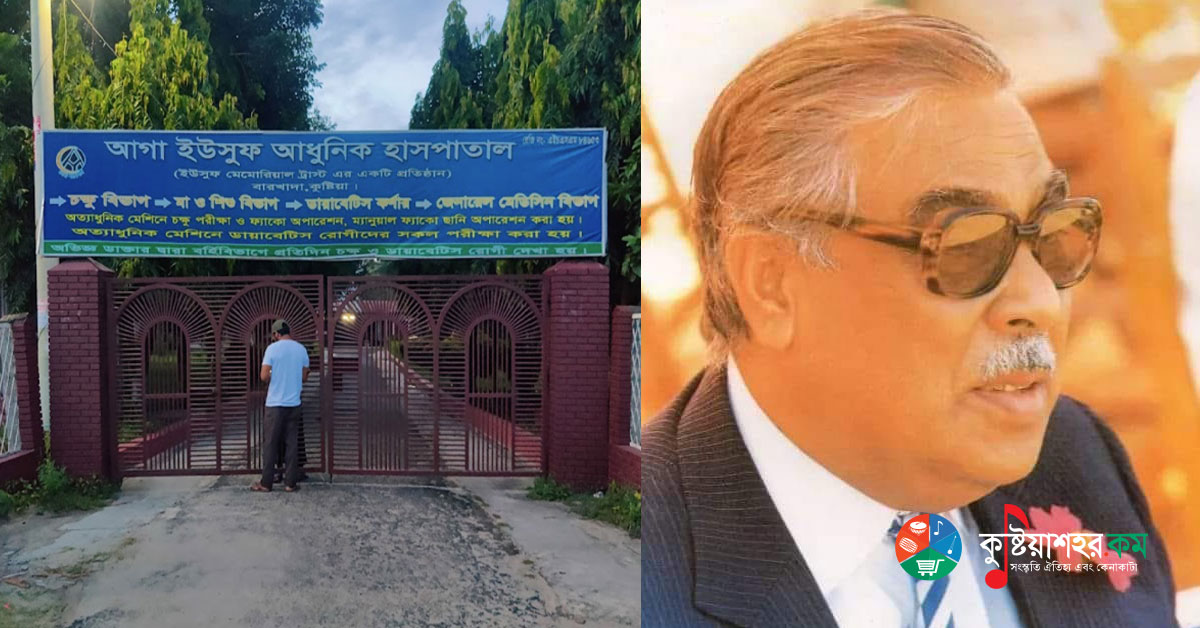
Alongside setting up all manner of mills and factories, Mr Aga Yusuf also built several charitable and service institutions. To this end he formed the Yusuf Memorial Trust in his birthplace, the village of Barkhada, in the name of his late father. Under this trust an eye hospital, an orphanage, a mosque, religious institutions, scholarships for poor students, and — to help meet their expenses — a supermarket in town were set up.
Mr Aga Yusuf married Begum Badrun-Nahar in 1951. Their marriage was a happy one, and Begum Nahar always encouraged her husband in his endeavours. They had two sons and two daughters, whose nicknames were respectively Nayan, Nandan, Nora and Flora. The second son, Nandan, lived in London and passed away there. Aga Yusuf Sahib's wife Badrun Nahar breathed her last in Dhaka on 10 April 2003. Only twenty days later, on 30 April of the same year, Aga Yusuf passed away. Both of them had been ill towards the end. The bodies of both were brought to Kushtia and buried in the family graveyard in the village of Barkhada.