বাংলা
 English
In the 18th and 19th centuries the Kushtia district won historic fame for the litterateur Mir Mosharraf Hossain, the world poet Rabindranath Tagore, the Baul emperor Lalon Fakir and Justice Radha Binod Pal. This achievement was extended further in the great Liberation War of Bangladesh.
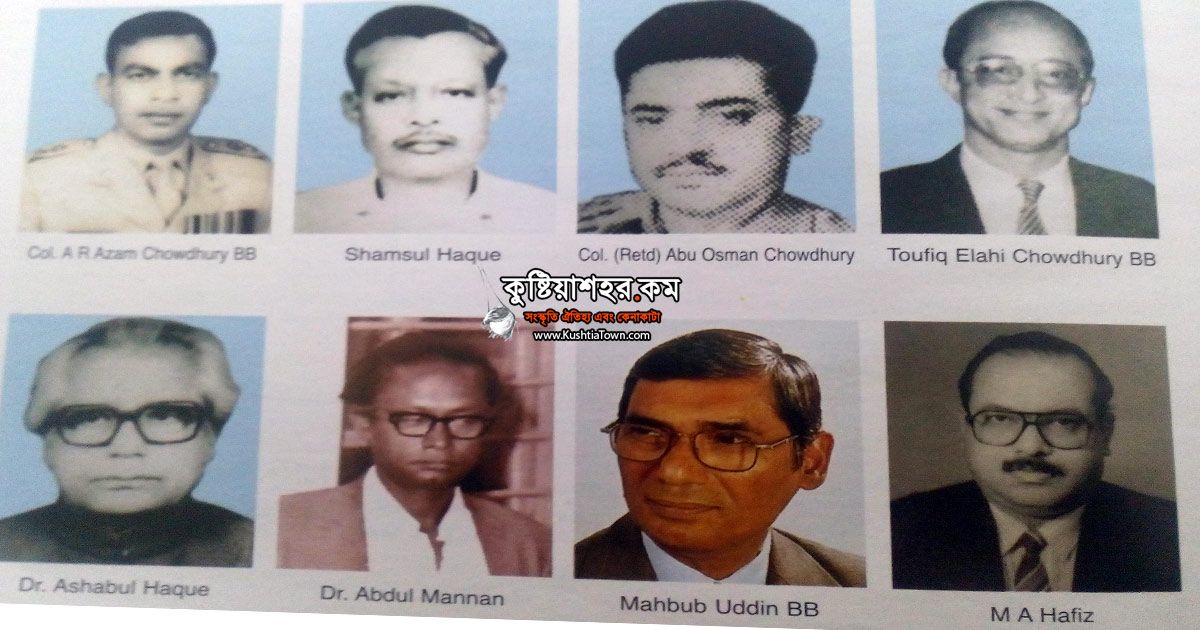
On the night of 25 March 1971, heavily armed, the Pakistani invading forces took control of Kushtia town. Against the background of the head of the military government, Yahya Khan, ignoring the results of the 1970 general election and the army's sudden seizure of the town, the people of Kushtia town, helped by the freedom-hungry people of all levels of the countryside who were up in movement, attacked the police line, the district high school and the telephone and wireless buildings late on the night of 29 March under the leadership of Bengali EPR members. Despite the air force's support, the invaders' defences broke within barely 48 hours of resistance before the "Joy Bangla" slogans of hundreds of thousands of people. The Bengali's hope of freedom from neo-colonialism took primacy in a bloody people's war. Alongside the freedom fighters of every level who fought at the risk of their lives in this heroic resistance against the invading forces, the many government officers and civilian organizers who fought included Abu Osman Chowdhury, A R Azam Chowdhury, Tawfiq Elahi Chowdhury, Mahbub Uddin, Mahfuz Us Sobhan, the District Commissioner of Kushtia Samsul Haque, Magistrate Syed M A Hafiz, Azizur Rahman Akkas (MP), Abdur Rauf Chowdhury (MP), Zahirul Haque (Raja Mia) MP, Golam Kibria MP, Ahsanullah MP, Ainul Haque, Mir Abdul Jalil, Akkas Ali Manju, Kh. Samsul Alam Dudu, Musa Mia, Kamrul Islam Siddiqui, M A Bari, Abdul Hamid Raihan, Abdul Aziz Mia, Dr. Abdul Mannan, Dr. Tofazzal Haque and others.

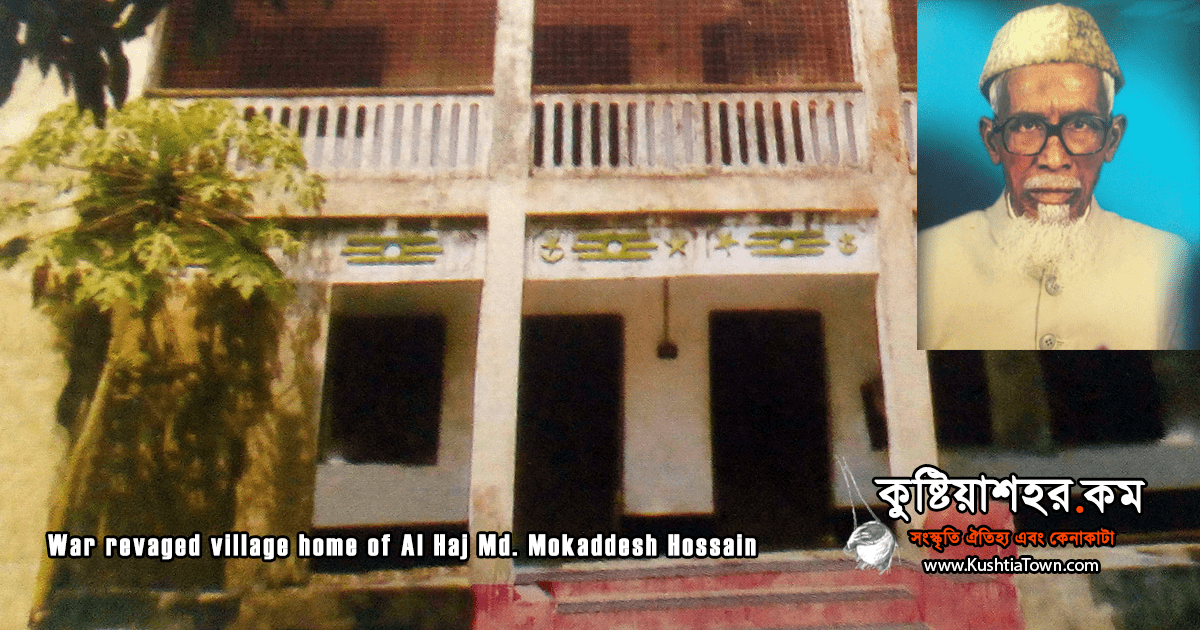
Until 15 April Kushtia remained free from the grip of the Pakistani invading forces. Leaving a trail of wanton destruction, they reoccupied Kushtia town. In the words of Mr. Kargil, a representative of the World Bank, the scale of the destruction recalled to history-minded people anew the tragedy of Hiroshima and Nagasaki. Ignoring the protests of the governments and peoples of many countries of the world, General Yahya Khan spread the fire of war across the whole of Bangladesh. Immediately after the formation of the government-in-exile under the leadership of Syed Nazrul Islam and Tajuddin Ahmad at Mujibnagar, the second phase of the Liberation War began. For the needs of guerrilla warfare, the valiant sons of Bengal took shelter in the countryside. Several fortresses of resistance grew up in localities far from the town. Bansgram of Kushtia district was one such fortress. Mohammad Mokaddesh, to whom the area owed much, was the owner of this fortress. A band of alert freedom fighters hid by daylight in his two-storeyed residence. Facing the threats of the local Razakar commander Khalek, the elderly area chief Mokaddesh Hossain continued the risky activities of the Liberation War. This news reached the invaders' office in Kushtia town.
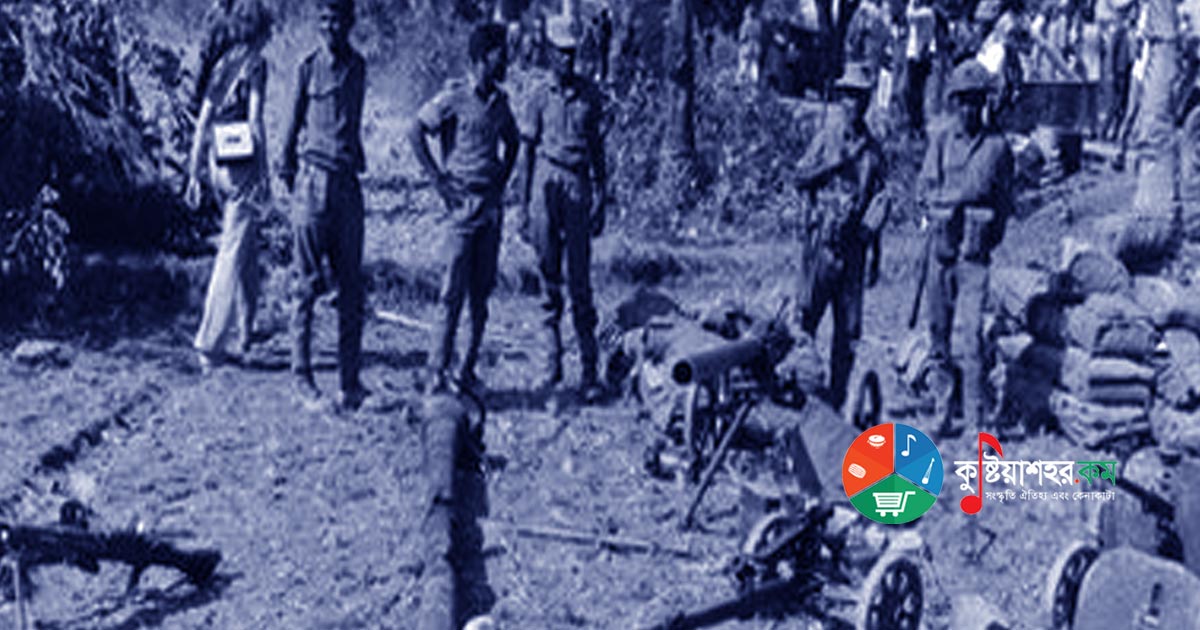
On the morning of 5 September 1971, an advance platoon of the invading forces took up position at Banshitola near Bansgram. A frontal battle began as a result of the freedom fighters' heroic resistance. In the terrible bloody battle the enemy side suffered considerable losses. In this frontal battle the valiant freedom fighters Taju, Didar, Yakub, Khurshid Alam Dil, Chand Ali, Sajan Ali, Abdur Razzaq, Abdul Mannan, Kiamuddin, Mobarak Hossain and Abu Daud — six in all — embraced martyrdom.
The invading forces could not accept this defeat by any means, going by the rules of infantry warfare. In retaliation, on 9 September, in the name of Operation Bansgram, and in collusion with the local Razakars, they set fire to the house of Mohammad Mokaddesh Hossain. That blaze reduced to ashes a century's collected books and many valuable possessions. In addition, Mokaddesh Hossain and his younger brother, the poet Abul Fazal Mohammad Mutalib, suffered physical torture. Mokaddesh Hossain's crimes were, first, that he was the father of M A Bari, one of the organizers of the Liberation War; and, second, that he was a shelterer of the freedom fighters of the area. Mohammad Mutalib was a doctor by profession; he attended to sick and wounded freedom fighters. In the eyes of the invading forces this service was a grave crime. Before and after the arson described above, the invading forces and their accomplices the Razakars and Al-Badr brutally killed a number of Mokaddesh Hossain's relatives. It is worth noting here that Mr. Mokaddesh had earlier incurred the wrath of the Muslim League for supporting Syed Altaf Hossain, the United Front candidate, against the Muslim League candidate Shah Aziz in the 1954 United Front election.
After independence, Bangabandhu Sheikh Mujibur Rahman wished to give Mohammad Mokaddesh Hossain the necessary financial assistance under a rehabilitation programme. But he politely declined to accept that financial help. This incident moved the Father of the Nation. At one point he told Home Minister Monsur Ali: "I don't find any difference between SK. Lutfor Rahman and M. Mokaddes Hossain." At his village home, on National Mourning Day, besides completing recitations of the Quran, Mokaddesh Hossain arranged meals for the poor. Mohammad Mokaddesh Hossain offered a sleeping society a modern outlook. The tide of development he created in his area, disregarding all manner of limitations and adverse circumstances, is evidenced by electricity, paved roads, growth-centre-based haats and bazaars, a union hospital, a traders' association building, a permanent police camp, a branch of Janata Bank, a madrasa, a high school and a degree college. In the evening of his life, with a view to keeping his eventful residence free of disputes over future ownership, he registered it under a public trust. Among the works he left unfinished were a memorial and museum of the Liberation War and a full-fledged hospital.
নীলিমায় মুক্তিযোদ্ধের স্বপ্ন বলাকা
Unbounded dream of a freedom fighter
Dr. Shazly Bari Sarah & Dr. Sadaf Bari Pinky
Taken from the above book