বাংলা
 English
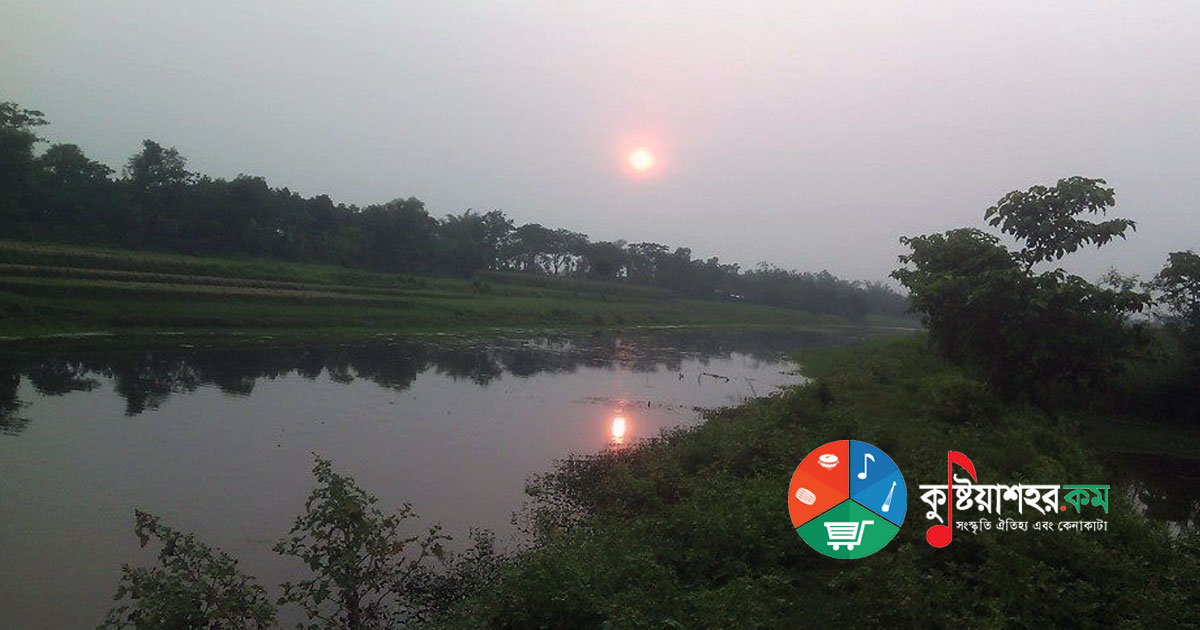
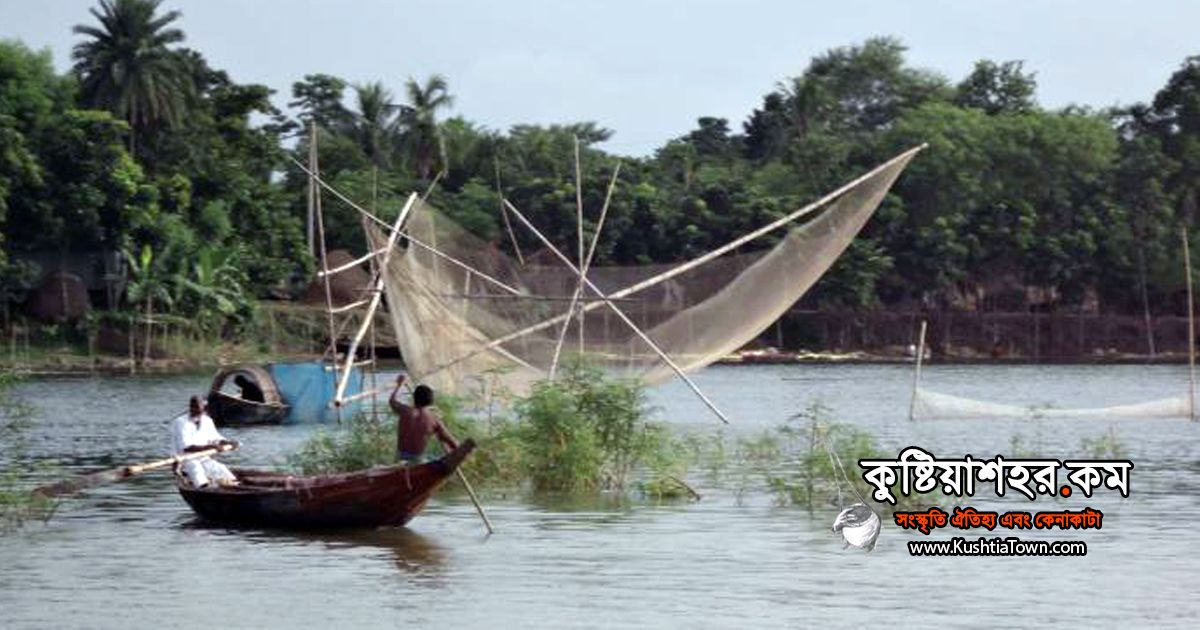
The river's name is Hisna. At one time it was directly connected with the Padma. In truth the Padma is its mother. When a river stretches out its child's wanderings, both banks of its course then take on a tempestuous form. The immense erosion of some part of its course swells its body; then, cleaving through that swollen part, it extends its branches and offshoots. The Hisna, too, was at one time a direct branch river of the Padma. Though now there is no way of telling from looking at it that it was ever a river. Thousands of sails have flown over its breast as well.
Today the Hisna river hardly seems a river at all. The very start of its course has lost its connection with the Padma. That was perhaps two hundred years ago.
Taking off somewhat westward from the Padma, the Hisna began its journey and flowed southward. That flow no longer exists, but the river's line has not been completely erased. Though the source mouth is now entirely extinct, on the road from Bheramara towards Bahadurpur there is a place called Byankapul (Bankapul); looking at it one feels that some thousand years ago the railway line ran right over the Hisna's breast, a little distance from its source. And it was there that the Hisna lost its bond with its mother. That parallel railway line, like a knife, cut the nerve-thread between the Hisna and the Padma.
East of Byankapul no trace of the Hisna now catches the eye. But to the west its existence still stands clear. Though the Hisna is a dead river, though roads of passage have been built over its breast, the Hisna is still the river of Bashi's household in Bheramara. And the Padma? Why, that is Bheramara's identity.
After entering Bangladesh, the Padma flows downstream past Rajshahi. Shortly after crossing Rajshahi, the Padma fixes the boundary between Pabna and Kushtia districts. Skirting the southern edge of Rajshahi district, the Padma flows south-east. Then, arriving in the Sardah-Charghat area, after flowing some way south, with the Jalongi (India) on the right and Bagha, Bilmariya and Lalpur on the left, the Padma turns every way again and, a little further on, gives a vigorous thrust through the north-west corner of Ishwardi. After this thrust it flows south again. On one side of this southward flow is Ishwardi, on the other Bheramara.
After a great bend in its course, this southward current is somewhat narrow, and for that reason about a century and a quarter ago the British built the Hardinge Bridge here. It joined Bheramara and Ishwardi and, in the larger sense, Rajshahi and Khulna — that is, North and South Bengal.
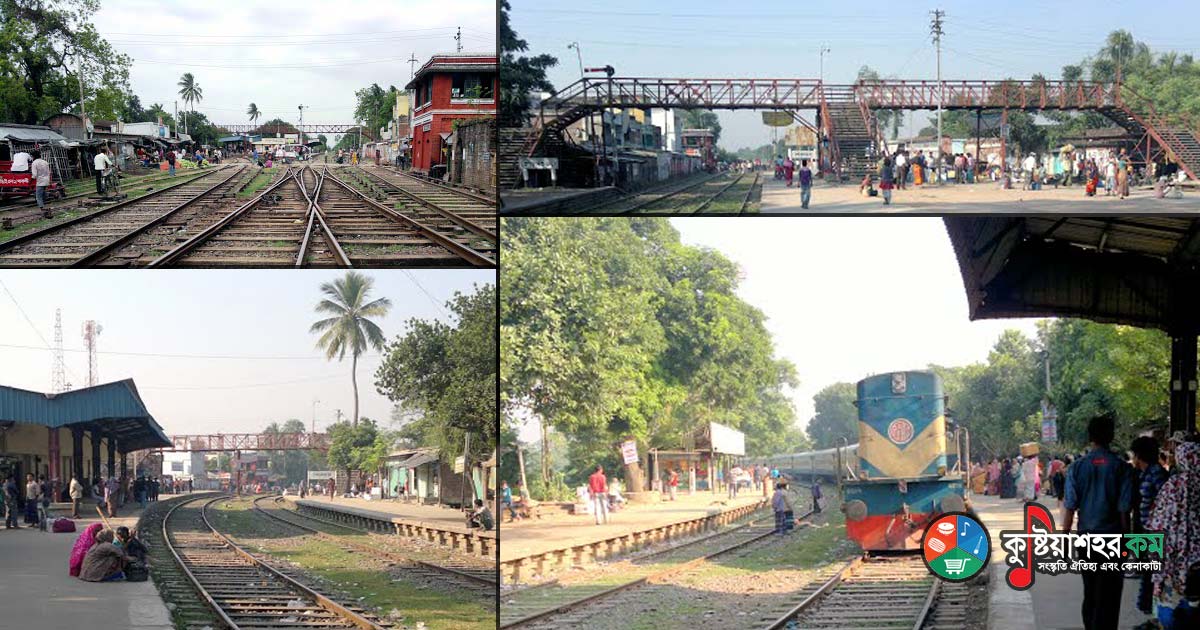
Bheramara is a sub-town whose rise owes to the Hardinge Bridge built over the Padma river and the railway station that preceded it. Why is Bheramara named Bheramara? The word for death evokes no joy. It is heard that after the British railway company laid the line, a flock of sheep was once grazing across the line. A train killed quite a few sheep of that flock. To make good the loss, the station itself is said to have come to be called the Bheramara station. In truth, in most cases no solid history of this naming can be found.
Yet considering the age of the railway track, the story of sheep dying in accidents being true in the naming of Bheramara is more a matter of possibility than fact. It is also heard that in this area, over a zamindari dispute, the two daughters of a certain zamindar, carrying on the enmity of a slaughter, killed one another; from killing a bhaira (brother-in-law) and seizing the zamindari, the name is said to have come. But since the link of time and name cannot be found, this conjecture loses its acceptability here. However, the most acceptable account is thought to be that one Vairam Agarwal, a Hindu marwari, first came to the bank of the Hisna and, building up the means of trade, laid the foundation of a commerce-based civilisation in this region. Day by day, that civilisation came to be known by his name.
Bhera maruk or maruk — the name of this small sub-town of Kushtia district is Bheramara. It is nevertheless a reasonable conjecture that one and a half to two hundred years ago Bheramara was a village pure and simple. Perhaps it was the British railway company's 'Bheramara station' that connected this town to the process of urban life. In that continuity, Bheramara is now a tidy sub-town, an upazila. Like ten other sub-towns, its heart still holds village after village and expanses of green fields.