বাংলা
 English
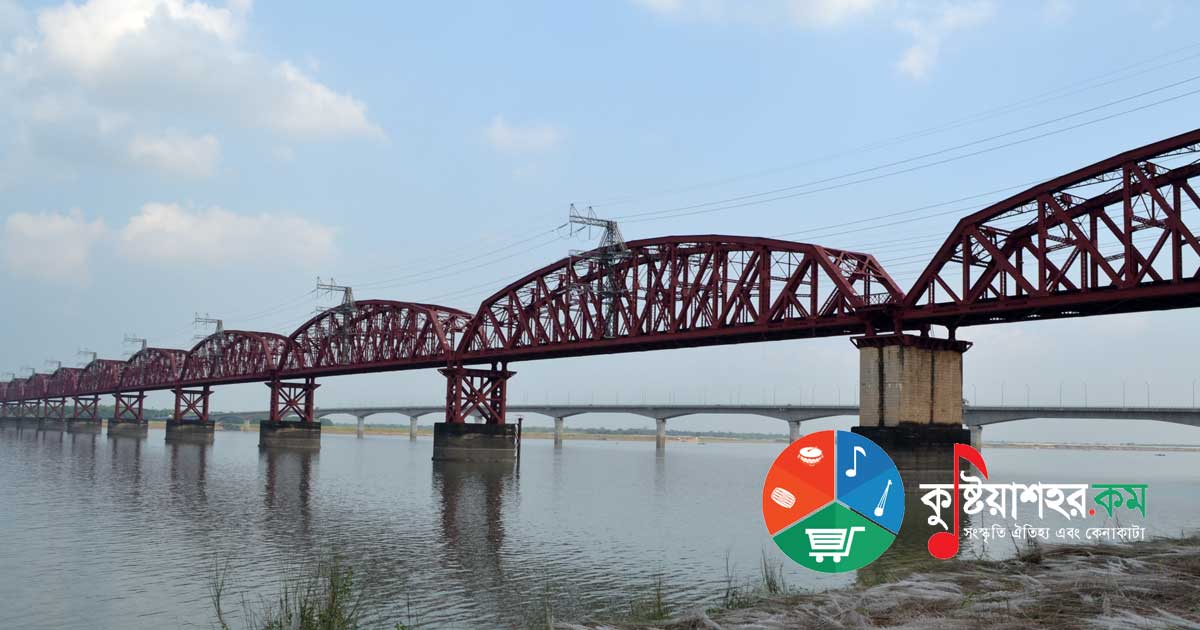
Graced by nature's exquisite beauty on the banks of the Padma, Bheramara and Paksey, at the gateway of the southern region, have turned into a delightful landscape for excursions. Here, the melody of the beautiful Padma's waves, the belt of green all around and the touch of the stirring breeze fill the heart. Likewise, this area holds history and ancient monuments, along with the Hardinge Bridge, the country's largest railway bridge of the early twentieth century, and the Lalon Shah Bridge, the country's second largest.
Above all, Bheramara, rich in the memorials of the Liberation War and independence, has grown into a scenic tourism spot. Another notable place has been added to the list of the country's tourist attractions. Every day both banks of Bheramara-Paksey resound with crowds of hundreds of thousands of visitors. Morning and evening, it seems like a fair of reunion. Unless you see it with your own eyes, you will not believe it.
One of Bheramara's monuments is the Lalon Shah Bridge on the southern side of the Hardinge Bridge. Similar to the Jamuna Bridge, the Lalon Shah Bridge is Bangladesh's second largest road bridge. Built over the mighty Padma river, this 1,786-metre-long bridge with two 7.5-metre lanes has created a network for direct road communication between Bangladesh's south-western and north-western regions, and the two toll plazas on both banks of the bridge have added further grace. The road of 10 kilometres at the eastern end and 6 kilometres at the western end of this bridge has added beauty. The Lalon Shah Bridge has been contributing significantly to the development of the transport infrastructure of the south-western region and the expansion of the transport system.
To the elders the Hardinge Bridge is 'Sara Pul'. For those who are now 80 or 90 years old, Sara Pul was once a dream. As the bridge over the Jamuna was the fulfilment of a dream, so too the Lalon Shah Bridge at Bheramara is the fulfilment of a dream. Elders say that when the Siliguri metre-gauge railway was installed in 1890, railway, ferry and steamer services began running between Sara Ghat on one bank of the mighty Padma and Damukdia Ghat on the other. When the final decision to build a bridge over the Padma was taken in 1910, controlling the Padma's course was an extremely arduous task. In attempting that arduous task, the world's first river training and guide embankments were constructed on both banks of the Padma. Guide banks were built extending about 8 kilometres upstream, and in 1912 the work of the railway bridge began. Thus, controlling the Padma's course, the work of the railway bridge began.
Building the spans in the soft silt was then another arduous task. Wells were sunk 190 to 160 feet deep beneath the river bed and the spans installed on them. In this way, over 15 spans each 52 feet high, with solidly built land spans on the two sides, the 5,894-foot-long railway bridge was constructed, which today has earned its place as an immortal monument. On the designs of Robert William Gales and Francis Spring, famous figures of the engineering world of the time, the firm named Braithwaite Walti and Cream built this railway bridge. On 1 January 1915, an engine with a few goods bogies crossed the bridge experimentally. It is learned that a driver named Sonamia first took an engine across the bridge. Then, on 4 March 1915, the then Viceroy Lord Hardinge formally inaugurated what was then the largest railway bridge. Since then this first double-line railway bridge has been named the Hardinge Bridge. This bridge carries the memorials of the Liberation War and the attainment of independence.