বাংলা
 English
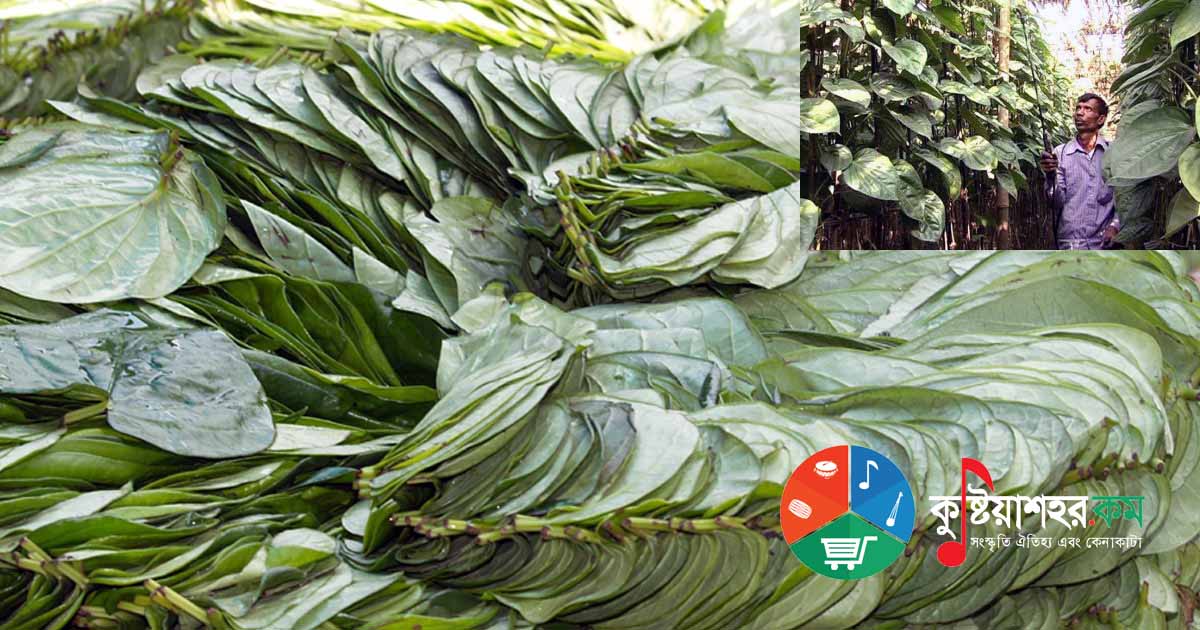
The leaf of the betel vine is called betel leaf, and it is chewed. Betel leaf is a very familiar item in Bangladesh. It is usually taken into the mouth and chewed after eating something. Offering betel leaf when entertaining guests, or at the conversation table of a meeting, is an old custom of our country.
Generally older people eat betel leaf. Betel shops are seen in abundance everywhere, in town and village alike. Chewing betel leaf turns the teeth red. There is a huge demand for betel leaf at home and abroad. In our Kushtia there is a custom around betel leaf: at weddings, after the meal, guests are offered betel leaf. Not only at weddings — after meals at other functions too, the custom of chewing betel leaf can be observed.
Betel leaf has been cultivated in the greater Kushtia region since long ago. Bangladesh's finest betel leaf is produced in the Kushtia region. Kushtia's betel leaf has worldwide fame. Foreigners who visit Kushtia chew the leaf and praise it highly. Barajes (betel orchards) catch the eye most in the Mirpur, Bheramara, Daulatpur, Bittipara and Lakshmipur areas. The leaves and roots of the betel in this region are quite large and taste quite good.
Profitable betel cultivation is growing day by day. On one acre of land a betel baraj of 300 pili (bets) can be made. The total cost, including bamboo, jute sticks, twine, rope, labour and maintenance, comes to about 1.2 million taka (12 lakh). After one year, betel worth about 2.4 million taka (24 lakh) is sold from a 300-pili baraj; at times it is even more. Such a profitable crop as betel cultivation is today under threat. Betel barajes have been struck by various diseases.
Betel growers Aslam, Mannan Master, Rajim Uddin and Ruhul Amin say that betel cultivation is Bheramara's principal cash crop. The livelihood of the farmers here depends on it.
Unrestricted imports of betel leaf from India have landed a huge number of betel growers of Daulatpur upazila in Kushtia in dire straits. With the country's markets flooded with Indian betel leaf, local growers are not getting a good price. Those hit hardest are the sharecroppers. With the market depressed, selling the crop is far from enough to run their households — even the share-rent money is not coming in.
According to the Department of Agriculture, betel leaf is cultivated on 520 hectares of land in Daulatpur upazila of Kushtia. The livelihood of the farmers of several villages, including Muthrapur, Madapur, Bagoan, Taragunia, Salimpur and Hisnapara, runs on betel cultivation. The farmers say that although betel is sold all year round, most of it is sold in winter. But with betel suddenly imported from neighbouring India in the peak selling season, some 50,000 betel growers here have been pushed to the brink.
When Indian betel leaf arrives freely, the price of betel in the country's markets falls drastically. As a result, selling betel in the market does not even cover the cost of production. Farmers of Mothurapur village say that when betel comes from India, they do not get even half the price for their leaf. The reason: huge quantities of betel leaf are being imported from India through various land borders at the private level. Betel grower Abdul Odud of Bagoan village says that setting up a betel baraj costs a great deal. He says that although imports of betel from India have driven the price of leaf down, the prices of the baraj's main materials — jute sticks, straw and bamboo — keep rising day by day. As a result, selling betel now does not even cover the cost of production.
Moving about on the ground, it was learned that many marginal farmers take land on share (borga) at 20,000 taka per bigha a year to grow betel. With the price of betel having fallen, they are now hard pressed to pay the share-rent. Betel traders and labourers are in trouble at the same time. Rafiqul Islam, president of the Daulatpur Betel Growers' Association, says that imports of betel from India must be stopped immediately to protect betel growers; otherwise a huge number of this upazila's betel growers will be ruined. He says that the betel produced in the country itself meets the country's demand, and expresses surprise that betel is still imported from India. The betel growers, labourers and traders of Kushtia hope that the government will move without delay to stop betel imports from India in the interest of the country's betel growers.