বাংলা
 English
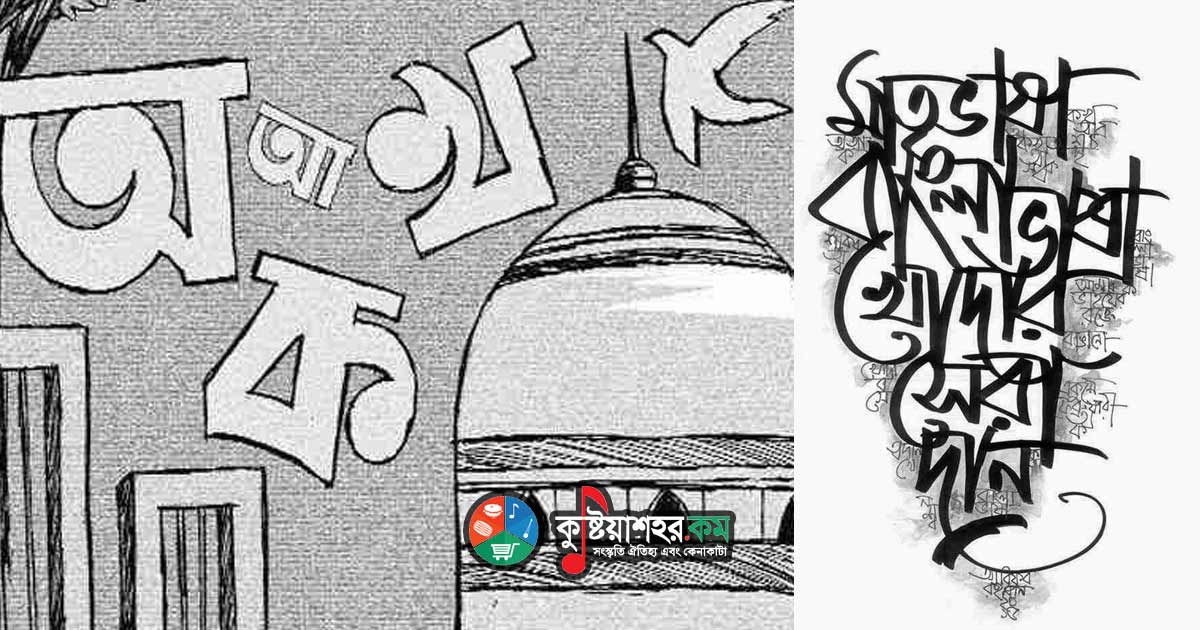
In the history of the Bengali nation, the Muslims played a pioneering role in the field of contribution to national life, greater than any other community living in Bengal. Their heroic role in establishing Bengali as the language of the Bengali nation, in the independence movement against the British, and in founding independent Bangladesh has no comparison.
Their contribution to enriching the Bengali language and to seating it in the dignity of a state language can never be forgotten. Before the Muslims arrived in Bengal, the Bengali language was in a state of extreme neglect. Dr Dinesh Chandra Sen says that before the coming of the Muslims, the Bengali tongue lived in the rural huts in destitute guise, like a peasant woman. Before Muslim influence, the Bengali language scarcely ever emerged, in utmost dishonour and disregard, in the songs of the Bengali tillers of the soil. The pandits took snuff from their pouches, recited Sanskrit verses with the flame of the lamp swaying, and were inclined to endless hairsplitting over the prosody of 'oil held in a pot' or 'a leaf holding oil'. Where, then, was the place of the Bengali tongue? Calling it the language of the low-born, the assemblies of scholars drove the Bengali tongue far away — just as the Brahmins keep away from the touch of the Hari and the Dom, so the Bengali tongue was untouchable to polite society, an object of the same hatred, dishonour and neglect. But just as a diamond in a coal mine awaits the jeweller, so the Bengali tongue was waiting for some auspicious day, some auspicious moment. The Muslim conquest brought that auspicious day and moment to the Bengali language. It would be no exaggeration to say that Bengali literature was, in a sense, a creation of the Muslims. [See: Dinesh Chandra Sen, The Influence of the Muslims on the Bengali Language].
The Bengali language is believed to have originated from the Charyapada. These Charyapadas were confined among the Buddhist Sahajiyas, and it is difficult even to call that the Bengali language. From the time Arabic, Persian, Urdu and Turkish words began entering the Bengali language, it began to evolve as a strong and living tongue. With the touch of Muslim rule it rose invigorated with vitality. Speaking of the literature, society and culture of the medieval period, Dr Ahmad Sharif says that under Turkish rule, with the patronage of state power, Bengali writing became the vehicle of royal literature.
It is worth noting that after the Treaty of Hudaybiyyah with the Quraysh of Mecca in 628 AD, Islam began to spread beyond Arabia, a spread that widened in 632 AD, in the period following the Prophet (peace be upon him) and his Farewell Hajj. At that time the Arabs began spreading out into China, India and Africa for the purposes of trade and the preaching of religion. Companions endowed with extraordinary scholarship travelled to various countries aboard Arab trading ships. At times the Arab seagoing ships would stop over at the port of Chittagong. The Companions aboard those ships began preaching Islam in the Chittagong region. They did not, however, enter the interior of Bangladesh with the purpose of preaching Islam. The shrines of many of them can be seen in the courtyard of the 'Messenger Mosque' in the city of Canton in China, known as the Ancestors' Graveyard.
During the rule of Caliph Umar (RA), Islam spread widely across Asia, Africa and Europe. At that time Sufis, dervishes and saints came to Bangladesh from Arabia, Iraq, Iran, Egypt, Turkey, Yemen, Khorasan and other regions. They went to different parts of Bangladesh and preached Islam. Attracted by the sublime ideals and equality of Islam, people embraced the faith in droves. Instead of their own tongues, these preachers of Islam learned the language of the people of Bangladesh, and in that very language they set before the people of this land the teachings, beauty, ethics and ideals of Islam. From that time Arabic, Persian and Turkish words began mingling with the body of the Bengali language, and those words were absorbed into the speech of the people of this land. It would therefore be no exaggeration to say that it was through this that the Bengali language gained true life. After the conquest of Bengal by Ikhtiyar Uddin Muhammad bin Bakhtiyar Khalji in 1204 AD, the auspicious era of Muslim rule began in this land. The kings who ruled here before Muslim rule despised the Bengali language and had banned it.
It had been said — 'Ashtadash Puranadi Ramasya charitanicha, bhashayang manabah shrutwa Rauravam narakan vrajet' — that is, one who practises the eighteen Puranas, the Ramcharit and the like in a human language [Bengali] must go to the Raurava hell. With the establishment of Muslim rule in Bengal under the leadership of Ikhtiyar Uddin Muhammad bin Bakhtiyar Khalji, the gates of a new horizon opened for the practice of literature in the Bengali language. And at the same time the people of Bengal became able to taste the true joy of freedom. The Muslim rulers of Bengal regarded the people of this land as khadem or servants, and devoted themselves to the welfare of the people of Bengal. These rulers were held in reverence by the people of Bengal. They were known to the people of Bengal as Shah-e-Bangala and Sultan-e-Bangala, and the national identity of the people of this land was Bangalian. It goes without saying that it was in the Sultanate era that greater independent Bangala was first founded. Behind the fame that the Bengali language and literature enjoy today in the courts of the world stand, in fact, the Sultanate rulers of that medieval age.
The Sultanate era is the golden age of Bengali language and literature. Not only in the field of language and literature — in social life, economic life, communal harmony, education, peace and prosperity, Bangala made unimaginable progress. Among the Muslim poets and litterateurs of that age who left a great contribution to the advancement of Bengali language and literature, the names of Shah Muhammad Sagir, Syed Hamza, Sheikh Chanda, Sheikh Faizullah and Shah Garibullah, the pioneer of the dobhashi puthis, deserve special mention. After the defeat of Nawab Siraj-ud-Daula on the plain of Plassey in 1757, the English East India Company took various harsh measures to suppress the Muslims of this land. In 1800 AD the English founded Fort William College in Calcutta and struck at the fluency of the Bengali language and literature that had been nurtured by the Muslims over five hundred long years. They joined stiff, incomprehensible Sanskrit words to the Bengali language and turned Bengali into a difficult tongue. On this Dr Muhammad Shahidullah says, 'Had the Muslims not been defeated on the plain of Plassey, perhaps the language of the prevailing puthis would have earned the status of the language of books for the Hindus and Muslims of Bengal. In the first half of the nineteenth century, as the Muslims of Bengal were engaged in the war of independence, they could not present themselves very prominently in the practice of a Bengali mixed with incomprehensible Sanskrit words.'
After the Sepoy Mutiny of 1857 they came forward again with renewed literary endeavour. In the eighties of that century, the Pir of Furfura Sharif, Kebla Mujaddid-e-Zaman Maulana Abu Bakr Siddiqui (RA), issued an exalted call to the Muslim poets and writers of this land to come forward in literary practice in Bengali, and he himself gave ample patronage in this regard. From that time the Muslim poets and writers of Bengal devoted themselves to literature with new vigour. In the same current, Maulana Shah Mohammad Abdul Karim Rahmatullah Alaihi, the Pir of Kharki in Jessore, possessed of extraordinary scholarship, composed the first authoritative, detailed and original work on tasawuf in the Bengali language, 'Ershade Khalekia, or the Theory of Attaining God'. The book was published in 1899 AD. From the eighties of the nineteenth century and from the beginning of the twentieth century, a new enthusiasm arose among the Muslim poets, writers and authors, and they devoted themselves with fresh energy to enriching Bengal's treasury of language and literature. Among these poets and writers the names of Kaikobad, Mir Mosharraf Hossain, Kazi Nazrul Islam, poet Golam Mostofa, poet Jasim Uddin, poet Farrukh Ahmad, Ismail Hossain Siraji, Maulana Akram Khan, Munshi Riaz Uddin Ahmad, Riaz Uddin Mashhadi, Munshi Mohammad Meherullah, Maulana Muniruzzaman Islambadi, Sheikh Abdur Rahim, Dr Muhammad Shahidullah, Syed Mujtaba Ali, Dr Lutfor Rahman, Abdul Karim Sahitya Bisharad, Yakub Ali Chowdhury, Kazi Abdul Wadud, Kazi Imdadul Huq and Nazibur Rahman, among others, are worth mentioning. Kazi Nazrul Islam, who emerged in the nineteen-twenties of the twentieth century, brought about a veritable revolution in Bengali literature. The Rabindra era of Bengali literature was then at its height. Breaking through that firm Rabindra orbit, poet Nazrul gave birth to another new orbit.
The Bengali language which before the Muslims' arrival was held in utter contempt, the Bengali language whose practice was said to lead to a hell called Raurava — that Bengali language, under the dedicated care of the Muslim sultans, earned royal honour. And to establish it again as the state language, on 21 February 1952 Salam, Rafique, Jabbar, Barkat and others had to lay down their lives untimely. It was along the path of the Language Movement that the nationalist movement of the Bengalis began, and through a broad nationalist movement the Liberation War finally began in 1971, and after nine long months of the Liberation War, on 16 December 1971, independent Bangladesh emerged. Before the Muslims came, the Hindu pandits of the day mocked the Bengali language as the language of the low-born. After the Muslims' arrival in Bengal, the Bengali language gained new life.
Through the efforts of the Muslim rulers, poets, writers, authors and luminaries, the Bengali language attained prosperity and was able to claim a place among the finest languages in the courts of the world. And not just that. In consideration of the dignity of the Bengali language, the United Nations recognised Bangladesh's Mother Language Day, 21 February, as International Mother Language Day. And all this is the harvest of the Muslims' contribution to the Bengali language.
Source and acknowledgements: M S Shahid, Daily Sangram