বাংলা
 English
Modernism in literature denotes the true character of creative works that are of recent composition, distinct from what earlier ages produced, rich in new appeal, and stirred by the thought of the contemporary era. Judged by this standard: 'A literature can be identified as modern when, in expressing some inherent values, it stands established in a status distinct from the literature of previous ages. Just as its mood and taste are new, so too does the character of the tendencies of the contemporary age emerge prominently there.'
Considering these matters, it becomes clearly evident that a fondness for the past combined with a scientific, rationalist outlook has established the Bengali literature of the past and present centuries in an entirely new context, quite distinct from the literary currents of earlier ages. English education, English literature, state policy introduced by the British and so on together shaped this new context. Dr Sukumar Sen says: 'The path of modernism in literature began to be discovered with the spread of English education and the new mentality that came of it. English education made possible the works of Rangalal, Madhusudan, Bhudev and Bankim. The self-respect, love of country and sense of wonder awakened in the minds of educated Bengalis by savouring English literature lie at the root of the inspiration of modern Bengali literature.'
It may be mentioned here in passing that the advent of modernism in Bengali literature followed roughly three currents. First, a change of thought within the existing literature. Traces of this change of thought are found in devotional and love songs, in poems of moral instruction, and in rhymes and poems dealing with social customs or events. Second, the translation and imitation of English prose and verse narratives and poetry. Third, romantic tale-poems of heroism and patriotic inspiration, modelled on the ideals of English narrative poetry.
It may further be noted that in the first half of the nineteenth century itself (which may be taken as 1800 to 1860 AD) the foundation of modern Bengali literature became firmly established in both verse and prose. Yet the contribution of Muslim poets and writers during this formative period was negligible. The Muslims' hostile attitude towards English education was the main reason for this. Even after the Sepoy Mutiny, when Muslim writers did devote themselves to the practice of modern Bengali literature, no environment was created for them to write in the sadhu form of the Bengali language. Apart from puthi literature, no interest in reading any other kind of literature had yet awakened among Muslim readers. On the other hand, religious excess and social decay kept them away from any inclination towards learning. Crushed by countless obstacles, deprived of everything, they were passing their days in a suffocating state.
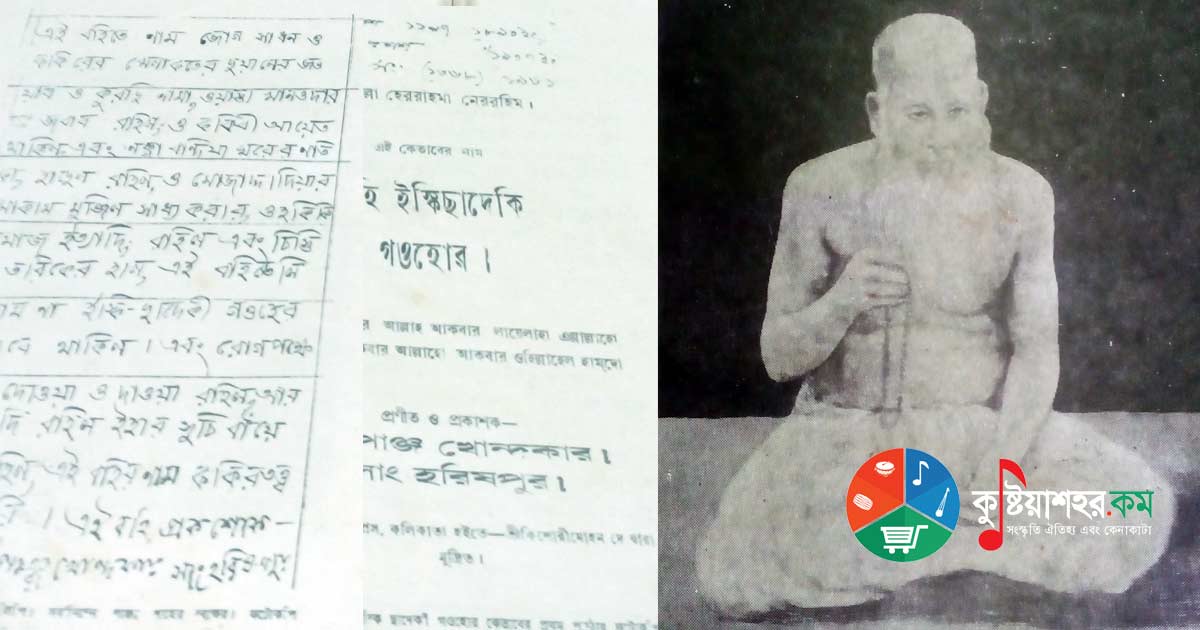
Panju Shah appeared in just such a closed environment. Owing to his lack of English education, financial hardship and social conservatism, he could not devote himself to the practice of modern verse or prose literature. He had no desire to assume leadership in spreading education or propagating politics. He held only a firm resolve to inspire people to set out on the path of other-worldly welfare. From this resolve, born of a poet's vision and grounded in literary endeavour, he recorded the method of establishing this mortal life in the immortal, eternal world. Panju literature is therefore a collection of the message of a spiritual quest for life. A 'message' (bani) is generally an eternal utterance in which literature finds shelter, not merely a set of religious precepts. Panju's message is expressed precisely in the form of literature within the vessel of poetic beauty, and that literature was created at the very time modern literature was reaching full flowering. No literature can be created transcending the influence of the age, the surrounding climate and the bounds of country and time. For this reason, knowingly or unknowingly on the poet's part, modernism entered Panju's literature quite naturally. An examination of his works will bear out this truth.
Of the three currents mentioned as creating modernism in Bengali literature, the first is seen operating effectively in Panju literature. In the puthi 'Iski-Chhadeki Gawhor', 'Meshele Kathuriar Kichcha' (The Woodcutter's Tale) is a poem of moral instruction. Yet reading the story narrated in the poem, one savours the taste of the modern short story. The village moalla's covetous gaze upon the woodcutter's wife, the moalla's burning desire to have his lust gratified in exchange for two milch cows, the woodcutter's daring venture to keep his wife's promise, the woodcutter wife's firm steps — rising above her dilemma — powered by the mental strength to accept harsh reality, the moalla's change of heart before the extraordinary self-sacrifice of the woodcutter couple, and an awakened consciousness about the value of humanity — these together carry the tale to the level of the short story. A distinctly modern consciousness is seen to be active here.
Objective analysis and reasoned examination are among the chief characteristics of modern literature. Nothing — human life, human society, scriptural teachings — escapes the scope of scrutiny and analysis. Though a poet of mysticism, this rationalist disposition was present in Panju's poetry. In his poem 'Ibrahim Khalilullah Korbani Den Tahar Bayan', as he analyses the story narrated in the Quran in the metre of poyar, the poet openly gives voice to his rationalist mind. Hazrat Ibrahim sacrificed a great many animals, but they were not accepted at the court of Allah. This gave rise to a question in the poet's mind — 'If Allah did not accept the sacrifice of those animals, how shall we cross Pulchirat by sacrificing animals?' Allah did not ask for the sacrifice of animals; He asked for Ibrahim's most beloved thing. Ibrahim, deeming his son his most beloved thing, sacrificed him. The poet argued that it is not the son but one's own life that is the most beloved thing of all. In his words:
What great love is — how a son can be.
Over knowledge love cannot be seen,
Nor, realising it, would one offer one's son in sacrifice.'
Slaughtering animals in blind faith does not constitute a sacrifice. The blood and flesh of animals do not reach the court of the Creator of the world; He observes a person's faith. It becomes clearly manifest that the poet's inner thoughts have been presented with great force through reasoned argument. His readiness to accept even religious injunctions through examination and scrutiny, his presentation of opinions consistent with modern science and reason, and his mental preparation to put forward realistic statements elevated Panju Shah from a puthi poet to the level of a creator of modern great poetry.
Vividly depicting the pitiable picture of life's suffering is another characteristic of modern literature. People today are distraught over the problems of food, clothing and shelter. This daily question of living is not absent from Panju's literature. His verse contains:
People preoccupied with the thought of food are compelled to take to begging; in the struggle for life, religion and piety are forgotten. Drawing on experiential knowledge, the poet has made a clear statement on this:
Born in your mother's womb, surrounded by great illusion,
I forgot all former words in the pain of the belly.'
The pride of pedigree and social arrogance are trivial before the anxiety for food. Then it seems —
Here the poet stands face to face with reality. This is a special mark of modern literature. In this connection a saying of Sukanta, a poet of the very modern age, is memorable. Sukanta says:
The full-moon moon is like a scorched loaf of bread.'
Long before Sukanta made this harsh comment on life, Panju had left language of that kind in his literature.
A subtle scrutiny of human nature is yet another special quality of modern literature. The combined form of joy and sorrow is life. Peace and unrest appear by turns on the path of life. Both should be accepted alike. But man cannot do so. To be elated in happiness and to die a little in sorrow is the natural instinct of the living world. The poet sang:
In sorrow the mind grows restless,
Such is the play of this world.'
Such a clear outlook on the knowledge of life was Panju Shah's. A taste-oriented vision towards life is also a principal mark of creating modernity in literature. This mark is present in Panju literature.
Medieval literature is laden with religious subjects and the glorification of gods and goddesses; the country and its people are secondary there. But in modern literature, patriotism and love of the motherland are specially reflected. Panju Shah had an unfeigned fondness for the country and for rural life. He promised to save the country in its bad days by bringing in foreign aid. He said:
I shall feed you paddy brought from abroad.'
Here the country's problems, anxiety over food and the desire for human welfare drew the poet into firm reality and encouraged him to give expression to the eternal anguish of life. It became possible precisely because he had the opportunity to know the destitute people of his age.
In passing, the remark of a certain critic may be quoted. He says: 'Man is the truth above all' — this is the essential message of modern literature, and by 'man' modernity understands the whole of man; it does not wish to leave out anything of man.
The gross instincts and desires of man, which are the chief elements of human life, have become the supreme theme of modern literature. In Panju literature, while accepting this 'truth of man' — that is, 'the spiritual glorification of man' — the man of flesh and blood driven by hostile senses also finds recognition. The poet has said many times that the eternal man is present even in ordinary people. Saying 'This man has that man within him', he pointed to the place of man above all. Even the maxim 'Service to man is the highest worship' is present in his writings. He said: 'Where else shall I take my meal of devotion but in man?' Noting these remarks, it seems that modernism is not lacking in Panju literature.
Women's life, the development of women's individuality, and women-related problems in social life are widely discussed subjects of modern literature. New interpretations of these found their place in the literature of Bankim, Sarat and Rabindranath. Women's life is not neglected in Panju literature either. Reading the poet's poem 'The Quarrel of Habil and Kabil' makes this truth evident. The story begins, unfolds and concludes through a conflict and clash. A naturally dramatic ambience has made the story even more touching. In character creation too, the poet's aesthetic vision joined with the scriptural subject to produce a wonderful wealth of feeling. How disastrous a consequence a covetous attitude towards women can bring is wonderfully depicted in the poem. From the introduction of a host of events — Habil's slaying of Kabil's life, the origin of separate races — the poet's dedicated effort to reach the very root of modern life can be observed. It may be mentioned in passing that the poet is also quite attentive to women's social dignity and the protection of womanhood.
The shadow of personal life is sometimes reflected in literature. This is happening in Panju literature. The poet ran his household with two wives. Perhaps even his utmost efforts could not satisfy them. That is why the poet said:
Yet your averted eyes would not turn back.'
Here the resentment of not getting, and the joy and pain of getting, have taken real form. In metaphor, symbol and simile the picture of the poet's inmost heart has emerged. In this tattva verse the poet is seen descending into the courtyard of practical life. Here he is engaged in struggle, not inclined to flight. He has accepted the responsible part of modern domestic life. And that is why in Panju literature, even within tattva, we find a fighting hero. The poet himself is that hero, all of whose creations are drawn from his own life — and in this he is considerably modern.
The creation of man is narrated in the Quran and the Bible. Taking material from there, Panju Shah composed a poem titled 'Purbokathar Bayan' (The Narration of the Former Tale). Though the subject is scriptural, his aim is to describe struggle-filled human life in beautiful language. It is the poet's desire that man, by contending with Satan, should try to prove his superiority. Just as Michael Madhusudan, taking up the story of the Ramayana, developed a modern poetic art in his Meghnathvadha and composed an epic in Western ideals, so too did the poet Panju Shah give form to life through the narration of the story of Adam and Eve. That man will triumph in rivalry with Satan and human strength will be held invincible — this is as if the Creator's own wish. To Satan Allah says:
In truth, the declaration of man's victory in competition with Satan, and the tendency to portray Adam and Eve as man and woman on the earthly world, centring on the tasting of the forbidden fruit, are themselves marks of a modern mentality. Panju literature has that mark.
Description of nature is one of the characteristics of modern literature. Though not extensive, charming descriptions of nature are found here and there in Panju literature. Just as the woodcutter's wife is setting out to give the moalla the opportunity to gratify his lust, a violent storm and downpour begin. From a solemn description of this natural upheaval, the poet's love of landscape emerges. He says:
Storm and water Allah has sent down in showers.'
In the verse of many poets before Panju Shah there is a lack of self-identification. Determining the date of composition is a very arduous matter. The matter is grossly neglected in many contemporary books as well. But in Panju Shah's poetry the poet's identity and period of composition are stated very clearly. It seems the poet wished to establish himself quite simply in the reader's heart. 'I shall know I was born at the foot of the Pathan' — from the way the poet began to present his self-account, he is considered a poet of the modern reality.
Self-confident expression is a special characteristic of modern poetic thought. On the other hand, mystic devotees have always been averse to self-advertisement. Even some modern poets harbour pessimism. But Panju Shah was a self-confident, optimistic poet. A short quotation from his verse will make the matter evident. The poet says:
And taught them to people in land after land.'
From the poet's remark on composing and propagating songs, we find him as a resolute, optimistic modern poet. At that time verse-metre was considered the sole vehicle of poetry. Now prose-rhythm too has come into wide use in poetry. Prose-poetry is a distinctive composition of present-day literature. Panju Shah did not use prose-rhythm in his verse, it is true, but he did include some prose compositions within his verse. From this fondness for prose his modern cast of mind can be known.
The greatest mark of modernity in the poet's mind is 'the consciousness of the life of one's own time'. It is true that the beautiful picture of the city-centred life of the nineteenth century has not been attractively depicted in Panju's verse, but it cannot be said that the poet was entirely indifferent to contemporary life. Floods, storms, famines and other natural calamities created crises in the social life of the time, and the poet has presented their touching descriptions with dates mentioned. From the poet's works, some discussion with examples can be presented.
In 1297 of the Bengali era, terrible floods appeared across the whole of Bangladesh. No one escaped the savage bite of that all-consuming flood. Paddy and jute were submerged, mango, black plum and jackfruit orchards were inundated, and floodwater rushed with great force across the householder's courtyard. The distress of the housewives reached its peak. Paddy on the bamboo platforms built in the yard and firewood were left drying in the open. The people and animals of every family stood face to face with death from shortage of food. The honour and dignity of the head of the household were imperilled. The poet did not merely see this scene; he experienced this painful situation through his own life. So from the poet's throat burst forth inarticulately:
In the flood of the year ninety-seven no trace of dry land remained.'
The sorrows and hardships of the local people have been described as the poet's own sorrows and hardships. Investigation reveals that the flow of water of three canals on three sides of the poet's homestead made him and his family anxious. In the poet's words:
The water calls from below the Baroi,
What has happened — a storm?
Struck by the push of three canals,
Fakir Panju gasps.'
The poet's personal feeling is here expressed in universal feeling. From this statement of Panju Shah one can understand how greatly human life can be convulsed by a natural calamity. Famine is a terrible disease in the lives of the people of this land. Depicting the picture of famine in poetry is the task of poets. Panju Shah's poems and songs contain descriptions of the terrible famine of 1304 of the Bengali era. In a few lines the poet has presented the life-anguish of the contemporary starved people:
Thirteen hundred and four — paddy and rice terribly scarce,
A famine of grain has come; the fate of the cotton-growers has burned,
Inside the house and out — what shall I do, what shall I do.'
In the food crisis parents are anxious; thoughts of keeping their children alive leave them restless. There is no money to buy food; even when one wants to take money by pawning ornaments, the deceitful moneylender will not give it. Money has less value, goods cost more, and the people's purchasing power is limited. Even one's own kin — even the darling son-in-law — going to his in-laws' house does not receive his due respect. The beloved grandchildren too are deprived of the affection of grandfathers and grandmothers and of maternal grandparents. That is why one sees:
The son-in-law goes to his in-laws' house,
The fellow has great cunning — mushi mushi.
In times of sorrow, talk of happiness
None of that talk works,
What shall I do with grandchildren,
I die burning in the pain of the belly.'
The torment of the belly makes a man forget everything; a handful of rice becomes the most precious thing of all. Describing the destructive form of the aforesaid famine, the poet Panju Shah has brought out the consciousness of contemporary life. We have already mentioned Sukanta's consciousness of life. Here too the same subject is memorable. This life-realisation of Panju Shah is undoubtedly a mark of the modern.
Like floods and famine, the cyclone too makes human life so sorrowful — the poet mentions this in connection with his description of the flowing Ashwini storm of 1316 of the Bengali era. That day was both a folk festival of rural Bengal — Garshi — and the greatest religious festival of the Muslims — Eid-ul-Fitr. In the poet's words:
On Garshi day, Allah's shinni, for the great and the destitute alike,
Everyone is filled with joy.
The mistress sits cooking the shinni,
Who will make the shinni, who will eat it.'
The poet has vividly, touchingly and sweetly depicted in his poems and songs all the sorrows and hardships the people of the country suffered in sudden calamities.
Here we wish to return a little more to practical life, where a more reality-oriented modern thought is reflected in Panju's thinking. We know that the Western knowledge and science of the nineteenth century presented many necessary goods for creating happiness and comfort in human life. City people enjoyed those modern amenities of life. The influence of these inventions was not very extensive in rural life. But that these scientific inventions had reached the villages even in Panju Shah's lifetime is mentioned in his works. Seeing the modern fire-lighting device, the 'diashalai' or 'safety match', the poet exclaimed in wonder:
It gives flashes, it makes sparks, in the pitch-dark night.'
This appreciative remark about an English invention proves Panju Shah to be an admirer of Western civilisation.
The consciousness of contemporary life casts a clear shadow on the poet's heart; according to the variation in style of expression, the picture of that consciousness takes full or partial form. Panju Shah appears to have received the news of the First World War in the evening of his life. At this news his mystic heart filled with pain. The life-destroying machinery of war grieved him deeply. In his words:
Have come home grown silent,
A great war has broken out — who knows what will happen.'
The sight of the city-dwellers returning to their villages stirred the poet's heart. The reaction of the world war had then descended even on the luxurious urban life of the contemporary babu class, and specimens of it are present in Panju's writing. By 'In fourteen a bomb engulfed the whole world' the poet meant the First World War that broke out in 1914 AD. It may be recalled that in that very year the poet left this world. The news of the great time woven into the song signifies the outward unfolding of the modern current of thought in the poet's mind. He says:
Today turn men into beasts,
The mind does not consent to good deeds,
Brother has drunk brother's blood.'
Finally we see that there is a medieval influence in Panju Shah's language, metre and form. Even so, that literature is not devoid of modern thought. In truth, in Panju Shah's progressive thinking, both the outer world and the inner world have been made honeyed with modern consciousness. Even as a sacrificing devotee, he did not deny the all-sided appeal of life. If modernity is nothing but the name of accepting every aspect of life, then that modernity has its flowering in Panju literature. In truth, this poet — a puthi poet, composer of devotional songs, successor to syncretist devotees and bearer of Sufi tattva — composed literature sitting in the bosom of a secluded village of timeless Bangladesh, far from the modern city, and into that literature modernism entered, knowingly or unknowingly on his part. So it may be said that the presentation of objective analysis and reasoned criticism, the pitiable picture of life's suffering, the scrutiny of human nature, man's values, the predominance of women, the reflection of personal life, the characteristics of the creation of man, the description of nature, the consciousness of contemporary life and so on have made Panju Shah considerably modern and progressive. Though he was a composer of puthis and songs, yet there was no lack of modern thought in his verse. Herein lies the success of his poetic work.
- The Life Story of Panju Shah
- Panju Shah's Contributions
- Panju Shah — The Development of Spiritual Thought
- A Brief History of Panju Shah's Ancestors
- Mystic Poet Panju Shah: Life and Philosophy