বাংলা
 English
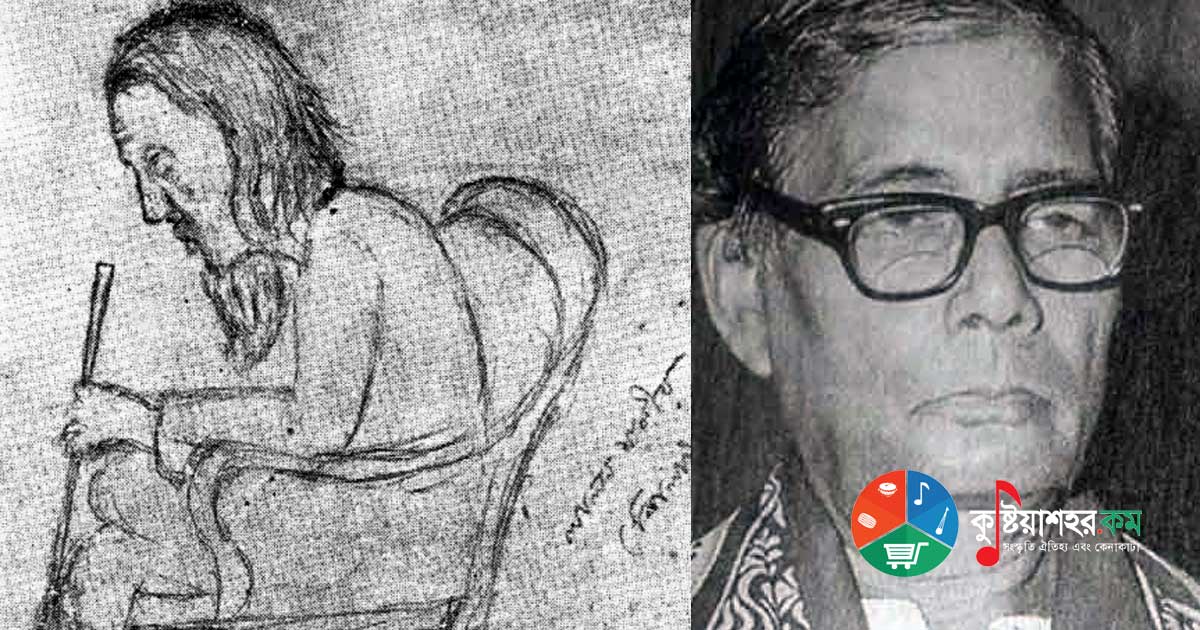
At this time many people brought him money and fruits as offerings. Every year, in the month of Falgun, he held a bhagura, a communal feast. Five to seven thousand people would come here to eat and to sing. Here I give an account of this bhagura. It has another name: saduseba, the service of the sadhus. Even today this saduseba is held in place after place of Bengal, especially in parts of Nadia (Kushtia), Jessore and Pabna. Fakirs of almost all communities are invited to it. As a rule, saduseba is held at no one's house except a fakir's; but anyone who is a disciple of some fakir may hold saduseba.
Usually a wide space is cleared inside a mango or jackfruit orchard. There, rows of small beds are set up. The furnishings of these beds are a kantha and a pillow on a mat. This is called a 'gadi'. Upon these gadis the sadhus, with their disciples, sit discoursing on religion and singing. Saduseba usually begins at dusk. Group after group of sadhus arrive at the assembly from different villages, chanting in unison the word 'Aleek'. It means: Allah is one. Then, according to their rank, they salute and greet everyone and take their seats at their appointed places. In the evening, after taking 'chailpani', the sadhus begin to sing.
Though each group has songs of its own, there is a continuity running through all the songs. All must sing songs of the same bhava. At times, amid these songs, a contest, a palla, also takes place. Nowadays in Kushtia district the disciples of Lalon often hold contests with the disciples of Panju Shah. Needless to say, each sings the songs of his own guru. And their songs are composed in such a way that each song of one answers every song of the other. As they sing on in this way and it is about two o'clock at night, someone utters the word 'Aleek', and all the songs stop at once, like musical instruments. Then the fakirs eat and sleep each at his own gadi.
The next morning the goshtha songs begin. Then, finishing the morning meal, all begin to sing. After the midday meal the fakirs receive some alms according to their merit.
In the sadusebas that Lalon held, three to four hundred taka would be spent even in those days.
The villagers held him in the deepest devotion. In their joys and sorrows he was their constant companion. In three or four villages, when anyone fell ill he would relieve them with medicines and the application of mantras. Perhaps for this very reason he wrote a book collecting kaviraji prescriptions, called Sar-Koumudi. From time to time he gave the villagers talismans and amulets. We have found an amulet on a piece of paper written in Lalon's own hand. His upright and courteous manner attracted all alike, rich and poor. He was most self-restrained in life. Though he lived in the ashram with his wife, it is heard that there was no physical relationship between husband and wife.
'He lived in the akhra with his wife. According to the sect's doctrine, he had no children or descendants.' - Hitakari
To be continued...