বাংলা
 English
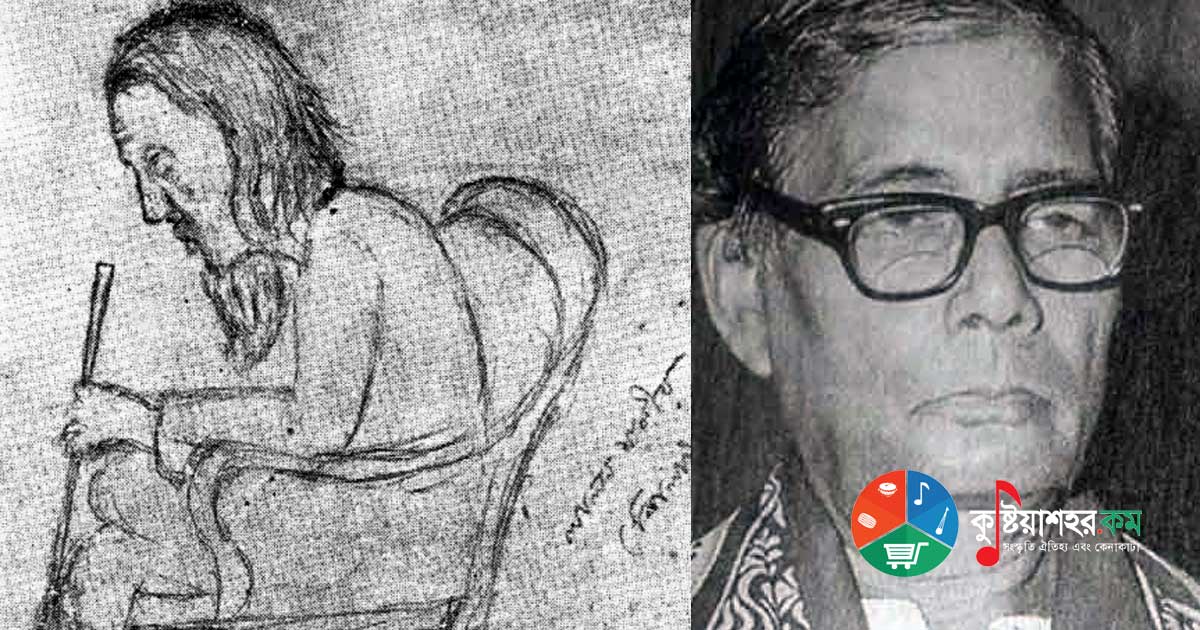
It is not easy to know the story of Lalon's life, though it is not impossible. For many elderly people who know much about Lalon are still alive.
Compared with the lives of the other sadhus of this land, the story of Lalon's life is easier to know for this reason: their lives are filled with all sorts of incredible, miraculous tales, while the story of Lalon's life is not. Though his disciples are deeply devoted to him, they do not regard him as God. That is why the place of his birth, his parents and his household have not become a second Nabadwip in the fervour of their devotion. They cannot even say clearly of which caste Lalon was born or where his home was. What they have found is Lalon's countless songs; blending melody with the tune of the ektara in joy and in sorrow, they spend their whole lives with nothing else.
After Lalon's death, an essay about Lalon was published in the Hitakari, a periodical of Kumarkhali. In it, Lalon's earlier life was recorded as follows:
'It is commonly known that Fakir Lalon was a Kayastha by caste; the Bhoumik families of Chapra, under Kushtia, were his people. None of his relatives is alive. He is said to have been stricken with smallpox on the road while travelling on pilgrimage and to have been abandoned by his companions. At the point of death on the road he regained his life through the kindness and shelter of a Muslim, and became a fakir. The marks of smallpox remained on his face.'
Recently, in the month of Shraban, the fine essay that Babu Basanta Kumar Pal wrote about him in 'Prabasi' followed this account. He did not even hesitate to identify Lalon's parents and relatives. But we never heard such an account from anyone in Lalon's own village. From an old weaver who lived on the eastern side of his house, we heard the account of Lalon's birth as follows:
He was born into a Brahmin family. In childhood his mother took him along on a pilgrimage to Nabadwip. When Lalon was stricken with smallpox there, the wretched mother left him by the riverside and came away. When the child's consciousness returned in the cool breeze of the river, it was dawn. A Muslim girl, going to the river to fetch water, saw the boy lying there, picked him up and brought him home. Under her loving care the child grew, day after day. That woman's guru was Siraj Sai of the village of Uloberia in the Jessore of that time. When the child grew a little older, Siraj Sai took him in, and through his teaching began Lalon's schooling and religious life; and in the course of time Lalon was initiated into the Muslim faith.
It is said that when he grew up he met his Brahmin mother. Out of fear of society the sorrowful mother, wiping her tears, told him: 'My son, now that you have become a Muslim, stay there. Only visit me now and then.' As long as that mother lived, Lalon kept going to see her. When we mentioned two incidents to Lalon's disciple Bholai Shah, he said: 'Many say many things about him, but nobody knows the real events.' Be that as it may, knowing that it would soon become very hard to learn anything about Lalon, we have related the above incident. For the elders who even today know something about Lalon will not live much longer. There is one reason to believe this account: on reading all of Lalon's songs, the influence of the Muslim faith is found to be stronger than the Hindu influence. Recently we found a hakimi book written in Lalon's own hand, and a notebook containing Muslim prayers and litanies. Reading them, one feels that Lalon knew Persian or Arabic. In some of his songs are found portions of many verses of the Holy Quran. This suggests he could read the Holy Quran. Now if Lalon became a Muslim in mature age, it is a thing to ponder how, at that age, in the midst of such uneducated society, he mastered the Muslim scriptures so completely. And the author in Prabasi has said that Lalon's Hindu wife was most eager to become his follower, but her relatives did not let that wish be fulfilled. We heard from Lalon's disciple Bholai that Lalon married into the renowned Khonkar family. But of the wife of his former faith they know nothing.
When Lalon had made a name for himself far and wide through his songs and the glory of his life, many people of Cheuria village in Kushtia became his devotees. Once the weavers of the place built him a small house inside the village, and he began to live there. Later he married Bishoka, daughter of the Khonkar (landlord) of Harishpur village, which belonged to Uloberia in the then Jessore. From an old man of Cheuria village we heard that Lalon had two wives. But according to Bholai Shah, Lalon had one wife, and her grave lies beside Lalon's own grave. Bishoka was very humble and took the utmost care of Lalon's devotees.
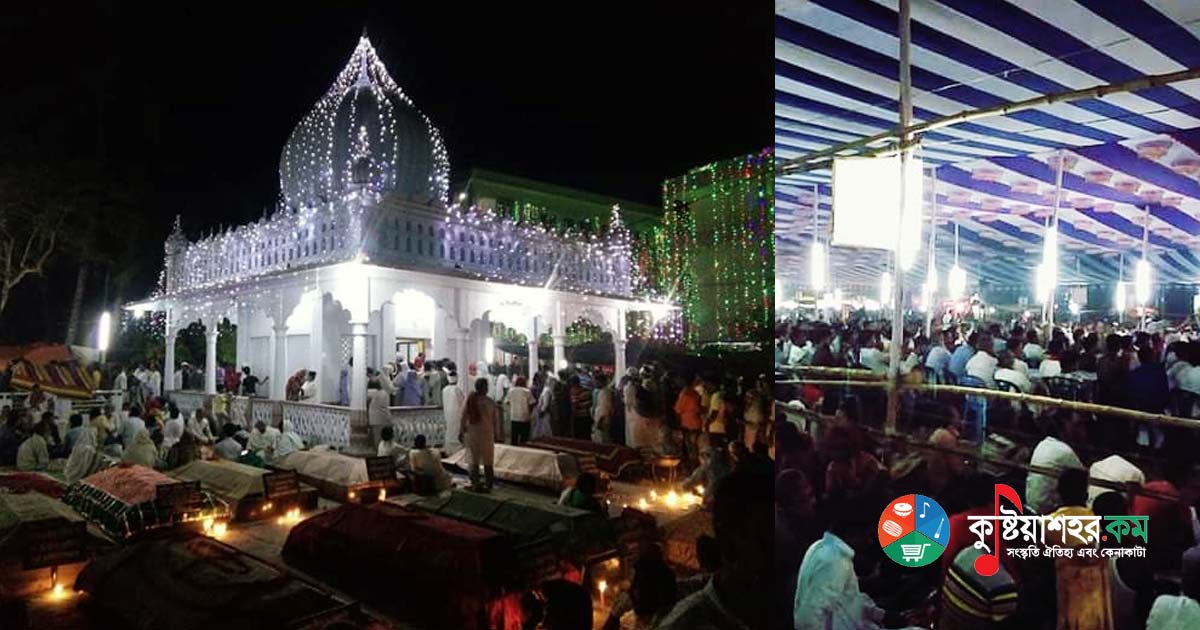
At this time many people brought him money and fruits as offerings. Every year, in the month of Falgun, he held a bhagura, a communal feast. Five to seven thousand people would come here to eat and to sing. Here I give an account of this bhagura. It has another name: saduseba, the service of the sadhus. Even today this saduseba is held in place after place of Bengal, especially in parts of Nadia (Kushtia), Jessore and Pabna. Fakirs of almost all communities are invited to it. As a rule, saduseba is held at no one's house except a fakir's; but anyone who is a disciple of some fakir may hold saduseba.
Usually a wide space is cleared inside a mango or jackfruit orchard. There, rows of small beds are set up. The furnishings of these beds are a kantha and a pillow on a mat. This is called a 'gadi'. Upon these gadis the sadhus, with their disciples, sit discoursing on religion and singing. Saduseba usually begins at dusk. Group after group of sadhus arrive at the assembly from different villages, chanting in unison the word 'Aleek'. It means: Allah is one. Then, according to their rank, they salute and greet everyone and take their seats at their appointed places. In the evening, after taking 'chailpani', the sadhus begin to sing.
Though each group has songs of its own, there is a continuity running through all the songs. All must sing songs of the same bhava. At times, amid these songs, a contest, a palla, also takes place. Nowadays in Kushtia district the disciples of Lalon often hold contests with the disciples of Panju Shah. Needless to say, each sings the songs of his own guru. And their songs are composed in such a way that each song of one answers every song of the other. As they sing on in this way and it is about two o'clock at night, someone utters the word 'Aleek', and all the songs stop at once, like musical instruments. Then the fakirs eat and sleep each at his own gadi.
The next morning the goshtha songs begin. Then, finishing the morning meal, all begin to sing. After the midday meal the fakirs receive some alms according to their merit.
In the sadusebas that Lalon held, three to four hundred taka would be spent even in those days.
The villagers held him in the deepest devotion. In their joys and sorrows he was their constant companion. In three or four villages, when anyone fell ill he would relieve them with medicines and the application of mantras. Perhaps for this very reason he wrote a book collecting kaviraji prescriptions, called Sar-Koumudi. From time to time he gave the villagers talismans and amulets. We have found an amulet on a piece of paper written in Lalon's own hand. His upright and courteous manner attracted all alike, rich and poor. He was most self-restrained in life. Though he lived in the ashram with his wife, it is heard that there was no physical relationship between husband and wife.
'He lived in the akhra with his wife. According to the sect's doctrine, he had no children or descendants.' - Hitakari
To be continued...