বাংলা
 English
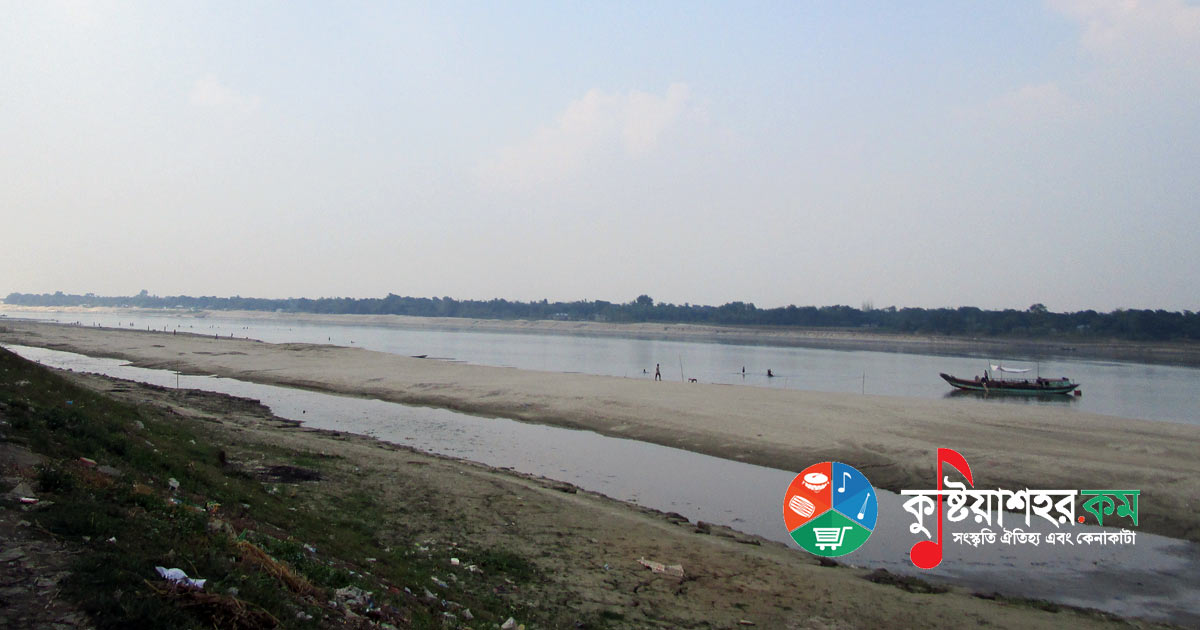
The Gorai is a major distributary of the Ganges, that is, of the Padma. Flowing out between the present-day villages of Barkhada and Hats Haripur, the Gorai originates from the Padma river. It is an important river for the south-western region of Bangladesh. The identification number given to it by the Bangladesh Water Development Board, or 'Pawubo' (BWDB), is River No. 24 of the south-western region.
The Gorai river takes its origin from the Padma river flowing through Hats Haripur union of Kushtia district and, flowing as far as Nakol union of Shripur upazila of Magura district, it has fallen into the Madhumati. At one time the main stream of the Ganges flowed through the Gorai, although the Hooghly-Bhagirathi was the original channel of the Ganges. Nineteen kilometres downstream of the Hardinge Bridge in the north of Kushtia district, at a place called Talbaria, the Gorai originates from the Padma. The river flows through Kushtia district and enters Jhenaidah district at a place called Ganeshpur. Then, flowing along the Jhenaidah-Kushtia border, it enters Rajbari district through a village called Chadar. After that, flowing along the borders of the Jhenaidah-Rajbari districts, the Magura-Rajbari districts and the Magura-Faridpur districts, it flows as the Madhumati through the districts of Narail and Bagerhat.
The course of the Gorai-Madhumati is winding and long. It flows 89 km under the name of Gorai, 137 km under the name of Madhumati and 146 km under the name of Baleshwar - that is, a total length of 372 km. The Gorai has many branches: the Kumar, the Kaliganga, the Dakua, the Burhi Gorai, the Burishal and so on are branches of the Gorai. Besides, the Nabaganga, the Chitra, the Kapotaksha, the Satkhira Yamuna, the Golgesia, the Elengkhal, the Atharobanki and other rivers have come into contact with it. The Barashia, the Kumar and the Chandana are also tributaries of this river. In the monsoon season boats and other small vessels ply from the source up to Kumarkhali, but in the dry season this stretch becomes unnavigable. The stretch downstream from Kumarkhali is reasonably navigable; vessels can ply here all year round. The average width of the river from its outfall to Narail is 450 metres. The stretch from the estuary upstream to Kumarkhali is influenced by the tides. Being connected with the Padma, it serves as a special aid in the exchange of goods by waterway. Many settlements have grown up around the river. The river holds fish in great abundance, by catching which the people of the region earn their livelihood. The areas along the Madhumati are very fertile, and therefore favourable for crop production.
The poet Rabindranath Tagore spent many days of his life on the banks of the Gorai-Padma rivers. The two rivers are mentioned many times in his writings. The poet wrote of the Gorai river under the name Gauri; at times he also wrote of it as Gorai in his poems. The natural beauty of the banks of the Gorai is depicted in his poetry with great aesthetic grace:
The char of the Gorai river
draped in the gleam of new paddy, floats upon the water
like a green dream it is, like a cloud
brought down from the sky to the earth, it has forgotten its speed
in the noon sun it lights a fire and plays upon the river's char
in the gusty wind the smoke of sand flies without cease
at night the river's char sleeps in the lap of darkness
the firefly maidens swing the lamps of dreams across its breast.