বাংলা
 English
A computer is a machine that can perform mathematical and computational work very quickly by following precise instructions.
The word computer comes from the word compute, which means to calculate or count. A computer, then, means a calculating machine. But today a computer can no longer be called merely a calculating machine: a computer is a device that takes in information and analyses and presents it through various processes. The mighty influence of mathematics and the computer lies at the root of civilisation's growth and of its rapid present progress. The first computer arrived in Bangladesh in 1964.
History
The various efforts of the prehistoric era to invent counting machines are regarded as the history of the computer. In ancient times people once used shells, pebbles and knots in rope to express numbers. Later, various techniques and devices were used for counting, but in computer history the ancient counting device called the Abacus is regarded as the first machine. It was invented around 2400 BC in Babylon. The abacus is a counting instrument that works by shifting beads arranged in a frame; as a counting device the abacus was made in Egypt or China around 450/500 BC.
In 1616 the Scottish mathematician John Napier used printed marks, notches or rods for calculation; these rods are known as Napier's Bones. In 1642 the 19-year-old French scientist Blaise Pascal invented the first mechanical calculator, introducing a method of addition and subtraction with the help of toothed wheels or gears. In 1671 the German mathematician Gottfried von Leibniz, building on Pascal's machine, created an even more advanced mechanical calculator capable of multiplication and division, using wheels and rods; he named the machine the Reckoning Machine. Later, in 1820, Thomas de Colmar refined the reckoning machine and made Leibniz's device popular.
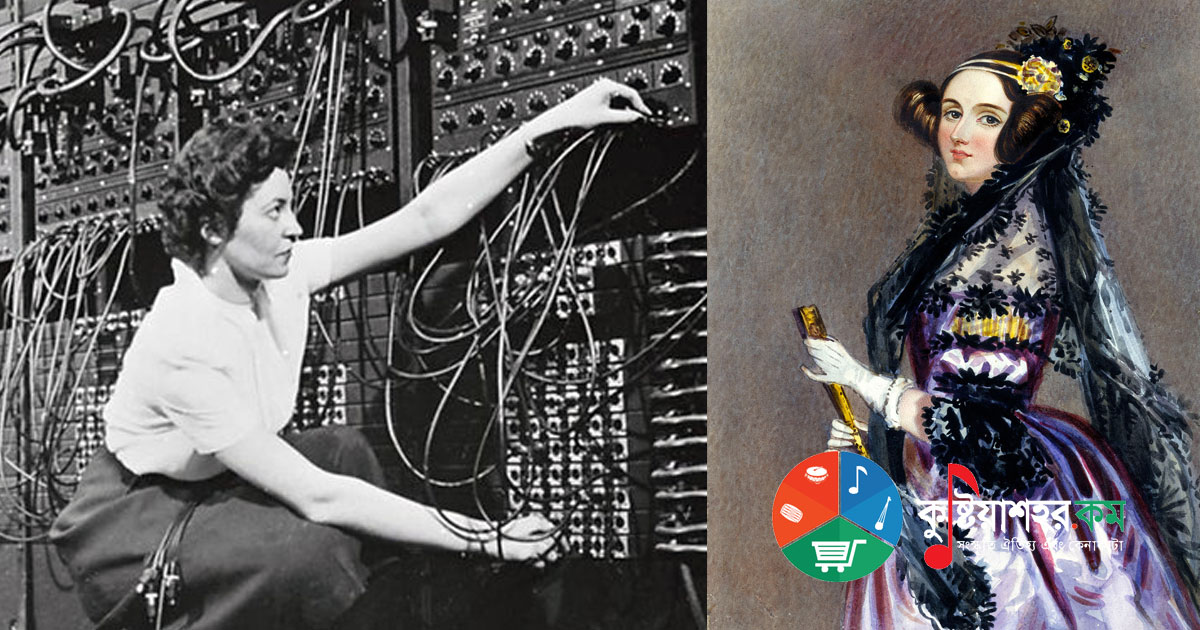
In the early nineteenth century, Charles Babbage was the first to proclaim loudly the idea of building and using a modern machine (one that could perform mathematical calculations purely mechanically — that is, without any kind of intelligence). He named it the Difference Engine. While working on this difference engine (in 1833) he conceived of an even more advanced and universal machine called the Analytical Engine. But for lack of the necessary machinery and money he was never able to finish either of them.

Computer science truly began through Alan Turing's research, first theoretical and later practical. From the mid-twentieth century the modern computer began to develop. With the invention of the microprocessor in 1971, microcomputers developed rapidly. Many kinds of inexpensive personal computers (PCs) of various natures and sizes entered the market, and with them were invented many kinds of operating systems, programming languages and countless practical application packages. Alongside, computer networks and the Internet and their related services spread widely, and countless institutional and non-institutional computer education and research establishments were founded and expanded to provide computer education. In recent times computer and information technology (IT) has captured a huge share of business and commerce, and employment has in many ways become computer-dependent.
After the United States' Intel Corporation invented the microprocessor in 1971, microprocessor-based computers began to appear on the market, and a great revolution took place in the computer's shape and capability. In 1981 IBM's personal computer, or PC, came to the market. Thereafter powerful microprocessors were invented one after another and strong PCs were built. Because IBM from the very beginning placed no restrictions on building IBM-compatible computers, the prices of such computers fell sharply and their use grew steadily. Around the same time, alongside IBM, Apple Computer Inc launched its own invented Apple-Macintosh computer on the market. But because Apple showed no generosity whatsoever in allowing compatible computers to be built, the Macintosh's price stayed excessively high, and as a result Apple could not gain much popularity. Still, because of certain special practical advantages, Apple-Macintosh computers were widely used mainly in the printing industry.
History of Computers in Bangladesh
Computer use in Bangladesh began in the sixties and gained wide ground in the nineties. From the middle of that decade, information technology began gaining wide familiarity in this country. Bangladesh's (then East Pakistan's) first computer was installed in 1964 at the Atomic Energy Centre, Dhaka, of the Pakistan Atomic Energy Commission. It was a mainframe computer of IBM's 1620 series (International Business Machines - IBM). The machine's chief use was performing mathematical computations in complex research work.
In the sixties, scientific research at home and abroad, along with banking, insurance and business and commerce, began to expand rapidly; and as routine accounting grew accordingly, there also arose the need to bring speed to computation. Hand-run accounting in many large institutions became nearly impossible. At that time several of the country's big institutions installed costly mainframe computers. In the late sixties the then Habib Bank installed an IBM 1401 computer and United Bank an IBM 1901 computer. These computers, used mainly for all the banks' accounts and bookkeeping, were third-generation mainframe-type machines.
Before independence, in 1969, an IBM 360 computer was installed at the Bureau of Statistics, and a mainframe computer was also installed at the Adamjee Jute Mills around this time. On a limited scale, computer hardware and software began entering university-level curricula in mathematics, physics, applied physics, electrical and electronic engineering and similar subjects even before independence. From 1972 onward, large computers such as the IBM 370, IBM 9100 and IBM 4341 were successively installed at the institution named the Bangladesh Bureau of Statistics.
History of Bangla Software Innovation
Writing Bangla on a computer first became possible in 1987, and the credit for this success goes to an engineer named Mainul Islam. Using his own invented Bangla font, 'Mainulipi', he arranged for Bangla to be written on Apple-Macintosh computers. In this case no separate keyboard was used for Bangla — the work was done with the English keyboard itself. The different alphabetical order of English and Bangla, and the problem of Bangla conjunct letters, were solved by taking advantage of the convenience of the Macintosh computer's four-layer keyboard. Right after Mainulipi, two more Bangla fonts named 'Shahidlipi' and 'Jobbarlipi' were invented and used the same way on Macintosh computers. The very next year, 1988, at the initiative of a private organisation called Ananda Computers, the first interface suitable for use on Apple-Macintosh computers, 'Bijoy', was created. It was in this very period that the first Bangla keyboard layout was made. Among the first-generation Bangla keyboards, 'Bijoy' and 'Munir' are notable. In the interface method the Bangla font and the Bangla keyboard were joined to the computer's operating system, and with that keyboard made active and a font selected, Bangla could be typed on the computer. The Bijoy interface was Macintosh-based, and since Apple-Macintosh computers were extremely expensive, its users were few — it was used mainly in publishing work.
Considering the vastly larger number of IBM computer users, in early 1992 two higher-secondary-level students, Reza-ul Al Amin Abdullah (Onko) and Md Shahidul Islam (Sohel), invented a self-contained Bangla word-processing software called 'Borno'. From Safeworks, the own firm of the two talented teen programmers, the invention of this self-contained word processor was a landmark event in the history of Bangla software. The word processor was based on DOS (Disk Operating System - DOS), but the program's own framework was like Windows. Three kinds of keyboards could be used with Borno: Munir, Bijoy and the Easy keyboard. The Borno software also included the facility to restructure (customise) the keyboard — that is, anyone who wished had the freedom to create a new keyboard layout to their own taste or convenience. Later, as the Microsoft Corporation kept releasing ever more improved versions of its word processor, in 1993 the interface 'Bijoy' was invented for using Bangla fonts and the Bangla keyboard with the IBM computer's modern operating system, Microsoft Windows. Then in 1994 another interface named 'Lekhoni' was created too. And although 'Aboh' (invented at the end of 1992) was the first interface usable on IBM computers, because of certain faults it was not used very much.
The Computer System
A system is the combined effort of a number of integrated components working toward the achievement of some common purposes. The components of a computer system are as follows:
- Hardware,
- Software,
- Humanware or the user,
- Data or information.
Hardware
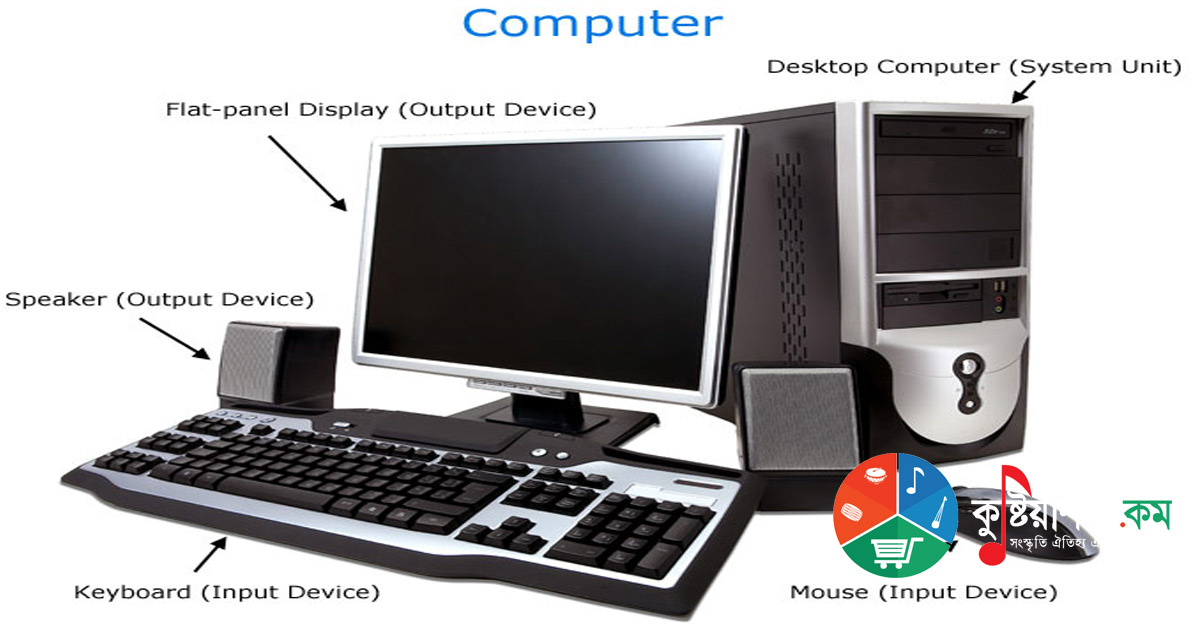
All the machines, parts and devices that make up a computer's outward form are called hardware. Computer hardware can be divided into three main parts.
1. Input devices:
1. keyboard, 2. mouse, 3. disk, 4. scanner, 5. card reader, 6. digital camera, and so on.
2. System unit:
1. hard disk, 2. motherboard, 3. AGP card, and so on.
3. Output devices:
1. monitor, 2. printer, 3. disk, 4. speaker, and so on.
Software
A program is a set of instructions arranged sequentially in the computer's language for the purpose of solving a problem or performing a task. The program or collection of programs that makes the hardware functional by creating a relationship between the computer's hardware and its user is called software. Computer software can be divided mainly into two parts.
- System software: the system software maintains coordination in the work among the computer's various units and keeps the computer's capability meaningfully engaged for running practical programs.
- Application software: the program used to solve practical problems or process data is called application software. For solving practical problems, many kinds of ready-made programs are available as commercial products, commonly called package programs.
Humanware or the User
All the people engaged together in tasks such as collecting data, writing, testing and storing programs or data, operating the computer, designing and recording systems, and bringing about coordination between software and hardware are collectively called humanware.
Data / Information
The smallest unit of information is called data. Data is some unarranged, disorderly raw fact. Data is mainly of two kinds -
(a) Numeric data or countable data, such as 25, 100, 456, and so on. (b) Non-numeric data, such as the names, occupations or nations of people or countries, or pictures, sounds and dates.
Operating System
An operating system is a kind of software that controls the execution of computer programs and performs scheduling, debugging, input/output control, accounting, compilation, storage assignment, data management and related tasks. The operating systems most widely used on today's microcomputers or PCs are: DOS, Windows 95, Windows 98, Windows 2000, Unix, Ubuntu, Mint, Mandriva, Debian, Fedora, Mac OS X, Windows XP, Windows Vista, Windows 7, Windows 8, Windows 8.1, Windows 10 and Linux.
Applications
The computer has a great many uses. From household work to business, science and many other fields, its use is immense. Above all, in the field of communication it has brought a unique revolution. In medicine and human welfare too it is a unique companion. In a word, the computer is a machine capable of doing almost every kind of work.
The computer in geography:
1. The computer in GIS: computers are used in the field of GIS technology. In this technology, various kinds of information are added to maps with the help of the computer.
Types of Computer
On the basis of a computer's construction and working principle, it can be divided into three types.
- Analog computer
- Digital computer
- Hybrid computer
On the basis of size, capacity, price and importance of use, the digital computer can again be divided into four types.
- Microcomputer
- Minicomputer
- Mainframe computer
- Supercomputer
Microcomputers can be divided into two kinds.
- Desktop
- Laptop
The complete classification of the computer is shown below:
Analog Computer
A computer that can measure one quantity relative to another is an analog computer. It can record temperature and other regularly changing measurements. The speedometer of a motor car is an excellent example of an analog computer.
Digital Computer
In a digital computer everything is expressed by two kinds of electrical voltage: the presence of voltage is expressed as 1 and its absence as 0. It can complete any mathematical addition process and performs other operations such as subtraction, multiplication and division. All modern computers are digital computers.
Hybrid Computer
A hybrid computer is a computer built from the combination of the best features of analog and digital computers. It is used in scientific research. So it can be said that, in terms of technology and fundamentals, a partial combination of analog and digital computers is the hybrid computer. Usually in hybrid computers data is collected by the analog method and computed by the digital method. For example, a hybrid computer used in a meteorological office measures air pressure, heat and so on by the analog method and computes them by the digital method to give weather forecasts.
Mainframe Computer
Minicomputer
A computer that can serve more than fifty users at almost the same time with terminals attached is a minicomputer. It is used in industry, commerce and laboratories — for example the PDP-11, IBM S/36, NCR S/9290 and IBM 9375.
Microcomputer
The microcomputer is also called the personal computer or PC. A microcomputer is built with an interface chip (motherboard), a microprocessor, CPU, RAM, ROM, hard disk and the like in cooperation. The use of this computer is seen in every sphere of daily life. Macintosh and IBM PCs are computers of this kind.
Supercomputer
An extremely powerful and fast computer is called a supercomputer. This computer's speed is nearly a billion characters per second. A computer with the memory capacity to manage vast information systems like a country's census is a supercomputer. The CRAY 1 and Supers XLL are computers of this kind.
Tablet Computer
The tablet computer is a kind of microcomputer, known as the palmtop computer. It is touchscreen technology, and it runs on Android and Windows operating systems.